
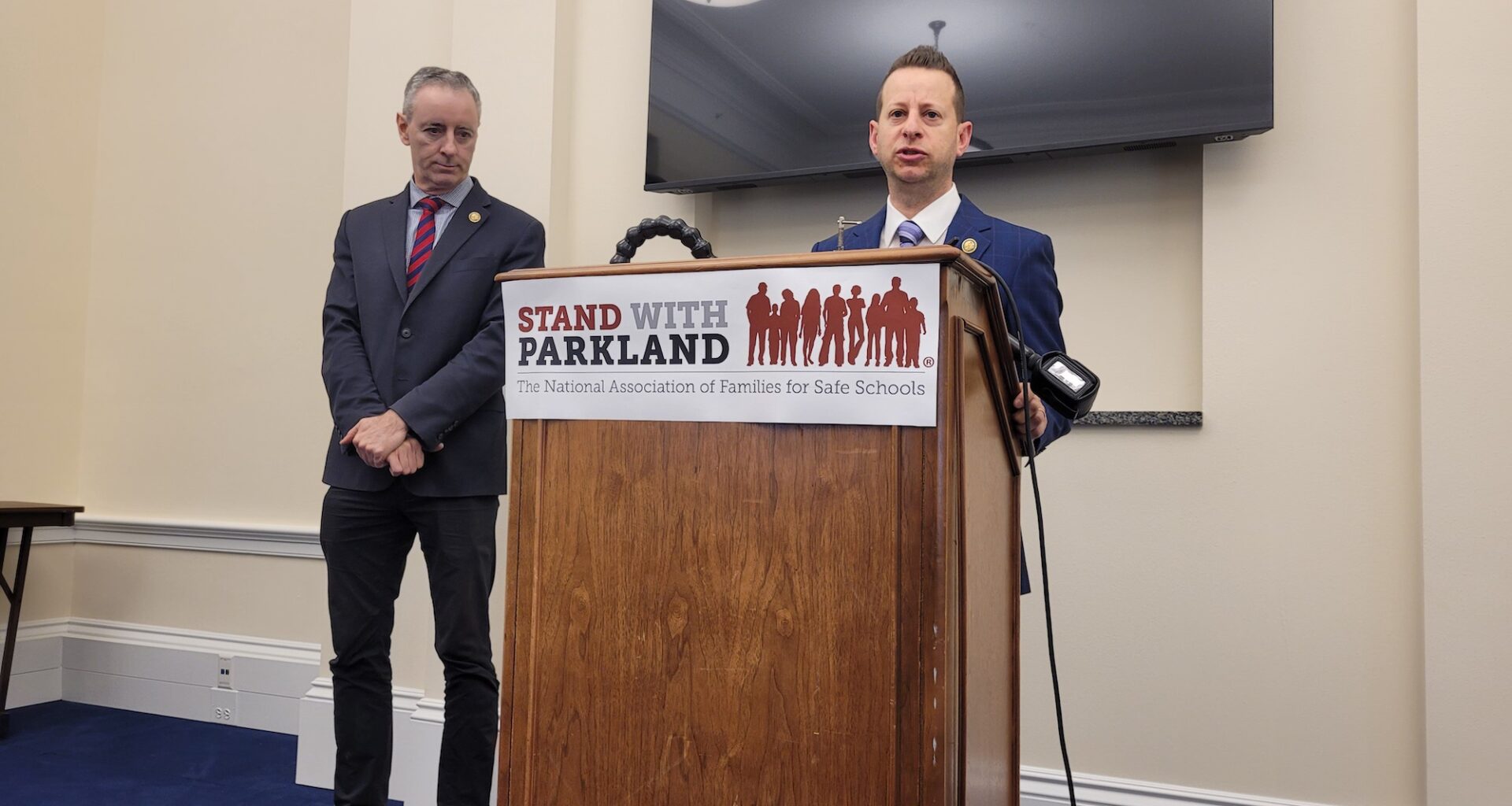
U.S. Rep. Jared Moskowitz feels confident gun control measures enacted in the wake of the Parkland shooting will survive Florida’s Legislative Session. But the Broward County Democrat is following the issue closely even as he pushes other reforms in Washington.
Moskowitz served in the Florida House when the shooting occurred in his district and sponsored a massive legislative package passed that year. But portions of the law continue to draw scrutiny, with the Florida House in January passing legislation to roll back the gun-buying age in Florida from 21 to 18, the age limit before Florida’s Parkland law took effect. But Moskowitz predicted the bill will go no further, suggesting the state Senate will not take the matter up.
“There’s a lot of people who still understand why we passed that law, how that law is currently working,” Moskowitz said.
“It’s targeted. It does not prevent possession, so people’s constitutional rights are not inhibited. A grandparent or parent who wants to go hunting with their 18-year-old, they can. If a parent or grandparent wants to buy their 18-year-old a firearm, they can. But a high school student cannot go into a gun store, walk out with two AR-15s, unlimited ammunition, body armor and walk into school on their own. That is what that law has prevented.”
The Congressman shared a microphone at a Washington press conference on Tuesday with Tony Montalto and Tom Hoyer, founders of Stand With Parkland. Each Florida father lost a child in the 2018 mass shooting at Marjory Stoneman Douglas High School.

“These parents have been crisscrossing the country trying to make sure that other parents like them, other family members like them, don’t become part of an exclusive club,” Moskowitz said.
Montalto lost his daughter Gina in the shooting. He lobbied for the law currently on the books.
“The laws passed in the wake of the Parkland tragedy got it right,” he said. “We think they were bipartisan, and we’ve seen that they have helped prevent tragedy. So we do not support lowering the age.”
Hoyer, whose son Luke was killed in the shooting, stressed that each element of the law passed in Florida after the Parkland shooting specifically addressed something that led to the tragedy.
“All the elements of what we passed in Florida are based on something that happened to us. To your question specifically, the killer that shot my son was 18 when he bought the rifle that he used to kill my son. That’s the reality,” he said.

“The efforts to overturn some these, you use what-ifs. The current example is a single mother living on the wrong side of the tracks, can’t arm herself if she’s under 21. It’s a what if. We’re dealing with realities. Fortunately in Florida, so far, thoughtful minds are putting more weight on the reality than the what ifs.”
The Florida Senate under President Ben Albritton last year did not take up a House-passed bill to lower the gun age. So far, he has not firmly said if the issue will be heard, but said the subject is “due real caution.”
Ultimately, no Senate companion bill on the topic was filed this year, though the House bill has been directed to the Senate Rules Committee. Albritton has signaled little interest Senators taking up the bill.
“This last year, they were not supportive of it. I have not heard anything different this year,” Albritton said at the start of Session. “It will be determined by the Chairs and the Senate and the Senate appetite for such a bill as a whole.”
At the same press conference, U.S. Rep. Brian Fitzpatrick, a Pennsylvania Republican co-sponsoring Moskowitz’s federal Measures for Safer School Districts (MSD) Act (HR 1335), said tragedy should not have to stay fresh for the dangers of school safety failures to feel real. The federal legislation covers bipartisan measures such as improving school alarm systems and installing more secure interior and exterior doors for campuses and classrooms.
“Congress always needs to resist the temptation, and the public needs to resist the temptation, of lowering their guard as we separate months and years down the road from a tragedy,” Fitzpatrick said. “We’ve seen this in so many instances, 9/11 being the perfect example. Post-9/11, the Patriot Act passed 99-0 in the Senate — one Senator abstained — and a few years down the road, it became controversial because the threat of 9/11 had waited several years. You should not need tragedies to keep your guard up. And that’s an impulse that we have to resist as a country. The guard has got to be up at all times. And if it made sense, immediately following tragedy, and it makes sense to keep that in place.”
But Moskowitz said it’s an issue he intends to continue following closely, if only because Parkland gets further away each year. Nearly all members of the Florida House first won election to the body after the Parkland tragedy and were not around when the bill passed. But the Senate has many, including Albritton, who served in the lower chamber when Moskowitz carried the legislation to passage in 2018.
“The elected officials that are in Tallahassee now that weren’t there for Marjory Stoneman Douglas, for them It’s politics. It’s just pure partisan primary politics. The elected officials that want to keep it in place were the ones who went through it, that are still there,” he said.
“For people who didn’t experience and didn’t interact with family members who came up, didn’t interact with the students, didn’t have that experience. And look, that’s a challenge that you face after you pass any law after some sort of national tragedy.”