

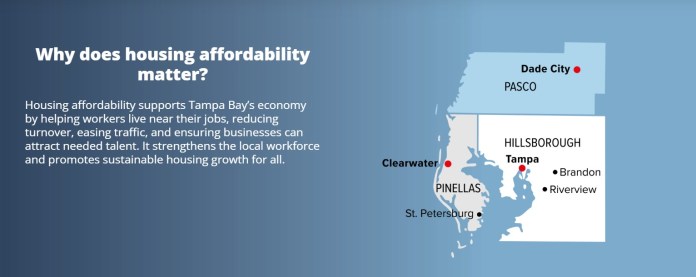
Recently, the Tampa Bay Partnership released ‘The Housing Equation’ report, the region’s first comprehensive analysis of housing supply, demand and affordability across Hillsborough, Pinellas and Pasco counties.
Made possible with support from JPMorganChase and backed by independent research, this report delivers data-driven, actionable insights that empower investors, businesses, policymakers, developers, nonprofits and the public to better understand the tri-county housing gap, enabling them to shape meaningful solutions.
Tampa Bay is projected to add 564,000 residents and 211,000 households by 2035, a surge that will reshape housing needs. Yet, recent production hasn’t kept pace. The research shows that between 2018-23, the region added nearly 100,000 households but built only 82,000 units, fueling rising costs and widening affordability gaps.
“Housing affordability affects every resident and employer in our region, making it one of the most urgent challenges we face together,” said Bemetra Simmons, president and CEO of the Tampa Bay Partnership.
Key findings from The Housing Equation include:
Existing gap: The region does not have enough homes priced affordably for households earning 80 percent of the area median income (about $69,500 for a family of four) with an estimated shortage of 80,650 units.
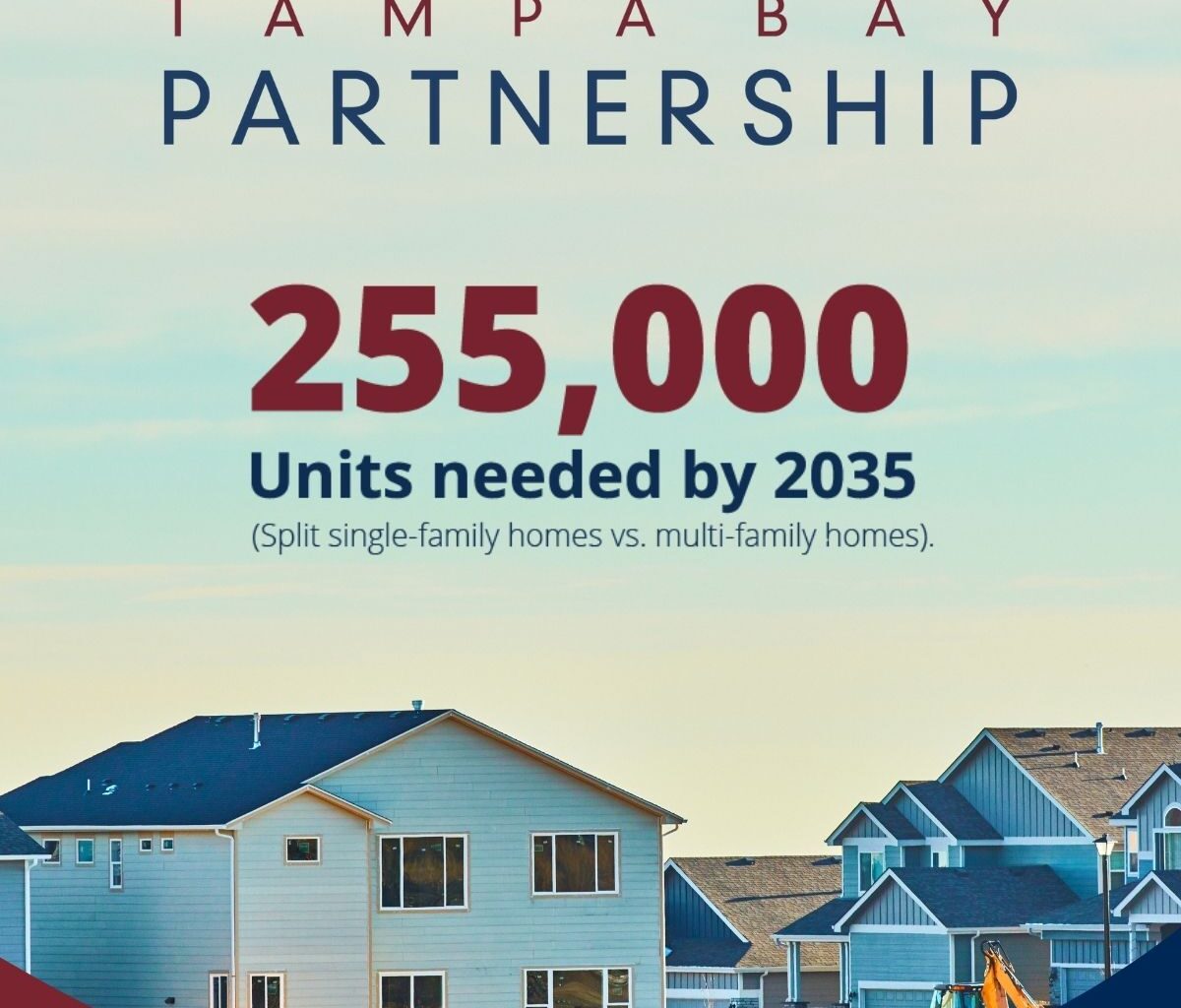
Future demand: By 2035, the region needs to add approximately 254,700 new housing units, an average of 21,225 units per year, to keep pace with projected growth. That includes 10,685 single-family units and 10,540 multifamily units annually.
Cost burden: A third of all households — over 408,000 families — spend more than 30 percent of income on housing; 52 percent of renters are cost-burdened, and 24 percent of homeowners.
Rising rents: Median rent surged 48 percent in five years, while wages rose only 29 percent.
Funding leverage: If addressed, $273M in gap funding can unlock $663M in additional funding and create $1B in economic impact for Tampa Bay.
“The Housing Equation breaks down what’s needed by county, income level and housing type, then points to proven strategies like zoning updates, creative financing and advocacy that can drive long-term economic growth,” Simmons added. “Now that we have a clear understanding of how many units we need, we can create a comprehensive Regional Action Plan to meet that goal.”
Read the full report at www.tampabay.org/housingequation/.
For more information, please contact Jessica Vega-Eugene at jessicav@consultvistra.com or 813-263-0792.