
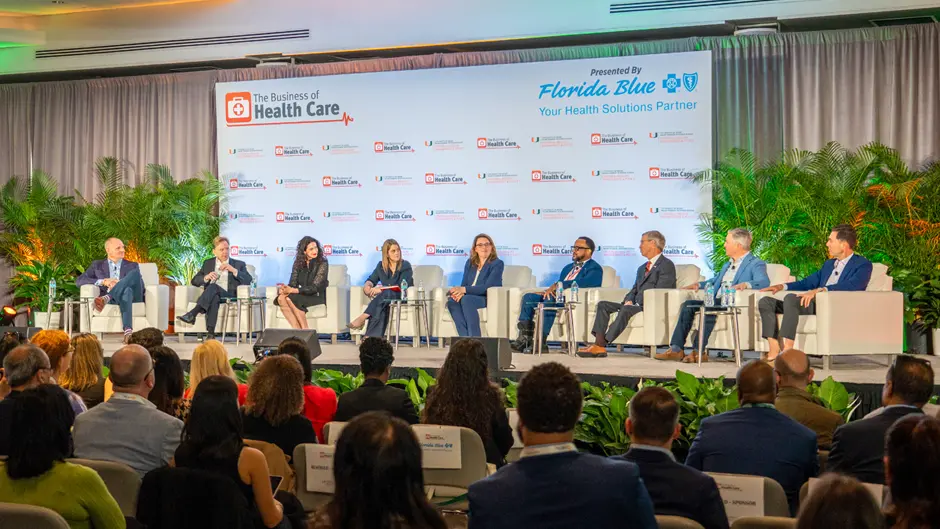
Affordability, restoring trust, improving health outcomes, and the need to modernize the Medicare system were among the potpourri of issues addressed Feb. 6 at the 15th annual University of Miami Business of Health Care Conference, this year titled “Navigating Change” and hosted by the Miami Herbert Business School.
Initiatives to modernize the platforms and other structural changes underway at the Centers for Medicare and Medicaid Service (CMS) were discussed in the keynote panel by Stephanie Carlton, CMS deputy administrator and chief of staff; Stephen Parente, professor and Minnesota Insurance Industry Chair of Health Finance and associate dean, Carlson Global Institute, Carlson School of Management, University of Minnesota; and Donna E. Shalala, former secretary of the U.S. Department of Health and Human Services, former University of Miami president, and professor emerita, Miami Herbert Business School.
“At CMS, we’re taking a modern look at the challenges today and the regulatory guidance that affect business operations. The general framework needs to be modernized to a process that is less micromanaging and provides better outcomes,” said Carlton, adding that “there are too many players in health care that are defenders of the status quo.”
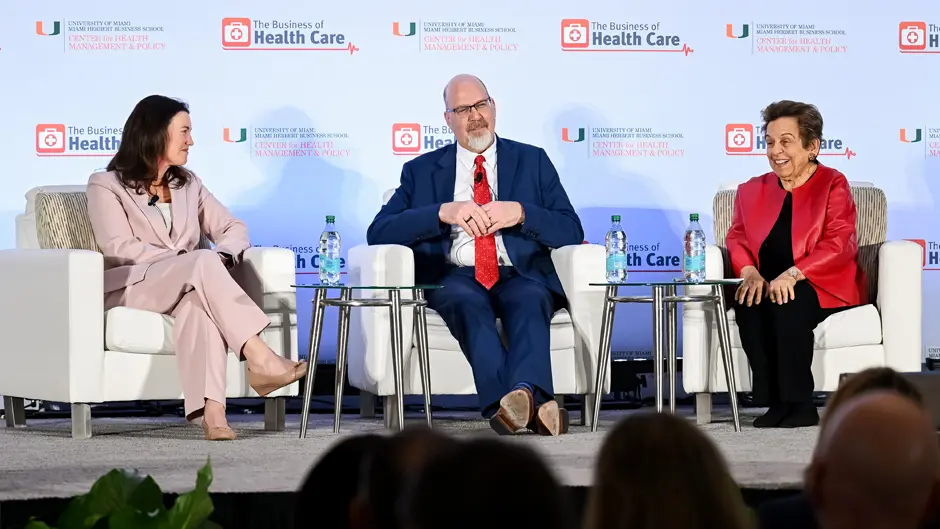
Donna E. Shalala, right, moderated the keynote panel with Stephanie Carlton of CMS and Stephen Parente, health economist at the University of Minnesota.
She explained that the program, which provides care for 60 million Americans, operates on a COBOL-era system and with at least six different Medicare administrative contractors that sometimes provide different answers for claims depending on the area of the country.
“The system is outdated; it’s not serving patients well; it’s not serving taxpayers well, and we’re not able to be good stewards of the program with that antiquated of a system,” Carlton said.
Carlton highlighted two issues—affordability and chronic disease—driving the need for structural change within the health industry.
“Understanding those two big drivers of health care really inform everything we do at CMS, and so we tackle it. We can do better in America,” Carlton said.
She noted that the U.S. is twice as expensive as other westernized countries when cost is measured on a per capita basis and that, in terms of chronic disease, obesity in this country is at 40 percent compared to 20 percent in most European countries and only 6 percent in Japan.
Parente, who noted one of the highlights of his career was being part of the team that worked at the White House to create the pandemic provider relief fund, expressed frustration with those who say the health care system is “broken.”
“It’s not that the system is broken; it’s the consequence of smart people who are mostly dead and regulations that were enacted before smartphones, computers, and other technologies,” he said. “It can certainly be improved on.”
Brian Pieninck, president and CEO of GuideWell Mutual Holding Corporation, moderated the opening panel, which included the participation of nine executives representing the major industry sectors, from nursing to doctors to insurance, financial management, and pharmaceuticals. The industry is poised at a moment of incredible need and incredible opportunity, he said.
“This is a moment of opportunity to effect change, to set a new trajectory, and it will be the collaborators who lead the charge,” Pieninck said. “When a multistakeholder group such as this gets together, it can elevate not just the conversation but an industry.”
Yet the $5.3 trillion already stressed-and-strained industry faces enormous challenges—the aging U.S. population, inefficiencies and discrepancies, fragmentation and an uncertain macro economy, he added.
Panelists expressed their optimism for the benefits that AI can bring.
Stephen Ubl, president and CEO of Pharmaceutical Research and Manufacturers of America, suggested the new technology will greatly enhance research and bring us into a “golden era of medicine.”
“We are going to see molecular abundance like we haven’t seen before in selling gene therapies, targeted medicines that are curative in nature. We will push past the tipping point where we will pull costs out of the system in a significant way,” Ubl said.
“But we have to nurture this ecosystem that’s the envy of the world if we want to continue to be the engine of public health gains and more and better medicine. We must not just innovate but apply,” he added.
Dr. Roger Mitchell Jr., president of the National Medical Association—the largest organization representing Black physicians—highlighted the need to ensure that new information and research being inputted to inform AI differ from what has been done in the past.
“As innovators and front-line researchers, we understand the importance of the research that goes into artificial intelligence,” said Mitchell, emphasizing the importance of equitably distributing the new technologies across all communities.
Ann Jordan, president and CEO of Healthcare Financial Management Association, said that to improve the current system, stakeholders need “to self-disrupt.”
“If we’re looking at incremental improvement and applying AI to the old system, we’re not doing ourselves any favors. Our institutions got us here,” Jordan said.
“To deliver on affordability in the long term, we have to clean up on the business side, reduce fragmentation, and reinvent the macroeconomic thought process. How much are we going to disrupt ourselves?” Jordan asked.
Paul Pavlou, dean of Miami Herbert and the Leonard M. Miller University Chair Professor, welcomed the more than 800 participants in attendance at the half-day conference. A major researcher of new technologies, Pavlou highlighted AI’s potential to “save lives, reduce costs, and improve outcomes.”
Steven Ullmann, professor and director of the business school’s Center for Health Management and Policy, and Karoline Mortensen, professor and associate director of the center, moderated a question and answer session.
In recommendations to the many students at the conference, Dr. Bruce Scott, president of the American Medical Association, urged those entrering the field to embrace the art of medicine.
“Nothing will ever replace the healing touch of a doctor or the listening ear of a nurse,” Scott said. “Embrace the concept as we move to this brave new world that we’re not wanting to replace the caregivers (with new technologies), but rather give them more tools to deliver that care more effectively.”