
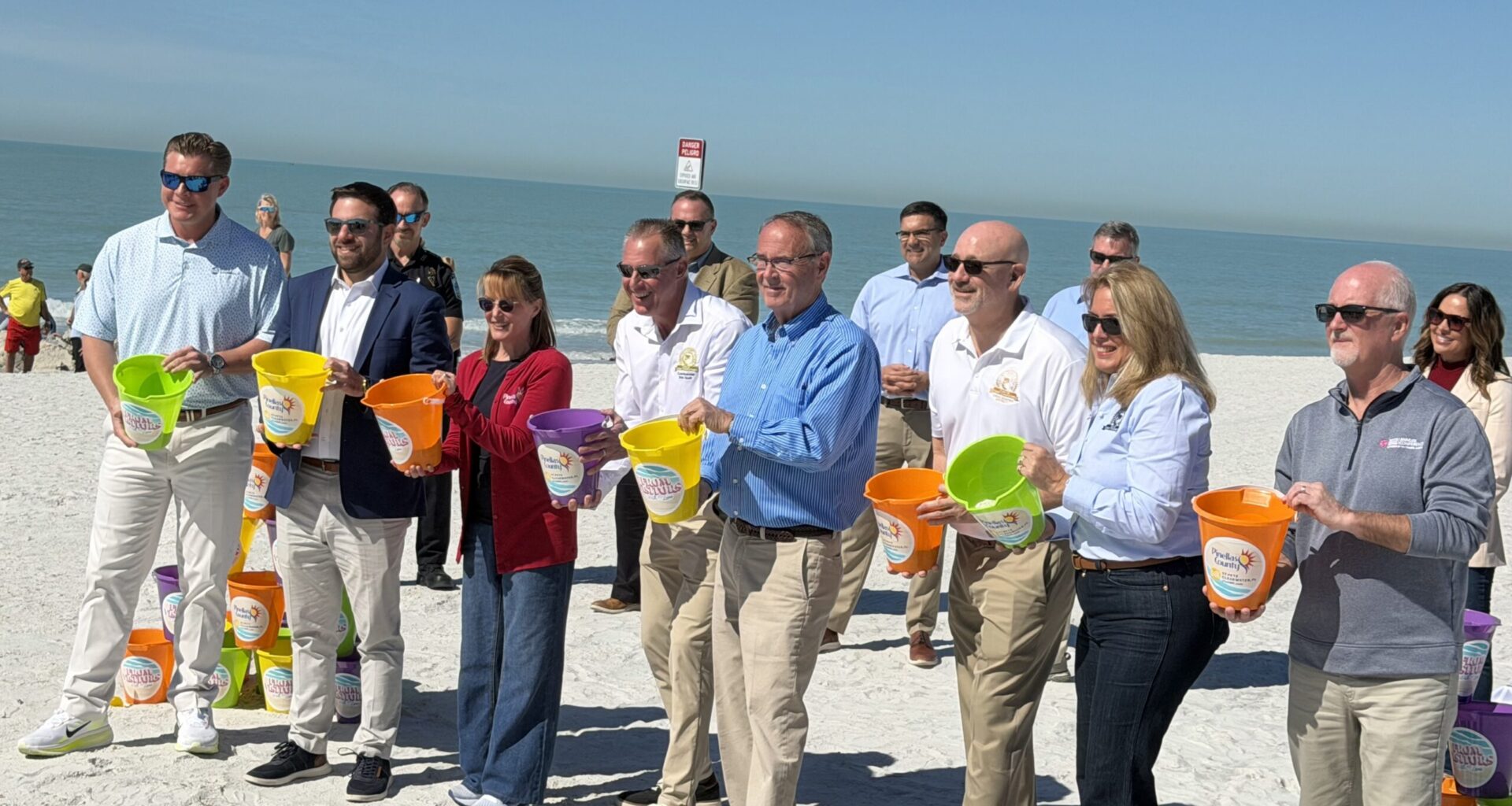
In record time, Pinellas County’s beach nourishment project has been completed. Local leaders and elected officials came together Monday to mark the occasion at Treasure Island.
Approved in June 2025 by the Pinellas County Board of County Commissioners, the $125.7 million initiative began with dredging sand from Egmont Shoal, Pass-a-Grille, Blind Pass and John’s Pass.
This sand was then distributed at Sand Key (Clearwater), Treasure Island, Belleair Beach, North Redington Beach, Redington Shores, Indian Rocks Beach, Indian Shores and Upham Beach.
An estimated 2.5 million cubic yards of sand were added across 12 miles of land. According to the County, this amount of sand could fill up the Dali Museum more than 40 times.
Nourishment initiatives usually take place about every five to six years to ensure the condition of the beaches.
The U.S. Army Corps of Engineers helped pay for previous projects – usually more than half the cost. However, the County was not able to receive compliant easements from all property owners – thus losing eligibility for the federal funding.
In 2017, the organization began requiring owners to sign 50-year easements – which provide legal public access to private property.
“We have not put a grain of sand other than emergency dune placement on the shore since 2018,” Pinellas County commissioner Kathleen Peters explained to the Catalyst. “So, the elevation of the shoreline was anywhere from six to eight feet below elevation because so many years had gone by with erosion.”
In 2024, Hurricane Helene damaged the beaches significantly because there “was no sand there to absorb part of the energy of the waves.”
Pinellas County Public Works was approved to oversee the effort and used tourist development tax dollars, paid by visitors and residents, and state grants to fund the nourishment.
“This is an engineered beach that was designed to provide protection from storms,” Pinellas County public works director Kelli Hammer Levy said, “but it also provides other benefits such as critical habitats for nesting sea turtles and shorebirds.”
The County was able to receive an emergency permit from the U.S. Army Corps of Engineers to complete the work, which will expire in March. Construction on the project began in September. She explained that since some residents did not sign an easement, there were gaps in certain areas.
“Probably one of the biggest challenges was just the fact that everybody was working 24 hours a day, seven days a week,” Levy said. “There were a lot of temporary inconveniences for a much bigger gain.”
Since January, the County has also been planting sea oats and other Florida native vegetation in recently constructed sand dunes at most of the beaches as well. This will help “maintain and bolster” the structures, according to the County’s website.
The process should be completed in the next two weeks, she added.
According to the Florida Department of Environmental Protection, dunes are “the first line of defense against storms and act as a buffer to protect upland property and natural habitats.”
They act as a “flexible barrier” to prevent damage from high tides and waves. Additionally, dunes can serve as a “home for many plants and animals.”
Pinellas County Board of County Commissioners chair Dave Eggers explained that the beach nourishment project will have key tourism impacts. Visitors come from around the state, country and the world.
“If you think about our parks, our trail and these beaches, they are all incredibly big, valuable assets to our residents,” he said. “If you don’t invest in them, then you lose not only what our residents like to have, but you lose the economic benefit and the protection benefit.”
Pinellas County is currently working with the U.S. Army Corps of Engineers to reestablish a partnership, Peters added, and find a resolution on how to meet the requirements of the federal government.
“I’m proud that we decided as a community that it was important to do it ourselves,” Eggers explained. “It’s a tough decision, but certainly the right one.”