
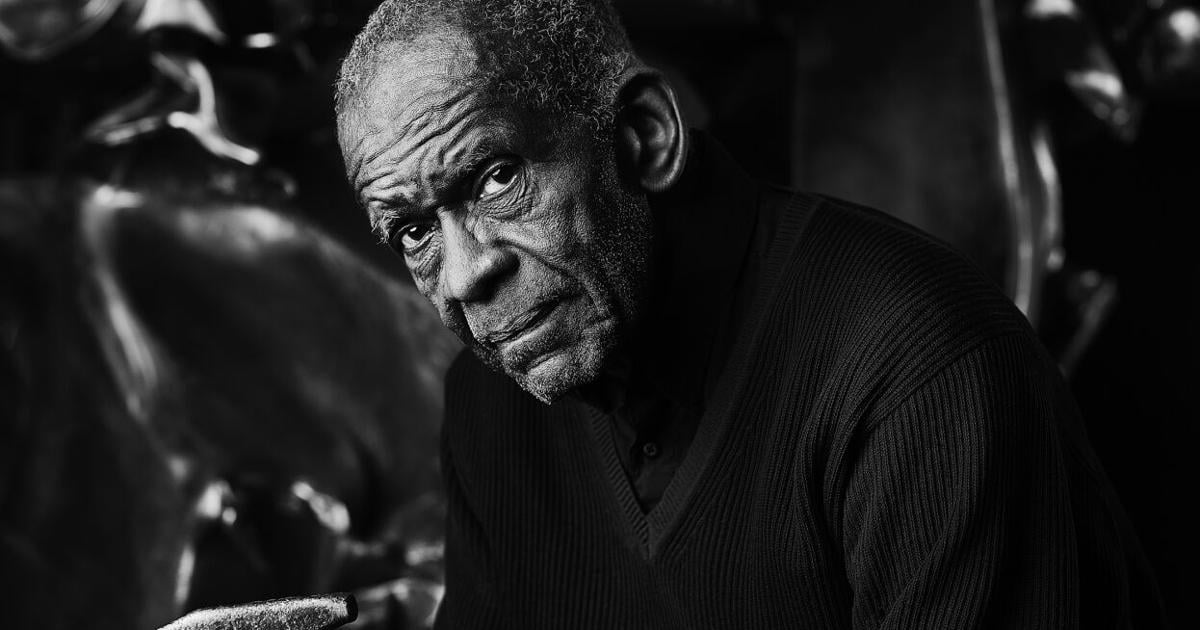
An ongoing exhibition in Miami’s Design District welcomes visitors with welded stainless steel, aluminum, and bronze sculptures, offering reflections on the momentous Civil Rights era.
The Miami Institute of Contemporary Art (ICA Miami) debuted “Richard Hunt: Pressure,” a posthumous exploration of Richard Hunt’s artistic advancements, during Miami’s Art Week last December. Following Hunt’s passing in 2023, the exhibition aims to honor the late sculptor’s legacy by highlighting over 50 years of his artistry through 25 carefully selected sculptures.
ICA Miami’s Artistic Director Alex Gartenfeld, curator Gean Moreno, and The Knight Foundation presented the city with a rare opportunity to witness Hunt’s sculptures together for the first time in decades.

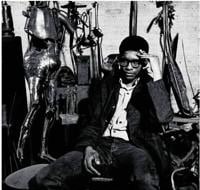
Richard Hunt seated with his early works at his Cleveland Avenue studio in Chicago, 1963.
(The Richard Hunt Trust/Artists Rights Society (ARS), New York)
“Seeing all his work together allows visitors to really consider what his impact has been on temporary art and introduces him to wonderful new audiences,” said Gartenfeld.
“I think he’ll be new to people, and I think when you see the work, how vivid it is, how alive it feels, and how beautiful it is, I think there’s this realization of, ‘How did I not know about this artist earlier?’”
A life in sculpture
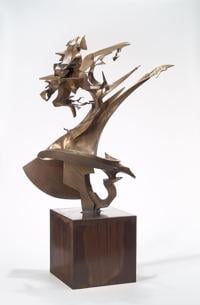
Richard Hunt, Flintlock Fantasy or the Promise of Force (1991-1996). © The Richard Hunt Estate
(Artists Rights Society (ARS), New York. Photo: Lee Fatherree)
Born in Chicago, Ill., in 1935, Hunt experienced life’s early moments during a period of immense social changes. Growing up on the South Side, Hunt was faced with the harsh realities of discrimination and segregation, growing up attending Black-only schools, churches, and facilities. During Hunt’s early adulthood in 1954, the Civil Rights Movement began, bringing African American leaders and activist groups to the forefront. Led by historical figures like Dr. Martin Luther King Jr., major strides were made toward the dismantling of segregation and the adoption of racial equality. These turbulent moments deeply shaped Hunt, inspiring a lifelong practice that combined both abstraction and reflection.
Hunt utilized remnants of found objects to create his earlier works, sometimes using furniture and car parts to create a sculpture. Throughout his career, he remained dedicated to experimenting with forms and figurines, creating a signature style that stands out amongst other sculptors from his time. Hunt remained dedicated to the idea of creating fluid illusions with his sculptures and keeping the resilience of the Civil Rights Era at the heart of it.
Curator Moreno recognized Hunt’s art as innovative, possessing features that seem to surpass the limitations of the previous art scene.
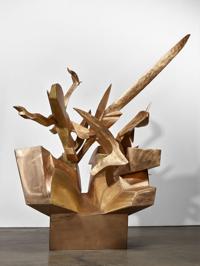
Richard Hunt, From the Ground Up (1989) © The Richard Hunt Estate
(Artists Rights Society (ARS), New York. Photo: Nathan Keay)
“Sculptures are inherently vertical, and they relate to the human body in the vertical way,” said Moreno. “With Richard’s sculptures, there is this horizontal stretch and this energy pulling things from the sides, and for its moment that’s quite innovative.”
Hunt created over 160 public art commissions nationwide throughout more than five decades of artistry. At 35, Hunt received major recognition for his dedication to sculpting in a survey held at the Museum of Modern Art in New York in 1971. Over the years, Hunt’s works have been recognized and displayed nationwide, being featured across 20 different states. Hunt’s artistry has also been featured in the Museum of Contemporary Art Chicago, the Smithsonian Institution, the Georgia Museum of Art, and the Abraham Lincoln Presidential Library and Museum, amongst others.
A walk through pressure
The “Richard Hunt: Pressure” exhibit contains 25 of Hunt’s works, outlining the significant changes in his style and life, separating years of growth and discovery by tables. The process of deciding which sculptures should be showcased out of over 160 pieces was not a simple task, Moreno says.
“Richard made so much work in his life that it was about finding the exact piece that can condense a period of time,” said Moreno. “The early 1960s are represented in the show by six works. I’m sure he’d made 60, so there was this challenge of, how do you get the feel of this exact period?”
With the aim of preserving its chronological order, Hunt’s works are separated into tables surveying sculptures from the late ‘’50s, ‘60s, 1965, ‘70s, and ‘80s, with creative changes being made in between each time period.
Amongst these pieces are works that quietly yet powerfully engage with the Civil Rights Movement, reflecting on Hunt’s lived proximity to its histories and figures. Rather than illustrating events directly, Hunt translated moments of grief, resistance, and triumph into abstract forms that provoke thought.
One of the exhibition’s earlier works, titled “Hero’s Head” (1956), depicts a welded steel sculpture that reflects on the lynching of Emmett Till, who lived just two blocks away from Hunt’s childhood home in Chicago. Another sculpture titled “I Have Been to the Mountain” (1977) is a maquette of mountains or pyramids that takes homage from Dr. Martin Luther King Jr.’s final speech. In additional works, including one titled “Freedmen’s Column” (1989), Black men and women who secured their freedom through resilience and resistance are honored through sculpture, with its upward-reaching structure embodying progress and the pursuit of change.
“Richard has really occupied this incredible place at the intersection of modernist sculpture and what we call assemblage,” said Gartenfeld. “His work, one of its many attributes, is to demonstrate how things that are seemingly abstract also have this very rich connection to American history and to the social context in which he lived.”
What’s next for ICA Miami
As “Richard Hunt: Pressure” reflects on the past, it also gestures toward ICA Miami’s future. With this exhibit closing in March, ICA Miami plans to continue spotlighting artists, giving visitors the chance to engage with fresh perspectives and expand their understanding of art history.
“I would really love for people to start thinking of new radical voices, voices that are really significant in changing American sculpture in the 20th century, and I think Richard Hunt is one of them,” said Moreno.
Looking ahead, ICA Miami plans to expand its impact in 2027 with the acquisition of a new building on the block, doubling both its exhibition space and programmatic impact. This new addition promises not only larger-scale shows but also a stronger platform for under-recognized artists to shape contemporary art and public memory.