
Florida executed its first prisoner of 2026 on Tuesday evening, a man twice convicted in separate murders 12 years apart and who stabbed a robbery victim in the neck with a hunting knife while his brother shot the man three times.
Ronald Palmer Heath, 64, was also a suspect in a third murder in a case that never went to trial. He was on death row for 35 years.
The lethal injection went as planned, and he was declared dead at 6:12 p.m. Ronald Heath refused a last meal or spiritual counseling.
His last words were “I’m sorry. That’s all I can say. Thank you.”
Ronald Heath was condemned in the 1989 murder of a traveling salesman, Michael Sheridan of Atlanta, largely on testimony from his younger brother, Kenneth Heath, who pleaded guilty in the same case and is serving life in prison. Kenneth Heath shot Sheridan three times during the robbery, and Ronald Heath stabbed him with a hunting knife.

The families of the men Ronald Heath was blamed for killing were at the prison in north-central Florida for the execution. Sheridan’s five brothers and one of his sisters attended the execution, along with five of Sheridan’s nephews.
Thomas Sheridan, one of his brothers, thanked Gov. Ron DeSantis for signing the death warrant.
“ Today’s outcome is the culmination of polite, patience, dogged determination, and keeping hope alive for justice to be served,” he said.
Sheridan’s family had campaigned for the Governor’s office to pursue justice for their brother, and Thomas Sheridan criticized people who advocated against the death penalty for Ronald Heath. He said those efforts cheapened the lives of Ronald Heath’s victims.
“ A final thank you for ordering the Ronald Palmer cocktail on Jan. 9 for tonight’s service,” Thomas Sheridan said. “ Governor, as we agreed, that goes on my bar tab.”

According to Duval County Court records, Ronald Heath shot and killed Anthony Hammetti in Jacksonville just days after Sheridan’s murder. Kimberly Reeves, his sister, said Ronald Heath losing his life doesn’t “change the facts” or bring her brother back. She still mourns and dreams of her brother, but she doesn’t delight in the death penalty, and she said she hopes Ronald Heath is at peace.
“ Ronald has had appeal, after appeal, after appeal,” she said. “None of our brothers were ever able to appeal for their lives. Not once.”
Rhonda Green, the sister of Ronald Heath’s first victim, Michael Green, said that though Ronald Heath’s execution didn’t bring her happiness, it was a necessary form of justice. Michael Green was funny, outgoing and loved to fish, she said. It’s horrendous, it took so long for justice, she said.
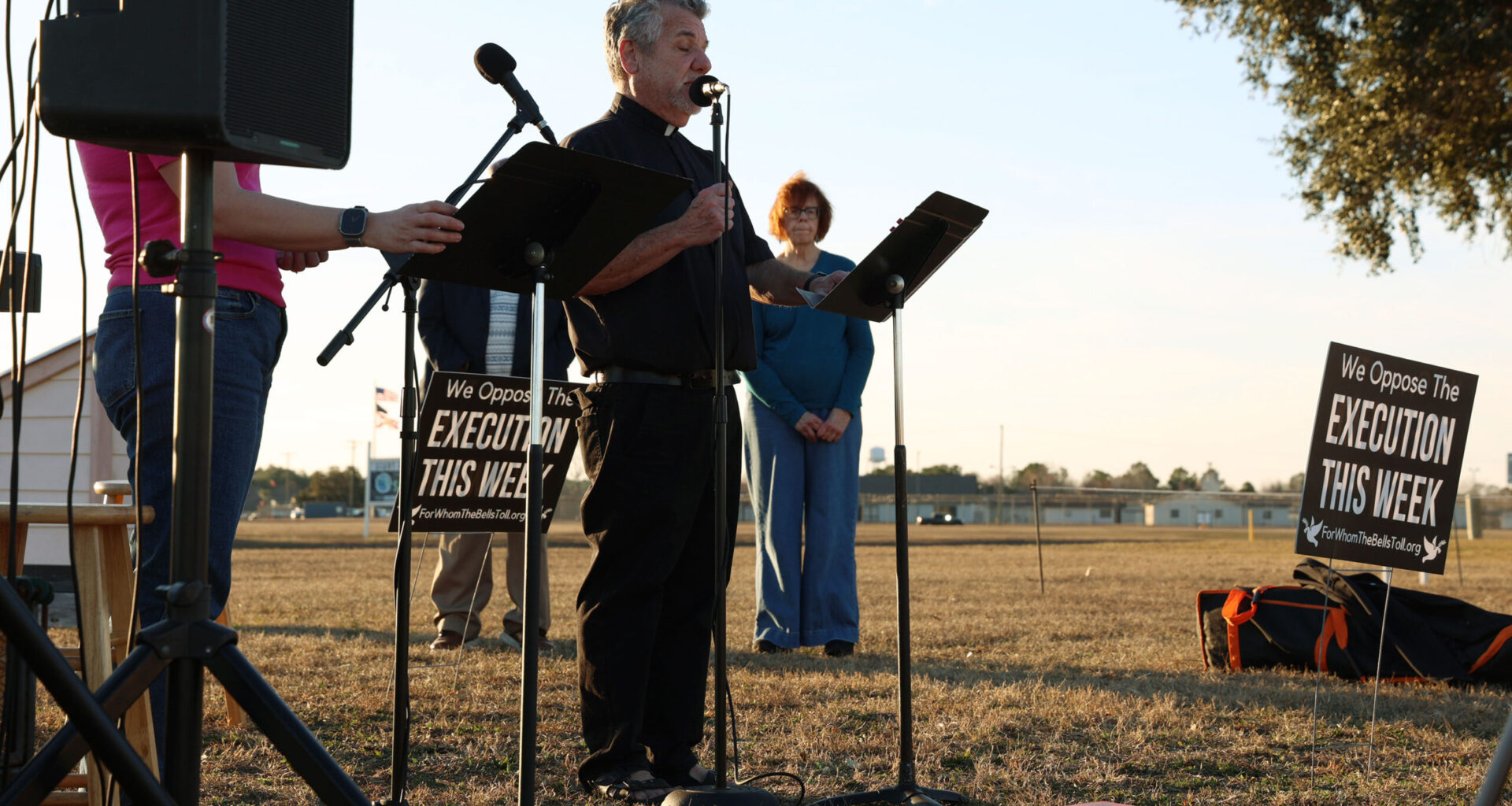
More than 50 people from the Floridians for Alternatives to the Death Penalty and Death Penalty Action came to protest Ronald Heath’s execution. “Ronnie was put to death for a murder he did not commit,” the group said in a statement late Tuesday. “The undisputed trigger man in that crime, Ronnie’s brother Kenneth, received a life sentence with the possibility of parole.”
His most recent legal appeals for leniency focused on whether Florida administers lethal injections properly and whether it would cause him needless suffering. He proposed dying by firing squad. Courts rejected his claims.
“In matters of murder and robbery, Ronald shows no weaknesses,” the trial judge, Robert Cates, wrote in 1990.
Ronald Heath’s death followed the executions of 19 prisoners in Florida last year, by far the most in the United States.
The jury found that Ronald Heath controlled and dominated Kenneth Heath into shooting Sheridan, leading to the death penalty.
This is how the crime unfolded, according to trial transcripts and court records:
Michael Sheridan, a traveling salesman, struck up a conversation with Ronald and Kenneth Heath at the Purple Porpoise, a dive bar, while on a trip in Gainesville. He bought them drinks and introduced himself as from out of town, and he asked if they knew how to get “Gainesville Green,” or marijuana.
The brothers had a history of legal trouble — Ronald Heath was sentenced to 30 years in jail at 16 years old for second-degree murder, when he was convicted of repeatedly stabbing a man he said made unwanted sexual advances on him. He ultimately beat the man, Michael Green, to death with a log.
Kenneth Heath had several burglary convictions and was released from jail three months earlier.
Ronald Heath suggested to his brother that they rob Sheridan. After less than an hour of conversation, Sheridan left with the brothers, despite hesitating because of an early meeting the next day.
When they stopped at a dead-end surrounded by woods, the group stopped to smoke marijuana.
Kenneth Heath pointed a .22-caliber handgun and pointed it at Sheridan, who thought they were kidding. Sheridan lunged at him, and Kenneth Heath shot him in his chest.
As Sheridan began to give up his valuables, Ronald Heath kicked him and stabbed him in the neck with a hunting knife. He tried to slit Sheridan’s throat, but the knife was too dull.
He repeatedly told Kenneth Heath to shoot him again to make sure he was dead.
Kenneth Heath shot him in the head twice. The first time, Sheridan looked at him and asked him what he was doing. The second time he saw “the life went out of his eyes.”
The brothers carried Sheridan into the woods so he wouldn’t be discovered right away.
They burned Sheridan’s rental car the next day and went on a spending spree at Oaks Mall, even getting haircuts with Sheridan’s credit card.
The court found similarities between his violent attacks on Green and Sheridan, which weighed into the jury’s decision.
Ronald Heath marks the first execution of the year, and according to the executive director of the anti-death penalty group, Grace Hannah, if his case is an indication, “this year will be just as aggressive and past pace.”
Melvin Trotter, a man convicted of murdering a woman in 1987, is set to be executed Feb. 24. Billy Leon Kearse, convicted of killing a police officer, will be executed March 3.
___
Maria Avlonitis reports via Fresh Take Florida, a news service of the University of Florida College of Journalism and Communications. The reporter can be reached at [email protected]. You can donate to support our students here.