
Three Key Biscayne Council members, who comprise Mayor Joe Rasco’s AD Hoc Committee, got a deeper look at an alternative stormwater modeling analysis by Georgio Tachiev at GIT Consulting LLC and Alberto Pisani, of CMA, Chen Moore and Associates.
What was learned at last week’s Resiliency Infrastructure and Adaptation Program (RIAP) meeting was that a fully developed integrated surface water and groundwater model has been completed and a pump network configuration is in the process.
Tachiev showed how six injection wells, 100-120 feet deep, (rather than seven) in Zone 1 could remove stormwater effectively, not disrupting the hydrological cycle, being totally environmentally friendly and coming in at a lower cost than AECOM’s proposed model.

Screenshot
Village workshops are planned for Feb. 18 and then April 8, when those costs could be clearly determined.
According to Tachiev’s presentation, the basic difference between the GIT model and the AECOM model from 2025 for Zone 1:
AECOM:
• Excess runoff is collected in pipes and directed to outfalls
• Groundwater recharge is reduced
• Treated water is discharged in the bay
GIT:
• Excess runoff is collected by the stormwater system and injected into the ground
• Groundwater recharge is nearly restored
• Outfall discharges are nearly eliminated
• Limited stormwater is discharged in the bay
Tachiev said the idea is to construct six injection wells, at a maximum 24-inch diameter, and those could be done in phases. Six corresponding pump stations also could be done in phases.
“Most of the system is 18-inch pipes but I’m not saying they all have to be larger,” he said.
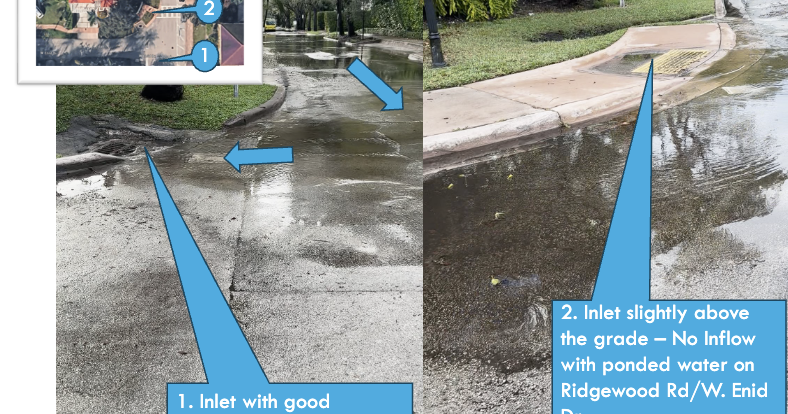
Some 7,000 feet of missing branches (piping) would be necessary and reviving catch basins and inlets at flood locations (up to 120) would catch ponding water.
Screenshot
Tachiev’s plan includes a closed-circuit TV inspection to assess the structural condition of storm sewer piping, repairing broken sections through storm sewer slip-lining (piping inside the existing pipe) or replacement and repairing outfalls and upgrade to a minimum 24 inches there with backup prevention.
Pisini explained that Stormwater retrofit projects are done all over the state, although environmental officials will look for red flags, if any.
“The key to the County is water quality discharge, water to the bay, so they will like this,” he said.
The Florida Department of Environmental Protection looks at the pressure applied to each well.
“That’s how Giorgio came to (this plan),” said Pisini, who added that eliminating all outfalls would be a mistake. “You always are going to need outfalls (in an emergency).”
Peak injection rates in GIT’s plan would be on the order of 14-15 cfs (cubic feet per second) per well for approximately 2-3 hours at 7.5 cfs and less than 2 hours for 15 cfs per well.
Screenshot
Permitting for designs would come in at about 120 days and a typical project like this would be done in a year, Tachiev said, so within two years would be “reasonable.”
As far as estimated costs, it’s a little too early to tell but $30 million was brought up (compared to $44 million by AECOM). Crested roadways, if deemed necessary in certain locations, and other such expenditures would need to be added.
“We are at a point for FDEP to approve the injection wells; that’s one of the critical aspects,” Pisini said.
The slideshow presentation can be found at this link.