
On her smartphone map, she watched the tiny dot scurrying toward her Fort Lauderdale address in real time. Then her phone buzzed with an alert: “Your food delivery robot is here!”
Karla Joan Nelson-Thatcher raced downstairs to the sidewalk outside her Veneto Las Olas apartment and found, waiting near the front steps, what resembled a 3-foot-tall picnic basket on wheels with glowing Pac-Man eyes.
It chirped, as did her phone: She scanned a QR code, the top lid unlocked and she grabbed the prize inside: a still-steaming order of dumplings from nearby Temple Street Eatery.
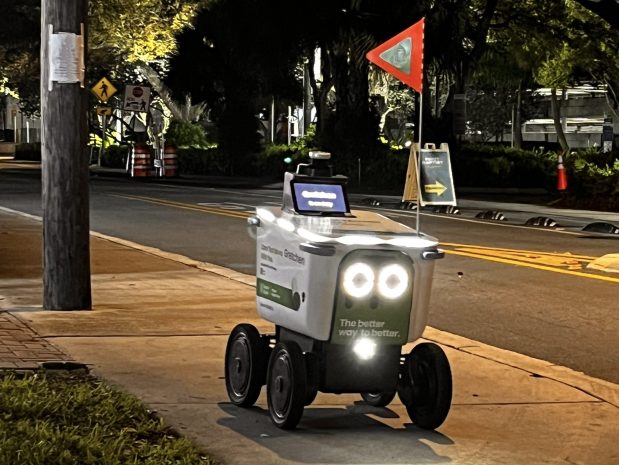
Gretchen Day-Bryant/South Florida Sun Sentinel
An Uber Eats-branded branded food delivery robot from Serve Robotics makes its way down the sidewalk on Northeast First Street in downtown Fort Lauderdale, as seen on Dec. 27, 2025. (Gretchen Day-Bryant/South Florida Sun Sentinel)
“It was delivered at the perfect temperature,” she said. “It was easy-peasy. I checked the box for the little robot to make delivery, and they even refunded my tip.”
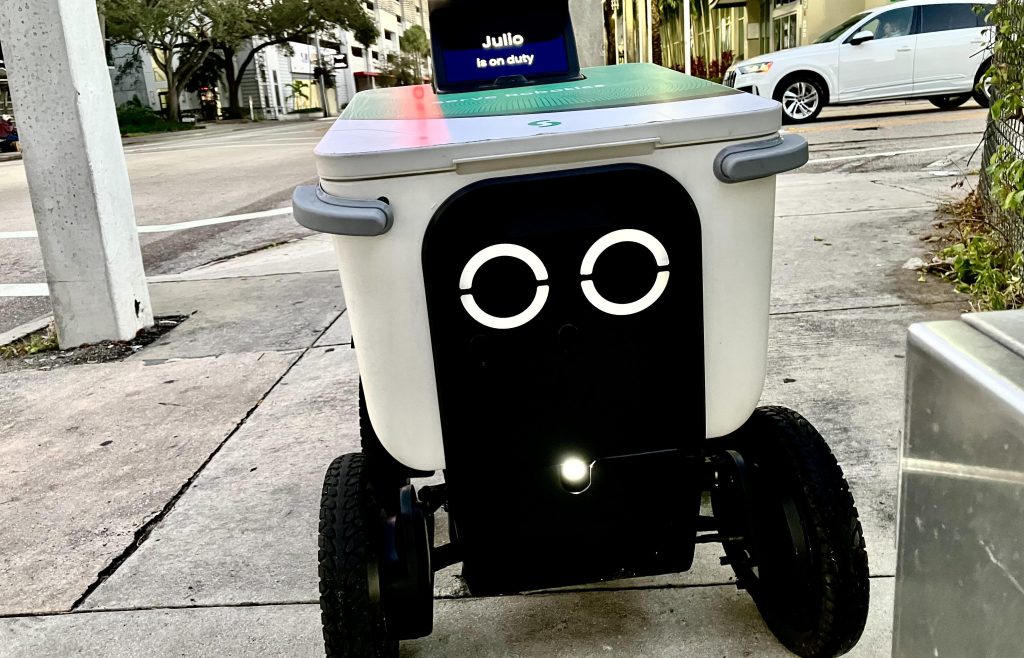
Meet Fort Lauderdale’s newest restaurant food couriers: automated self-driving robots. Since December, you’ve seen them rolling over train tracks near U.S. Highway 1 and Sunrise Boulevard, roaming Flagler Village and rolling down Las Olas Boulevard, winking their digital eyes at passersby, and bearing names like Gretchen, Phyllis, Julio and Gaspard.
There are just 10 in Fort Lauderdale so far, with plans to widen the artificial-intelligence-powered fleet in coming months, and some are already testing deliveries in pockets of Wilton Manors and Dania Beach, says Ali Kashani, CEO of California-based Serve Robotics, which builds the bassinet-sized carriers and partners with Uber Eats for deliveries.
Why Fort Lauderdale first? “It’s the population density,” Kashani says. “We need lots of residents living close by and infrastructure for robots to get around on sidewalks. Uber also has a big presence there already.”
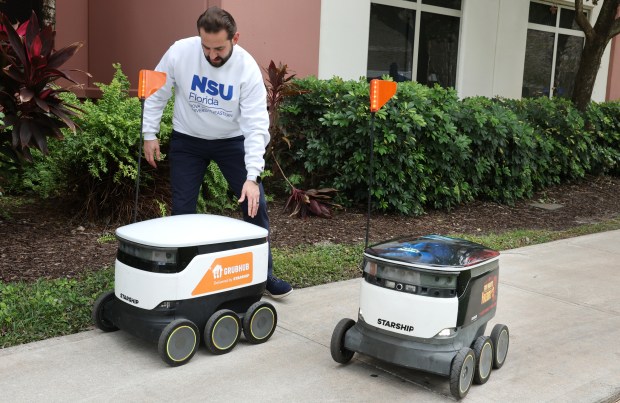
Elsewhere in Broward County, robots already made their debut at Nova Southeastern University in Davie last April, where slightly shorter versions — picture chest coolers on six wheels — use DoorDash to pick up and drop off Chick-fil-A and McDonald’s exclusively to hungry students and faculty. These sleek, stout bots waive orange antennae flags but never leave the sprawling 314-acre campus, says Zubair Hossain, customer success manager for California-based Starship Technologies, which makes the bots.
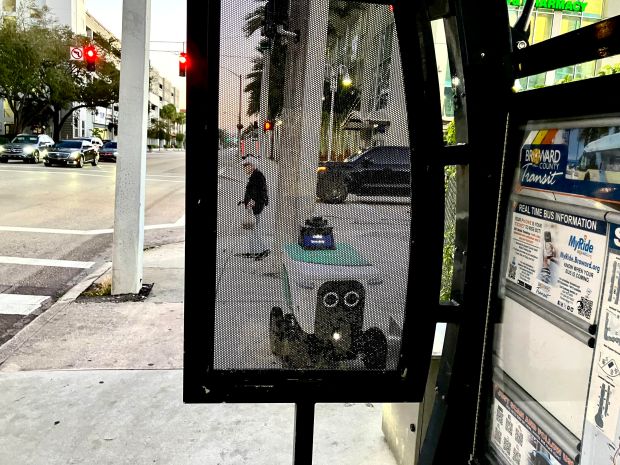
But Fort Lauderdale, by contrast, marks the first Broward city to welcome the autonomous invasion on public streets and sidewalks — sometimes with disastrous results. At times, these automated robots have been captured on camera looking like lost, doe-eyed puppies, especially when they’re trapped behind bus stops, ramps and pillars, or stand blank-faced at crosswalks, or get into staring contests with trash cans, or drive in glitchy figure-eights on the sidewalk like timid teenagers taking driving tests.
SoFlo TikTok feeds are littered with examples of bizarre robot snafus: Just last month, video caught a Brightline train demolishing one. In another clip, a cute, pink-colored bot with heart-shaped eyes blocked car traffic in the Brickell area, including an ambulance rushing to an emergency. A possibly disgruntled customer tried to pick up one Serve Robotics robot and pitch it into the Miami River in December, but settled for kicking it when that failed. (Social media is also littered with random encounters of robots tipping themselves over.)
When robot bullying goes viral on TikTok, it creates bias and ignores how useful robots can be, Kashani argues.
“There are definitely times when folks aren’t a big fan and react a certain way,” Kashani says. “But they’re reliable. They complete 99.8% of all deliveries. And they make the roads less congested, so what goes viral doesn’t represent what’s happening out there day to day.”
Viral videos of error-prone robots don’t exactly inspire confidence, some local restaurants say, especially when they interfere with business. Adam Shidlofsky, co-owner of Mitch’s Downtown Bagels in Flagler Village, says a Serve bot showed up at his business in December “completely out of the blue, without asking permission.” He used it anyway, because the order came from delivery partner Uber Eats.
Carline Jean/South Florida Sun Sentinel
Mike Alkurdi, resident district manager at Nova Southeastern University in Davie, puts an autonomous robot back on track after it got stuck while delivering food on campus on Tuesday, Feb. 3, 2026. (Carline Jean/South Florida Sun Sentinel)
“We put someone’s order in the [robot] once and it rolled away, and then its wheels got stuck on the curb,” Shidlofsky says. “I’m like, this food my team works hard to prepare is getting rocked back and forth. We don’t get to control who picks it up, which is why we prefer humans. I don’t want to be a guinea pig for a glitchy robot.”
Serve Robotics, for its part, admits wires do get crossed, and some of the 3,500 restaurants using Uber Eats delivery aren’t informed in advance. “Uber or Serve do communicate the enablement of robot deliveries to merchants, but there is a possibility that certain team members of a merchant are unaware of this program,” Serve spokesperson
Malory Van Guilder said.
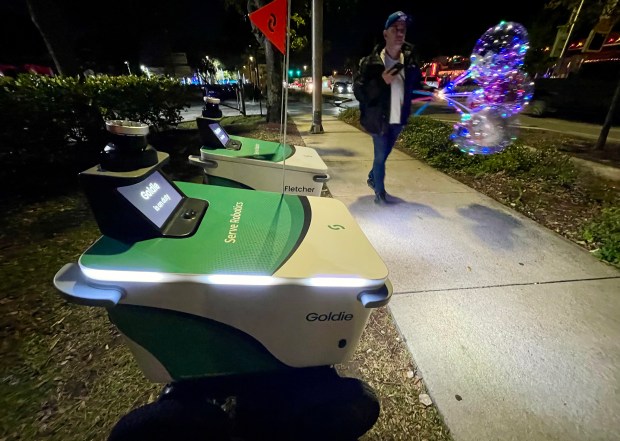 A balloon salesman passes robot delivery vehicles stationed along Wilton Drive in Wilton Manors. (Amy Beth Bennett/South Florida Sun Sentinel)
If customers are unsatisfied with robot deliveries, they have avenues to fix the issue, according to Uber Eats: “If an autonomous order goes wrong, the customer can contact Uber Eats support directly in the app, like they would for any other order.”
For skeptics who say restaurants handing prepared meals to robots is risky — given that their reputations are tied to how well the meals travel, food temperature and timeliness — human drivers are just as prone to mess-ups, argues Fort Lauderdale Commissioner Steve Glassman.
“Human drivers get bogged down in traffic all the time, delaying the order,” says Glassman, adding that he hasn’t heard robot complaints yet from Flagler Village’s urban professionals living in his district. “I don’t mind us being on the cutting-edge of technology now. At least with robots on sidewalks, it’s removing more cars from the roads.”
For now, at least, customers and curious commenters remain as skeptical as the restaurants. In the “Let’s Eat, South Florida” Facebook group run by the Sun Sentinel, reactions swing widely from bullish to post-apocalyptic.
“I’ve seen enough ‘Terminator,’ ‘Matrix’ and ‘I, Robot’ to know where this is going,” resident Stephanie Kesten Barber quipped.
“Stop replacing people’s jobs with robots,” poster Christina Marie added.
“I’ve seen them and I’m happy they are helping out,” another commenter, Shari Howard, wrote. “Deliveries are hard to make downtown.”
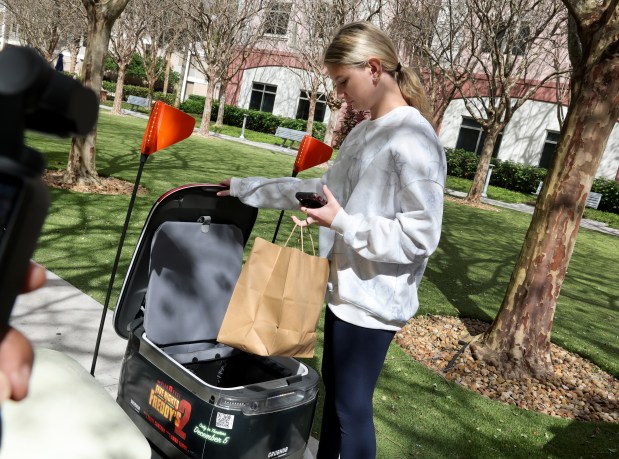 Nova Southeastern University freshman Christel Salazar picks up her food delivery from an autonomous robot on campus in Davie. (Carline Jean/South Florida Sun Sentinel)
Q&A: Most-asked questions about food delivery robots
Like it or not, the robot revolution is here, so get used to them sharing Fort Lauderdale’s sidewalks. We asked hospitality experts, restaurant owners, customers and city officials these 10 questions, and here are their answers.
Q: Can customers choose robot delivery over a human driver?
A: Short answer: Yes and no, and it depends on where you live within a delivery radius, says Ali Kashani, CEO of Serve Robotics.
For now, that radius spans Dania Beach north to Lauderdale-by-the-Sea and west to Wilton Manors, according to Uber Eats. Customers can toggle between robot or human delivery in the app, but even then a robot isn’t guaranteed, especially if they’re all in use or down for maintenance.
“If you pick one of the restaurants supporting robot delivery, then Uber Eats will decide if a robot is available and assign that robot to you,” Kashani says. “You’d get notification right away that your order is coming via robot, and you track it in real time.”
Q: What security measures do the robots have in place to stop thefts?
A: When robots perceive animosity or tampering from humans, they freeze up, says Marc Crocquet, Nova Southeastern University’s vice president of business services.
“There’s an immobilization,” he says. “An alarm goes off, and then the robot connects to a contact center where a live person can see the situation and monitor.”
Robot lids are kept locked unless a QR code is scanned or a code is entered by the person who ordered, Kashani adds.
At NSU, robots are aided by on-campus security and surveillance “cameras all over campus” to protect students, Crocquet says.
Rod Hagwood / South Florida Sun Sentinel
An automated food-delivery robot named Julio waits on the corner of Southeast Sixth Street and Andrews Avenue in downtown Fort Lauderdale. (Rod Stafford Hagwood/South Florida Sun Sentinel)
Q: Can you tip a robot?
A: You can’t monetarily tip a robot — yet, Kashani says. For now, tipping is waived on Uber Eats for robot delivery, an incentive so customers pick automated delivery over a human driver.
Q: Gretchen? Phyllis? What’s with the robot names?
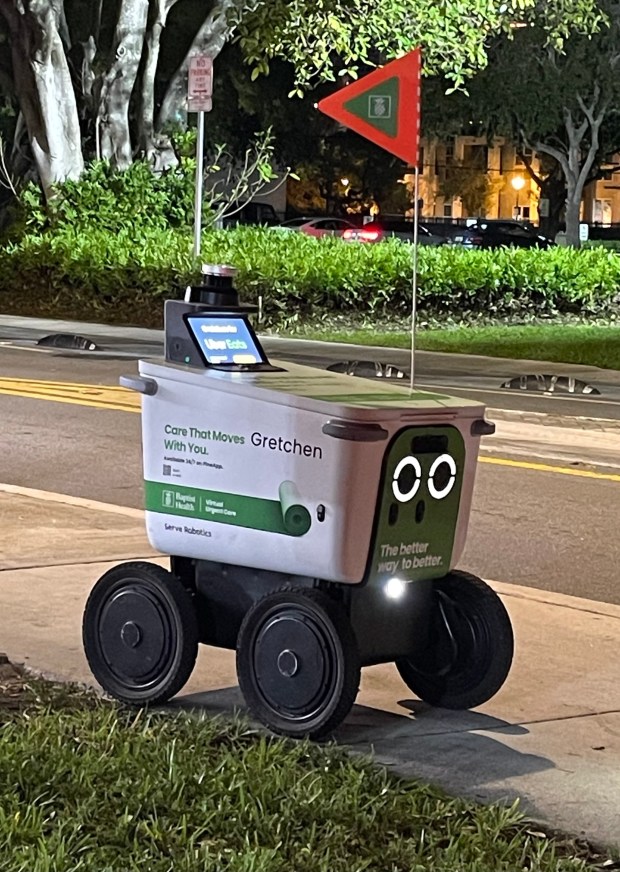
A: Simply put, nicknames humanize robots, Kashani says, especially if one “needs assistance on the street and needs to be identified.”
“It’s basically AI with a physical body,” he explains. “AI controls how it behaves, how it navigates among people, and part of that is being predictable. So they try to respect other people’s personal space and match their movement speed to humans nearby.”
Gretchen Day-Bryant/South Florida Sun Sentinel
An Uber Eats-branded food delivery robot named Gretchen makes its way down the sidewalk on Northeast First Street in downtown Fort Lauderdale on Dec. 27, 2025. (Gretchen Day-Bryant/South Florida Sun Sentinel)
Most robo-monikers come from the real names of aunts, uncles, siblings and pets of Serve Robotics employees, he adds, although users can contact the company directly to suggest names, too.
Q: How far can robots deliver food and drink from a restaurant?
A: About a mile away, according to Kashani and Uber Eats say, but up to 2 miles if needed, with the average food delivery taking 18 minutes.
Delivery robots are “pretty well-insulated to keep my food warm,” says Diego Ng, owner of Temple Street Eatery in Fort Lauderdale. “Which is good because if something happens to it, people don’t blame the robots, they blame the restaurants.”
But a mile or two is as far as he’s willing to allow. Any farther and “I will cancel the order,” he says. “I see the robot drives slowly and it stays on driveways, sidewalks, crosswalks, so it can’t handle big distances.”
Q: Will robot delivery take jobs away from human drivers?
A: Yes, if you ask Andrew Moreo, assistant professor of hospitality management at Florida International University.
“Some of the gig economy workers are going to lose out on their deliveries,” Moreo says. “Robots don’t make a wage, so it puts downward pressure on the gig workers.”
It’s easy to fear change, but robots will only make deliveries quicker, argues Peter Ricci, Florida Atlantic University’s director of hospitality and tourism management.
“If they’re faster and safer than human drivers, as a consumer, why wouldn’t I want to use them?” Ricci says. “If it’s saving that operator money and enhancing the experience, why not?”
Still, robot delivery only works well in dense urban cities, not suburbs, says Anil Bilgihan, an FAU professor of marketing and hospitality management.
“It will take a lot of these last-mile delivery issues and solve them,” Bilgihan says. “Because the robots have a short battery life, it won’t replace human drivers for longer distances like in Pembroke Pines or Weston.”
Amy Beth Bennett / South Florida Sun Sentinel
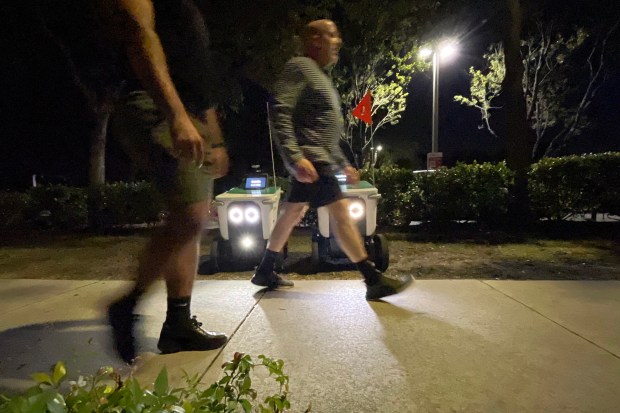
Pedestrians pass robot delivery vehicles staged along on Wilton Drive in Wilton Manors on Saturday, Feb. 7, 2026. (Amy Beth Bennett/South Florida Sun Sentinel)
Q: Where’d all these robots come from, anyway?
A: Companies like Serve Robotics, Coco Robotics, Starship Technologies, Pinkbot and Wing are leading South Florida’s autonomous invasion. Before that, delivery robots first rolled out into tech hubs like Silicon Valley and San Francisco post-pandemic before making their debut in downtown Miami and South Beach, Bilgihan says.
So far, restaurants have been slow to adopt them. Only 5% of national restaurants use drones or “autonomous vehicle delivery,” according to 2025 National Restaurant Association 2025 National Restaurant Association data, but 74% say using technology will help human labor instead of replacing it.
Q: What’s with the robots getting stuck on roads and sidewalks and “glitching” out?
A: If a robot glitches out mid-delivery, Kashani says a human being remotely takes over from a Serve command center and manually completes the robot’s intended destination using controls.
“Our team can remotely log in and kind of help it out,” he says. “And if that doesn’t work, there are pedestrians nearby who can go assist the robot.”
Robots won’t glitch out forever, adds FAU’s Ricci.
“AI constantly adapts,” he says. “In the future, when palm fronds fall in front of it, or a dog crosses the street, or FPL trucks are fixing power lines, robot AI will learn to find different routes.”
Q: Where will we see autonomous delivery robots showing up next?
A: Uber Eats, Starship Technologies and Serve Robotics declined to say, although there are plans to roll out more robots in Fort Lauderdale soon, Kashani says.
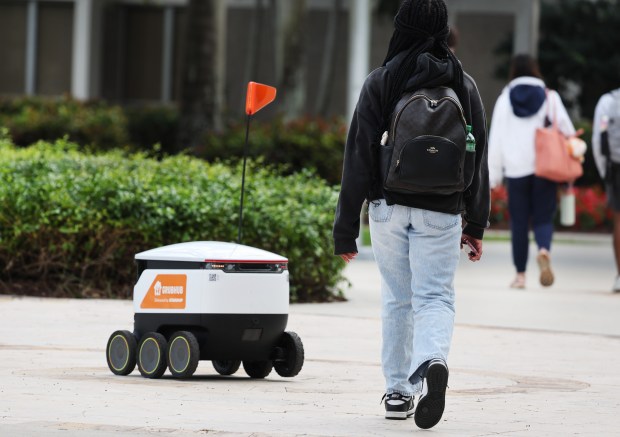
Carline Jean/South Florida Sun Sentinel
Food delivery robots are part of the scene on the Nova Southeastern University campus in Davie. (Carline Jean/South Florida Sun Sentinel)