
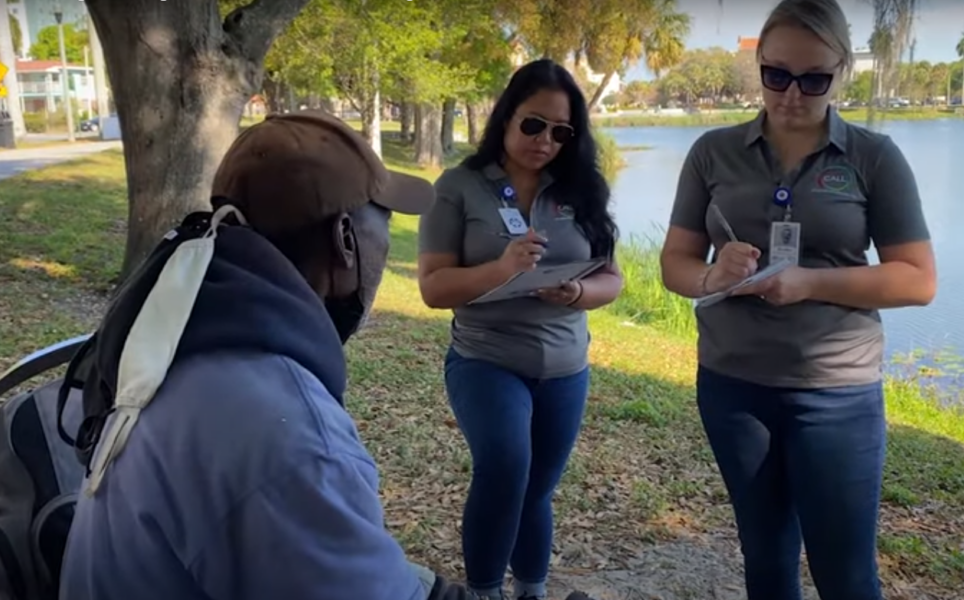
Launched in 2021, the Community Assistance and Life Liaison (CALL) Program began through Gulfcoast Gulf Coast Jewish Family and Community Services (JFCS) in partnership with the St. Pete Police Department (SPPD). CALL emerged amid nationwide calls for policing reform following the killing of George Floyd in Minnesota. Its mission: intervene on non-violent emergency calls dealing with mental health, substance abuse, behavioral issues, truancy, homelessness and neighborhood complaints.
“Following meaningful dialogue with community members and our officers in the aftermath of Mr. George Floyd’s (2020) death, it became clear that certain non-criminal calls, particularly those involving mental health crises, are often best supported by trained care professionals,” SPPD Chief Anthony Holloway told the Catalyst.
CALL restructured public safety, dividing and deploying resources more effectively so police can focus on criminal matters and CALL can focus on mental health and behavioral concerns, increasing public trust and reducing punishment, especially in vulnerable communities. “This approach reflects a shared commitment to using the right response for the right situation while ensuring the safety of both the individual and the community,” Holloway added.
To date, trained CALL social workers have intervened in nearly 20,000 non-violent 911 emergencies without incident. In approximately 95% of those responses, no police support was required. The program’s success has led to adoption in other cities like Largo and Clearwater, and other Florida regions are considering adopting the model.
Success didn’t come without challenges, however. Holloway said one of the biggest hurdles was “building confidence, both within the department and across the community, that trained civilian professionals can safely and effectively respond to appropriate calls while maintaining public safety and accountability.”
There are still persistent challenges that the individuals CALL serves face. Gulfcoast JFCS’s former Chief Operating Officer now District 6 City Council Candidate, Terri Balliet, acknowledged the harsh realities many vulnerable residents face – they need support beyond what the program can accommodate: housing, long-term treatment and sustained support.
“The hardest part is recognizing that those resources aren’t always immediately available,” Balliet recalled.
“The gaps are real. And yet, the navigators continue to show up,” she continued. “They focus on stabilizing the immediate moment, building trust and advocating for that individual within the system. It takes patience. It takes resilience. And it takes heart.”
Though no longer with Gulfcoast or CALL< Balliet hopes that the program adds more navigators and broaden coverage so every neighborhood has timely access to this response. Increased capacity means strengthening the continuum of care, improving follow-up with affected individuals and expanding opportunities for earlier intervention.
“From the very beginning – when we made sure to add the word ‘Life’ [to CALL’s acronym],” Balliet said. “The goal has been clear: to send the right response at the right time, in a way that protects dignity while strengthening public safety. That vision hasn’t changed.”
In recognition of CALL’s positive impact on the city, Mayor Kenneth Welch introduced a proclamation recognizing Feb. 2 as CALL Day. The proclamation is scheduled to go before city council Thursday.
When asked what this mayoral recognition means, Balliet responded “It means they are seen,” she said. “The navigators and licensed social professionals do quiet, emotional and often heavy work. They walk into living rooms, onto sidewalks and into moments where families are overwhelmed and individuals are struggling.”
“Recognition tells them that what they do matters … It affirms that care is not separate from safety – it is part of safety.”