
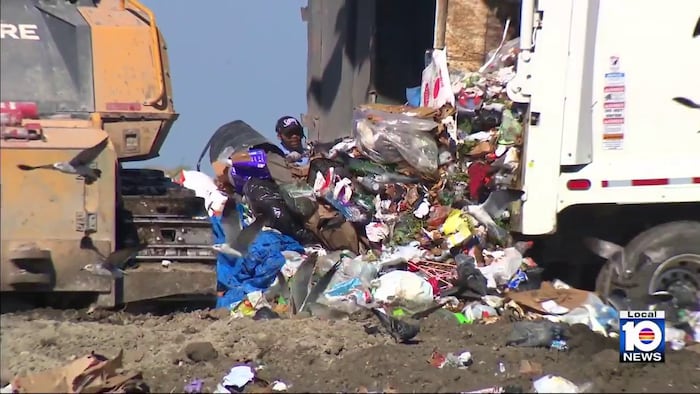
MIAMI-DADE COUNTY, Fla. — A new innovation being tested at the South Dade Landfill could help Miami-Dade County reduce its growing waste stream as officials search for ways to extend the life of local landfills.
Landfills are almost at capacity, leaving Miami-Dade scrambling to find effective solutions to divert as much waste as possible from being sent to landfills.
County leaders say the pilot project represents a major step forward.
“This is really big. This is big,” said Roy Coley, Miami-Dade County’s chief regulatory and utilities officer. “They’re taking green waste that normally would be placed in the landfill, cause a waste of space, and actually turn it into a usable product.”
The product is biochar — a carbon-rich charcoal that could become part of the solution to Miami-Dade’s solid waste problem.
“We produce 5 million tons of year of solid waste Miami-Dade County, the department itself is responsible for managing 2 million tons a year, and a huge percentage of that is green waste that can be reused and not waste space in landfills,” Coley said.
Green waste — including yard clippings, branches and fallen trees — makes up nearly 12% of what the county sends to landfills that are rapidly filling up.
As organic material decomposes, it releases methane, a powerful greenhouse gas, at a time when communities face mounting pressure to cut emissions. That urgency helped inspire Fort Lauderdale-based Clean Earth Innovations to focus on biochar.
“I pulled together some of the brightest of my team members that we worked together, and we said, let’s do something and it’s good for the environment, and we decided to focus on biochar innovation,” said CEO Harold Gubnitsky.
The company received $100,000 from the Miami-Dade Innovation Authority’s Solid Waste Challenge to pilot what officials say is the only biochar machine currently operating on top of a landfill.
“This is chipped up yard waste coming from piles behind it that otherwise would be in the landfill or some places that we don’t want to be,” Gubnitsky said.
The material moves by conveyor into a rotating kiln that reaches extreme temperatures.
“It’s called a rotating kiln. It’s got a ceramic encasing so it allows it to get super hot again, 1,400 to 2,000 degrees Fahrenheit. That’s when the magic happens,” he said.
The sealed, oxygen-free system produces almost no emissions as it bakes the biomass, while also creating another useful byproduct.
“And it creates another byproduct which can then be turned into electricity,” Gubnitsky said.
Still, biochar remains the main attraction.
“This is biochar. They call it nature’s black gold. And this has so many uses,” he said.
The material can help sequester carbon dioxide, nourish soil, improve crops, reduce the need for fertilizer or water, filter waterways and potentially aid in restoring Biscayne Bay.
“It’s granular activated carbon. It’s powdered activated carbon. We can take these carbon materials and we can sequester contaminants in our environment. We can use it in water and wastewater. So this is an amazing product,” Coley said.
County officials say the technology could also divert hundreds of thousands of tons of yard waste from landfills.
“When we think about landfill dependency and we look at how we can actually divert waste now into such a beneficial use, this is what innovation should look like,” said Aneisha Daniel, director of Miami-Dade County Solid Waste.
For now, the effort remains a pilot program. The first phase is expected to wrap up in April, after which the county will decide how to proceed. The machine currently operating at the South Dade Landfill can process about 4,000 tons of green waste each year.
Copyright 2026 by WPLG Local10.com – All rights reserved.