
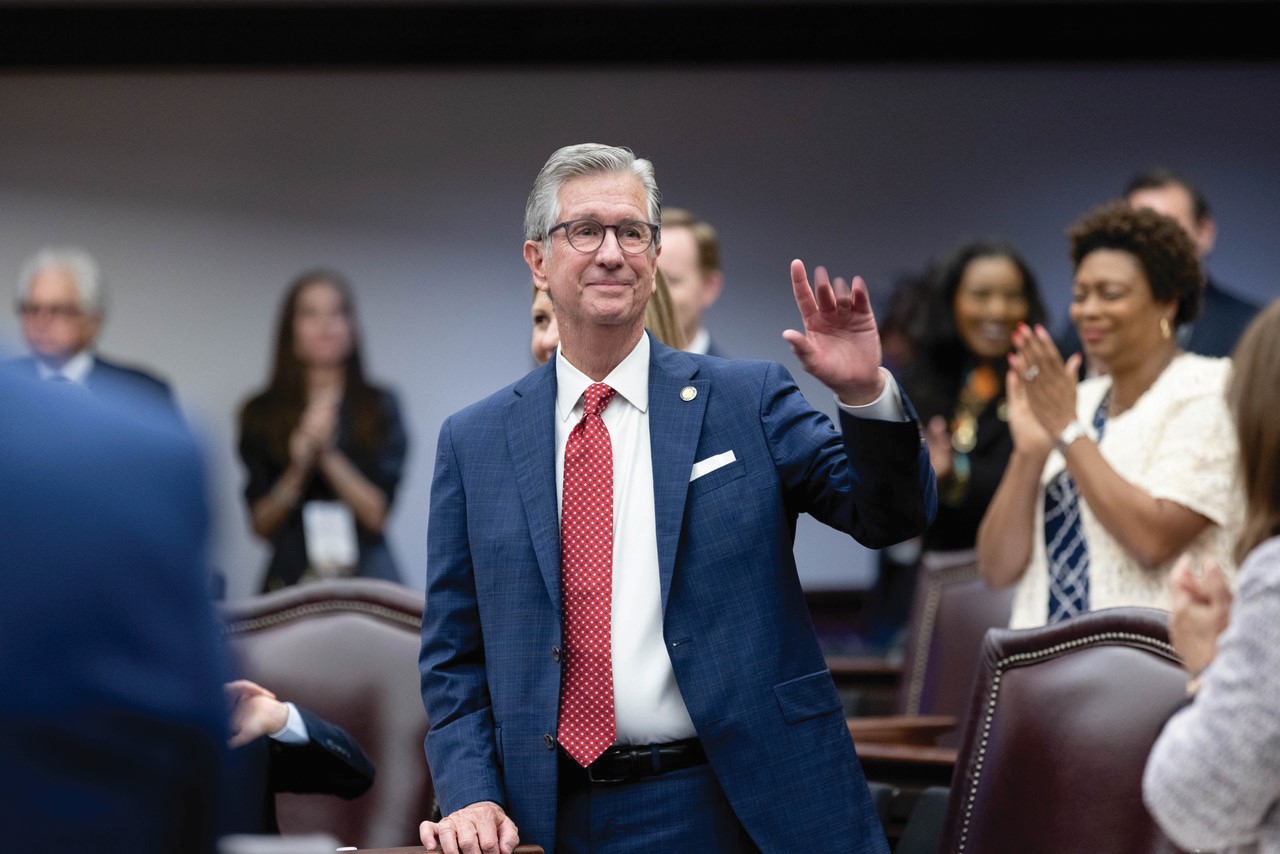
Sen. Jim Boyd is the current Senate Majority Leader. Following the 2026 election, he’ll be the next Senate President, replacing current Senate President Ben Albritton at the end of his leadership tenure.
Both bring a statesman’s mentality to the job, an approach Boyd leans into, and will continue to emphasize over the two years he wields the gavel.
If you ask the Senate President-designate about his priorities as leader, you won’t hear a lot of overtly partisan commentary, though his conservative values are clear. He favors lower taxes, fewer business-killing regulations and an overall emphasis on ensuring Florida families are able to grow and thrive in the Sunshine State.
When his tenure as Senate President begins, Boyd will be leading the upper chamber in a new era of Florida politics, one that has yet to be defined: That is, Gov. Ron DeSantis won’t be Governor anymore, and voters don’t yet know who will succeed him next year.
“I view myself as a servant leader, and my goal and my desire in having the opportunity and privilege of leading the Senate is to work with my partner in the House and my partner in the Governor’s Office,” he said of the executive office uncertainty.

But while no one has a crystal ball, Boyd has a prediction.
“While you’re right, I don’t know who that Governor will be, I know one thing: I’m pretty sure it will be a Republican,” he said.
Boyd didn’t elaborate on why he thinks so, but for those of us who work daily in and around The Process, it’s pretty clear. Republicans have cemented their voter registration majority, with well over 1 million more active voters in the state than Democrats. A Democrat hasn’t been Governor of Florida since Buddy MacKay, who served the remaining three weeks of fellow Democrat Lawton Chiles’ gubernatorial term after his death in late 1998.
But Boyd says he plans to work with Democrats, at least to some degree.
“My Democratic colleagues will tell you I work well with both sides of the aisle. So whoever the Governor is, I will be focused on building a relationship where we can do what’s right for our constituents,” he said.

Asked if that bipartisanship would extend to leadership positions in the Legislature by offering at least some Democrats the chance to lead or co-lead committees, Boyd said he hasn’t thought that far yet. He acknowledged that, typically, the majority party controls most leadership posts. Nevertheless, he vowed to ensure Democrats have a seat at the table.
“Whatever capacity they serve, they will have a voice in the room,” he said, adding praise for Senate Democratic Leader-designate Tracie Davis.
“We’ve already had good conversations about our ability to work together. So I’m confident that whatever role that that ends up being, my friends across the aisle will definitely have the ability to have their say in what we do,” Boyd said.
He offered an example he sometimes uses at home with his family.
“I say, ‘You know, the Democrats in their community got elected, just like I did in my community. So, you know, we control the majority, and I’m happy to be part of that majority, but that doesn’t mean they shouldn’t have a say as well.’ So I respect who they are, what they stand for, and I trust we’ll have a very good relationship, a working relationship moving forward.”
And Boyd has adopted a saying by former House Speaker Dean Cannon, who presided over the chamber early in his legislative career. Cannon would tell him of the Republican Party’s supermajority in the chamber, “just because you can, doesn’t mean you should.” The adopted motto shows Boyd isn’t looking for shocking, controversial legislation, but rather policy he truly believes helps Floridians.
The brass taxes
At the end of the day though, Boyd’s job as Senate President will be more about policy and budget than singing Kumbaya across the aisle.
And he’s got a plan for that, too.
This Legislative Session, lawmakers are poring over several property tax cut proposals, whether eliminating them altogether (with the exception of the portion that pays for public schools and public safety), slashing them for seniors, increasing homestead exemptions, or a number of other options on the table. Whatever emerges successfully from Session will then go before voters for their consideration later this year, where the issue faces a tough ballot test due to Florida’s 60%-plus-one vote threshold for passage.
If voters approve any sort of property tax reduction, it will be Boyd leading the Senate through that chamber’s deliberations on how to move forward with the change. Challenges could be plentiful, with local governments already foretelling shortfalls that could impact local police and fire budgets and, as some have cautioned, require tax increases elsewhere that could offset savings for property owners paying less.
“I don’t believe we can abolish all of the homestead property taxes,” Boyd acknowledged.
But he also agrees with others in his party that rapidly rising property values in recent years have created something of a windfall, and that all governments — whether it’s the state or a city or county — should be able to identify ways to ease tax burdens.
“I think all of us can find ways to tighten our belts, and our communities ought to be able to do that as well,” Boyd said.
“As we’re looking at what might be the right property tax proposal, we also remind ourselves, as leaders and as elected officials, that we ought to be able to do things in a more efficient and more tax-friendly way for our constituents.”
Tackling affordability
The property tax issue has arisen largely as a response to increasingly challenging affordability issues across not just Florida, but the entire nation. It’s expected to be a major focal point in the Midterm Elections this year. By the time Boyd takes the gavel, voters will have sent a message at the ballot box one way or the other.
And in Florida, there is a persistent affordability issue that’s mostly unique to the Sunshine State.
Property insurance rates have for years been among the highest in the nation. Homeowners have seen some downward movement on those rates following legislation cracking down on frivolous lawsuits. More providers have come into the state market, driving prices down.
Still, pain points remain, but Boyd hypothesized additional relief on the horizon.
“The reforms that we put in place are starting to really work through the system and through the actuarial tables that will provide homeowners in Florida some additional relief in the short years ahead,” he said, though he didn’t offer any insight to any potential additional legislative fixes.
The Senate President-designate also reminded that Floridians, like other Americans, are facing rising health care costs. There, he said it will be imperative to work with federal partners to ensure Floridians aren’t priced out of coverage.
“That’s always going to be a tough issue, because there’s only so many dollars to go around. But again, spending in the right places and spending it on the right things are important,” Boyd said.
Public education
While affordability is the kitchen table issue of the day — as it often has been throughout history — public education is also a hot button topic.
The issue has become a national one, and Florida is often considered the original proving ground for school choice policies. Former Gov. Jeb Bush was a champion for choice, and the fervor for it, particularly among Republicans, has only gotten more intense since his tenure in the early 2000s.
As with any policy, there are always detractors. School choice critics over the years have frequently derided such policies as a loss for traditional public education. The argument goes, particularly for school vouchers that allow students to use public funds to pay for private school, that choice programs are funneling funds away from public education.
But even with a large contingent of critics, school choice has been relatively popular, and it earns at least some bipartisan support.
Still, the battle rages on. This year, there are two issues facing lawmakers. One is an effort to add some transparency measures to the existing universal school voucher program, a fix bill (SB 318) that Sen. Don Gaetz is running. The other is in relation to the controversial Schools of Hope program.
That program began as an effort to ensure students in underperforming areas were able to access quality education by allowing charter schools to co-locate in underutilized public school facilities.
But some provisions landed with a thud. The program doesn’t require charter schools to compensate school districts for use of their resources, which has prompted pushback from some local School Board officials. And new language added to the program also made it so that essentially any school in the state is subject to the co-location requirement, regardless of educational attainment in the area.
The pushback prompted Sen. Darryl Rouson to file a repeal bill (SB 424), with Reps. Ashley Gantt and Robin Bartleman backing the House version (HB 6023). While it’s unlikely either will gain traction in the GOP supermajority Legislature, Boyd acknowledged there may be some unintended consequences.
“Can we make it better? Should we try to make it better? Absolutely,” Boyd said.
But at the end of the day, he’s a huge supporter for school choice done right.
“Sadly, there’s some public schools that are just not getting the job done, and kids don’t have a chance,” he added. “Generation after generation they find themselves in poverty because the kids and the families that they’re a part of just don’t have a chance to break that cycle.”
Boyd said he supports public schools — he’s a product of them himself — but strongly believes that when the system isn’t meeting a community’s needs, or an individual family’s needs, they should have options that do.
“I can’t tell you the number of parents I’ve had come through my office, and … they’ve just had tears in their eyes and say, ‘You know, my child was in a failing school. There was really no chance for success. I didn’t know what was going to happen, but this opportunity came up for this school or that school, and it’s made every bit of difference in my child’s life.’”