
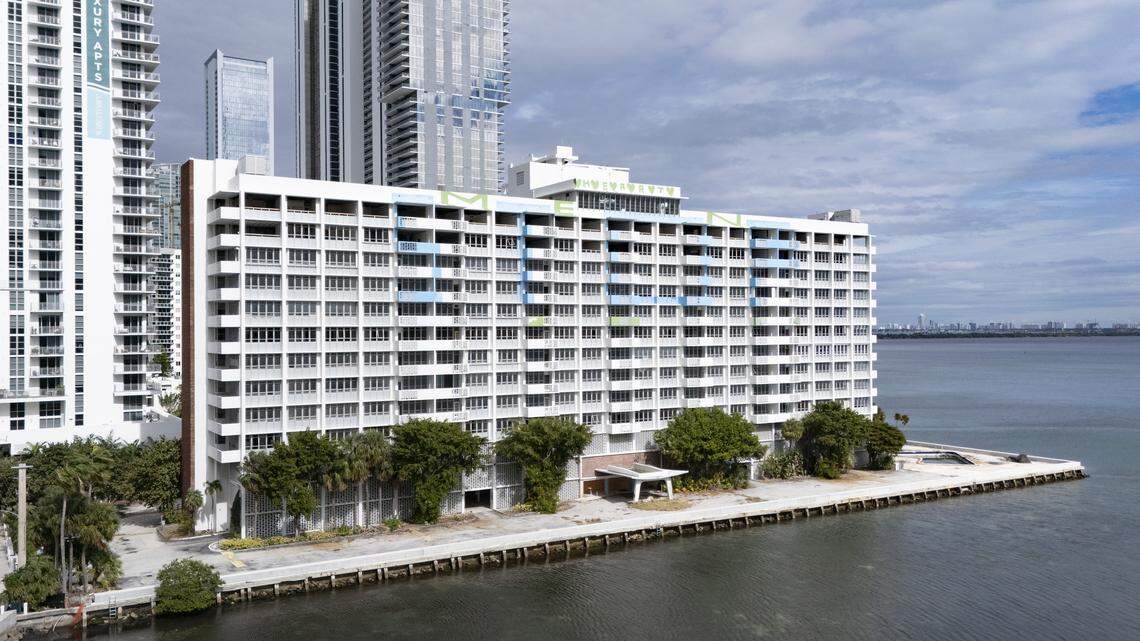
Biscayne 21, a condo building at 2121 N. Bayshore Drive in the Edgewater neighborhood, has been at the center of a years-long legal battle between residents and a developer.
PHOTO BY AL DIAZ
adiaz@miamiherald.com
A judge ruled this year that a developer that tried to buy out a Miami condo tower was on the hook for millions of dollars in repairs. But in another twist to the legal saga surrounding the waterfront property, the developer has filed a lawsuit against the residents who sued to stop the takeover.
If the suit is successful, the developer could escape those repair bills, demolish the Edgewater tower and build its planned luxury condos.
While the first lawsuit was still ongoing, the developer began demolishing the building, which is more than 60 years old. Now, Biscayne 21 is in such a state of disrepair that the developer estimates it will cost more than $60 million to fix the mess.
Glen Waldman, an attorney representing the condo residents who sued the developer, called the new lawsuit a “non-event” and a “last-ditch effort” by the developer to get out of repairing the building.
TRD Biscayne LLC, a subsidiary of Two Roads Development, the Florida-based developer behind the project, filed the suit in Miami-Dade Circuit Court on Jan. 30. The complaint asks the judge to terminate the building’s condo association, saying it’s not feasible to repair the building.
In a statement to the Miami Herald, Two Roads managing partner Taylor Collins cited “longstanding issues” with the building that existed before his company’s involvement. He said terminating the condo was “the most responsible and practical path.”
After last month’s ruling that the developer was responsible for repairing the building, Collins told the Herald that the firm “anticipated” the ruling and that it “has complied with all court orders and will continue to do so.”
Waldman pushed back against the developer’s claim that the building was in bad shape when it began the takeover process. He said Biscayne 21 had just passed all of its certifications and was in “excellent shape.”
Terminating a condo association, the process that has been at the center of the Biscayne 21 controversy, means changing the ownership of a building from individual condo unit owners to a single owner. Often, a developer will buy out and terminate a condo before tearing the building down and redeveloping the site.
READ MORE: A developer tried to push Miami condo owners from their homes. They fought back
As it stands now, TRD Biscayne owns 183 of the building’s 192 units. The others are still owned by the holdout residents who refused to sell their units and filed suit in May 2023. If a judge approves the condo termination TRD Biscayne is requesting, the holdout residents would be forced to accept the developer’s buyout.
Robert Murphy, one of the residents who sued, said he’s not surprised that the developer is making this new argument in court. But like Waldman, he said he doesn’t expect the lawsuit to succeed. Murphy said he’s looking forward to moving back into his condo once the repairs are completed, which he’s been told will take about two years.
TRD Biscayne is asking for what’s called an “economic termination” under Florida condo law. Economic termination allows a condo association to be terminated if a building has incurred severe damage, and it no longer makes financial sense to repair. This happens most often after a natural disaster like a hurricane.
Economic terminations, which Waldman said typically go before judges for approval, can allow a termination to happen, even with significant opposition from residents.
But Waldman says he doesn’t think TRD Biscayne will be successful in arguing for economic termination in this case — because the developer caused the damage to the building, and it would benefit from terminating the association.
Residents ask for $100M in damages
This week, Murphy and the other Biscayne 21 residents submitted a new complaint in their lawsuit, which is separate from the latest suit filed by TRD Biscayne. They’re asking for at least $100 million in damages from a longer list of defendants, including banks that lent Two Roads money, companies associated with the developer and people involved in the attempted takeover.
The developer had planned to take the condo over, terminate the association, demolish the building and redevelop the site with luxury condos. But the Biscayne 21 residents who refused to sell their units foiled that plan.
Biscayne 21’s condo declaration, the legal documents that establish the condominium, say that to terminate the condo association, 100% of unit owners must approve. To try to get around the rule, the developer, which had acquired a majority of the building’s units, amended the declaration to lower the threshold for termination.
But the holdout residents took the developer to court, and in July 2025, a judge ruled in their favor. In October, the Florida Supreme Court declined to take up the case, cementing the residents’ victory.
And in January, the circuit court judge ruled that the developer was responsible for repairing the building, which it began to demolish while the lawsuit was ongoing.
Even before Murphy was forced out of his condo in September 2023, he said the developer had begun to strip units. In November, he was allowed back into his condo for the first time since moving out. His unit was gutted.
Donna DiMaggio Berger, a South Florida attorney who has represented condo associations during termination disputes, said it was a “gamble” to start the demolition before the legal proceedings had concluded.
Follow More of Our Reporting on In the Spotlight

Miami Herald
Catherine Odom covers real estate for the Miami Herald. She previously interned on the Herald’s government team and has worked as a journalist in Germany and Armenia. She is a graduate of Northwestern University.