
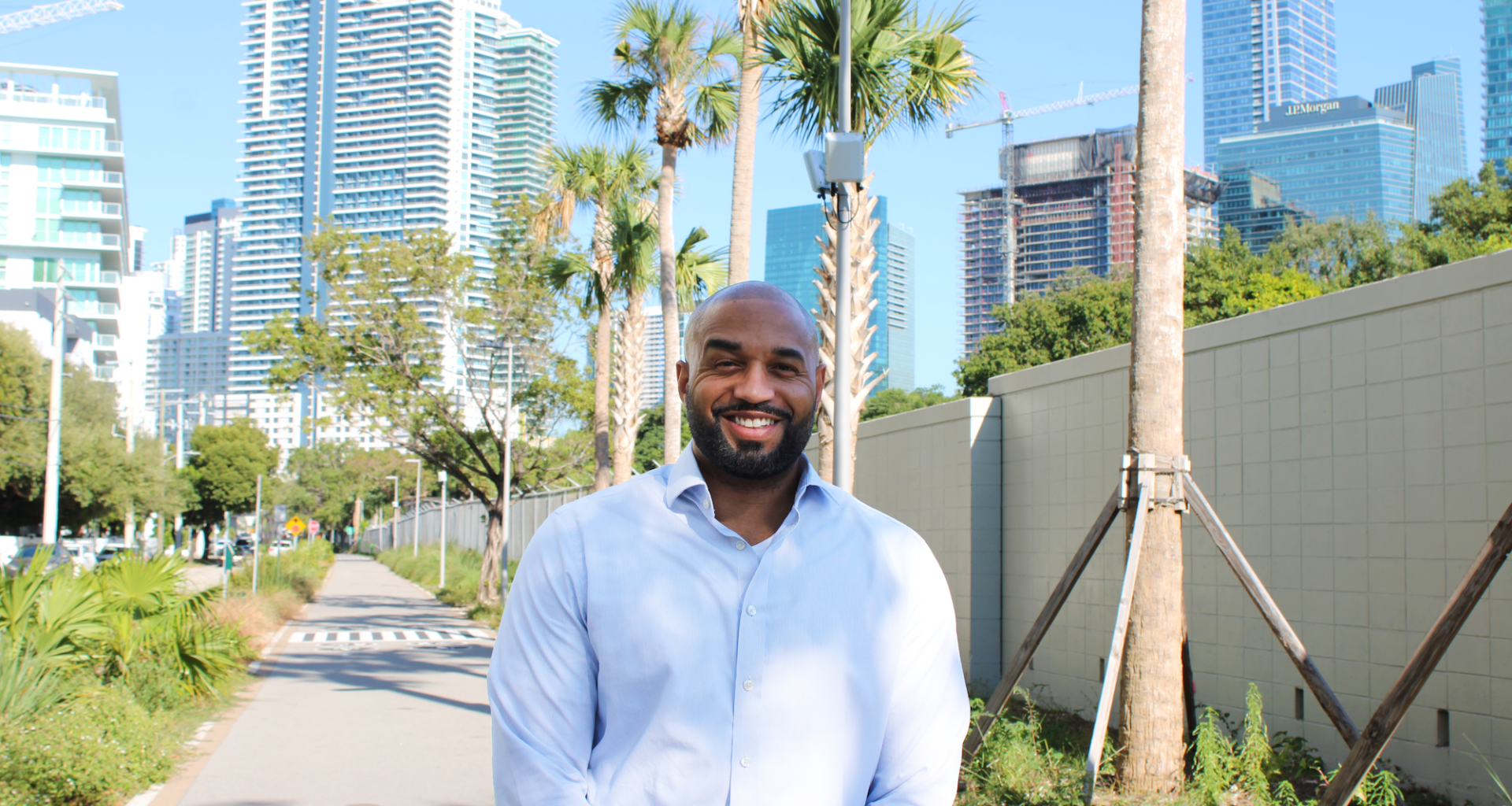

Friends of the Underline CEO Eulois Cleckley jumped at the chance to to help shepherd the Underline to its projected 2026 completion.
Friends of the Underline photo
Editor’s Note: This profile is part of New Times’ People to Watch issue, spotlighting figures we expect to make a big impact in Miami in 2026.
As omens go, it would prove to be a very good one — both for seasoned transportation public servant Eulois Cleckley and the Miami citizenry at large.
Back in the fall of 2021, Cleckley had just arrived in the Magic City to take over the reins at the Miami-Dade Department of Transportation and Public Works after four years as Executive Director of Denver’s equivalent Department of Transportation and Infrastructure. Lodged downtown and eager to explore his new city, Cleckley took a stroll across the South Miami Avenue Bridge and promptly stumbled upon the bustling Urban Gym. Its pristine, modern flex court for basketball and mini-pitch soccer, running track, and fitness equipment served as a gateway to the Brickell section of the Underline. “I was amazed,” Cleckley tells New Times. “I knew of the project, but until I saw it with my own eyes, I did not realize the magnitude of it — how unbelievable and fantastic it truly was.”
He’s right, you know, to crib the word bubble of the popular Morgan Freeman meme: The Underline is an exemplar of the promise and possibility of city building in an age of cynicism, doubt, and decay — an innovative, on-time, on-budget public-private partnership that is transforming ten miles and 120 acres of underutilized space (to put it kindly) beneath the Miami Metrorail into a lushly landscaped urban trail bespeckled with parks, living art installations, pollinator gardens, meditative spaces, and oases of community and respite.
The Underline is also a force for economic good, supporting more than 300 local businesses and, in conjunction with the Chapman Partnership, hiring individuals who have experienced homelessness to work on horticulture, operations, and maintenance teams.
For three and a half years, Cleckley admired the Underline planning and development from — well, probably not exactly from afar, considering his position, but certainly at a remove. And then, in January 2025, when the opportunity arose to help shepherd the project to its projected 2026 completion as CEO of Friends of the Underline, Cleckley signed on the dotted line. Still on the agenda: approximately another five miles of trail, along with everything from pickleball and basketball courts to amphitheaters, outdoor classrooms, and natural habitat-protecting microforests. (The day New Times catches up with Cleckley, he’s at the opening of the Chewy Bark Park. “It was very [well] attended,” he reports. “We had 600 RSVPs and more than 200 attendees — and that’s not including all the dogs.”)
“I’ve done a lot in my career — worked in a lot of different places, a lot of different cities,” Cleckley says. “What I always tell people, though, is that there may be over two thousand transit agencies or transportation departments throughout the country. But there’s only one Underline. So, for me, it’s exciting to do something that hasn’t been done before. A lot of us in this field dream of a project like this…of repurposing a public space to its higher, better use, of being a part of building something impactful that touches so many people’s lives — while also serving as a powerful economic generator that benefits the entire community. I’m lucky enough to help do exactly that every day.”
The uniqueness of the Underline is itself, Cleckley believes, a byproduct of the uniqueness of its germination and blossoming. The prime mover of the project is Meg Daly, who, after breaking both arms in 2013 and being unable to drive, began taking the Metrorail to physical therapy. On her pleasant walks to the station, she envisioned an alternative reality for the uncultivated, virtually abandoned space shaded below the tracks above. This epiphany threw the spark from which Friends of the Underline was born — Daly remains Executive Chair of the organization — and set about the tough, joyful business of kindling support at every single level of government and within private industry.
In this, the sustained efforts of countless civically minded citizens across several years and hundreds of planning and design meetings would prove key. “The people-powered approach,” Cleckley says, “is really what provides the throughline towards accomplishing something great, bold, and innovative like the Underline.” (For her part, Daly has praised Cleckley as a “visionary leader with an impressive record of delivering large-scale transportation projects that enhance mobility and connectivity.”) And, while Cleckley hopes other cities across the country will build their own Underline, he recognizes his adopted city is built different. “Miami, at its core, is entrepreneurial in nature,” he says. “It has a dynamic spirit. People in Miami take chances and think big. That’s at the heart of what makes Miami great — anything can happen here.”