
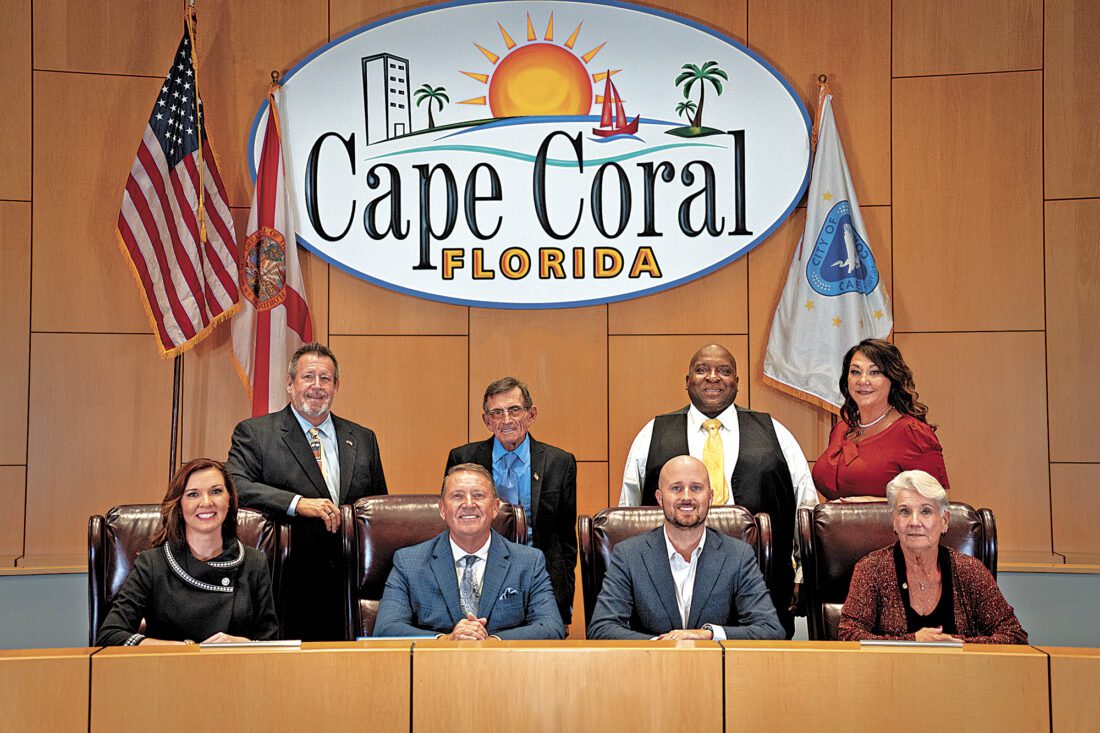
The 2024-25 Cape Coral City Council. PROVIDED
A proposed change to the city’s government structure — whether Cape Coral should move from a council-manager form of government to a strong mayor-council form — died aborning Wednesday.
With only three council members in favor of moving forward to bring the change to the ballot box, the proposed charter amendment is off the table for this election year.
A lengthy discussion was had during the council’s workshop Wednesday, as some on council shared a desire to potentially transition from to current structure — a hired manager who oversees city operations and an elected council which makes policy decisions and holds the manager it appoints accountable — to an elected mayor who oversees operations, and an elected council.
Councilmembers Keith Long, Rachel Kaduk and Jennifer Nelson-Lastra were in favor of putting the strong mayor form of government before the voters.
Council members who gave it a thumbs down said they did so because the city is in growth mode.
Long said by looking at the data, every one of the state’s larger cities adopted a strong mayor form of government before they were built out. He said the city still has much room to grow and if they build out under an executive that is directly accountable to the people, it promotes fiscal responsibility and growth.
“The whole foundation of the country is based on an elected official that is not a career administrator,” Long said, adding that the people should decide.
The presentation went into great detail of other cities — 43 strong mayor governments out of 411 cities in Florida — and their population, the year they began the strong mayor form of government, and what the city’s charter looked like.
Once the information was provided, City Attorney Aleksandr Boksner asked the council members to provide some guardrails to understand what they were comfortable with to craft a replacement charter based on an elected mayor who is responsible for day-to-day-operations.
A majority of council was not ready to go in that direction.
“For a lot of reasons, a strong mayor position is really going to compromise what this city can become and really restrict our future,” Councilmember Joe Kilraine said. “It is going to throw play over to a political partisan base and take away from a merit-based way of thinking about things. If we are turning over each election to have a political puppet and public staff in here. We are going to lose efficiency and economic benefit.”
Other council members agreed that it was not the time, as the city — third in the state in terms of land mass — is only half was to build out.
Councilmember Bill Steinke said there is still a tremendous amount of legislation that needs to be put into place as the city builds out.
“Difference between legislation and management is huge. Administrative management is a skill,” he said. “To rely upon an elective official to have that education and experience is dangerous.”
Councilmember Dr. Derrick Donnell said to replace the charter — the city’s bedrock governing document – with new one is huge and data strongly suggests at this point it is not the direction to go. He said he struggled with letting voters decide.
“What I am saying is they elected us for issues like this,” Donnell said. “They don’t have the time to dig into the details and understand the magnitude.”
Council did give a consensus to move forward with putting language on the Primary Election ballot on Aug. 18 regarding the position of mayor pro tem.
Boksner said the proposal amends the Cape Coral City Charter to clarify that the election of the mayor pro tem should be done by majority vote by the City Council at the first council meeting after the election.
The language will come before the council at next week’s council meeting to be voted upon and the other three ballot measures will come before the council at the Feb. 25 workshop.
To reach MEGHAN BRADBURY, please email news@breezenewspapers.com