
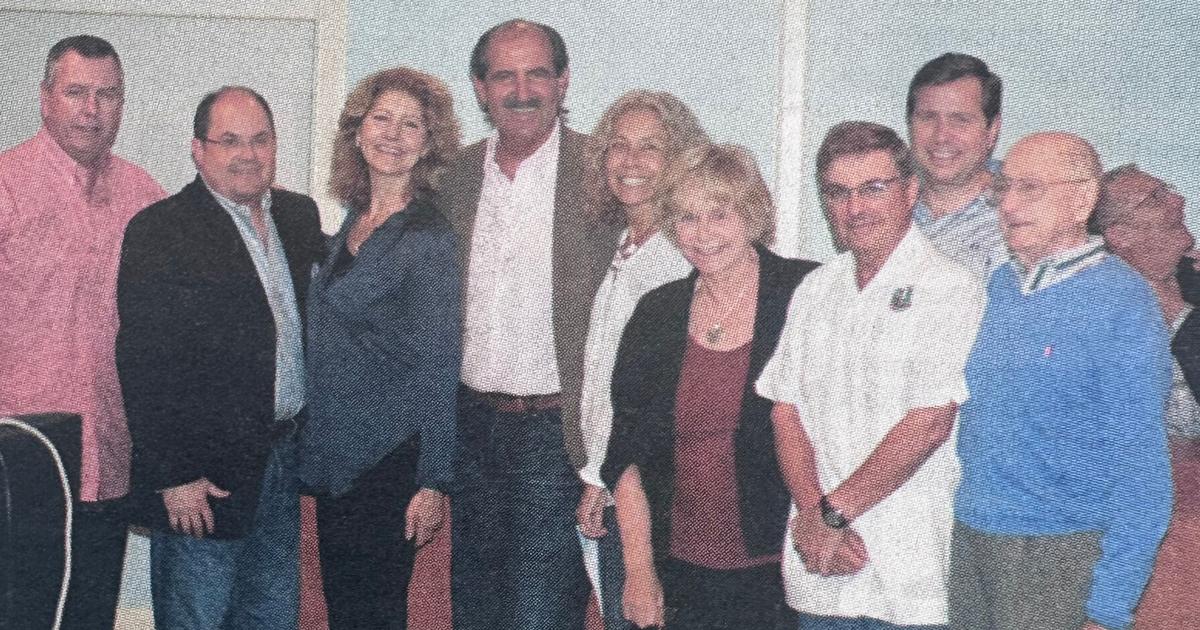
Awards of Excellence

The Key Biscayne Chamber of Commerce hosted the annual Awards of Excellence last week. Winners were, from left, Financial Services and Insurance, U.S Century Bank, Arturo Fundora; Restaurant, Boater’s Grill David Gonzalez; Fitness, Academy of Martial Arts, Robert Duzoglou; Retailer and Professional Services, Key Pharmacy, Marc Port; Healthcare and Business of the Year, Dermatology and Plastic Surgery, Dr. Susana Leal-Khouri; Media Communications and Print, The Islander News, Kelly Josephsen and Blanca Barra; and Tourism and Recreation, Mangrove Cycles, Bill Durham. Not pictured, Environmental or Innovative Practice: KB Green Golf Carts.
Bear Cut Bridge would go to four lanes under County plan
The latest Miami-Dade County plan for Bear Cut Bridge is to remove everything from “guardrail to guardrail,” including pedestrian and bike lanes, to make way for four lanes of traffic, two into Key Biscayne and two out.
The plan was crafted largely in response to concerns expressed by officials from IMG, organizer of the Sony Open tennis tournament held at Crandon Park, but Village officials say it’s also good news for the Key, as it will allow two lanes of traffic in each direction even when bridge repairs are underway.
“I can’t think of a better plan,” Mayor Frank Caplan said.
The outside lane on Bear Cut Bridge leaving Key Biscayne would remain closed except to bike and pedestrian traffic. That would allow for two lanes coming onto the Key and two lanes leaving the Key at all times even while repairs to the bridge, set to begin April 1 and last at least nine months, are ongoing.
Council to County: consider a new bridge instead of repairs
With everyone clear that something needs to be done to fix Bear Cut Bridge, some local leaders think the answer might be a whole new bridge.
Miami-Dade County officials say they will look into the suggestion, with County Mayor Carlos Gimenez telling the Village Council he’ll get more information and report back.
New bridge vs. repairs. For now, the county is moving forward with a plan to repair, not replace, Bear Cut Bridge, as County engineers estimate a bridge replacement would cost closer to $60 million.
Council member Jim Taintor broached the subject.
“I’m not so sure the direction shouldn’t be a new bridge,” he said.
Council member Michael Kelly agreed the idea should be studied. Resident Eugene Stearns, and an attorney for Sony Open operator IMG, also advocated for the idea.
“This is the chance to actually plan and build a real bridge that would provide long-term for the future,” Stearns said, stressing he was speaking as a resident, not an IMG attorney. “IMG’s problems have been solved,” he said, citing the plan to offer two lanes in and two lanes out during the tournament. “But I’ve got this little problem…that I live here. And my parents live here, and my children and my grandchildren. My grandchildren drive over that bridge every day and I don’t want to have to tell them to roll the windows down when they’re driving over the bridge. This bridge is like the heart in our bodies: if the bridge dies, we die.”
Ultimately, the Council approved a motion from Taintor to formally ask the County to “strongly consider” the option.
Option developed for new Bear Cut Bridge
Key Biscayne’s Eugene Stearns has proposed a plan for a new Bear Cut Bridge that he says would meet the area’s needs well into the future. Stearns’ concept uses elevated roadways that allow traffic to flow smoothly from the mainland all the way to Key Biscayne, while cars going to attractions on Virginia Key or Key Biscayne utilize ground-level roads.
Gene Stearns says Miami-Dade County’s planned repairs on Bear Cut Bridge are woefully misguided, instead he believes the County should be looking at a new bridge and road design that would eliminate congestion and meet modern and future needs.
“The intelligent solution would be to undertake needed bridge repairs, which could be planned and completed in literally a matter of weeks, and buy valuable time for a more complete and permanent solution,” Stearns argued in a plan he submitted to the County, which is available at saverickenbacker.com along with additional information. “I think it’s probably the most important issue that has involved our community in decades. We are the only community I can think of that has one road in and one road out and whether it works or doesn’t work is in someone else’s domain.”
According to Stearns, it can all be done under current financial realities. Even without a 25-cent Rickenbacker toll increase, the Miami-Dade County Commission passed to support the current repair plan, he said, causeway toll revenue is sufficient to support an $81.5 million 20-year bond and an $88.5 million 30-year bond. With the 25-cent increase, he added that the County would be looking at a $91.5 million 20-year bond or a $100 million 30-year bond.
Stearns notes plans to convert the Rickenbacker toll to the Florida SunPass system could take the numbers all the way to $118 million for a 30-year bond issue. With the County’s own estimates for a new bridge coming in at $75 million to $125 million, he argued the project is economically feasible, especially when one considers current trends like a solid market for municipal bond issues, historically low interest rates and low construction costs.
“We have before us an historic opportunity to modernize the Rickenbacker and we need historic leadership to make it happen,” Stearns said.
Crews filmed while residents seethed
Traffic was backed up on the Rickenbacker Causeway on President’s Day holiday while crews filmed a vehicle on the William Powell Bridge.
Honoring Officer Nelly
The community turned out in full force to honor Key Biscayne Police Officer Nelly Real.
Key Biscayne Rotarian heading up Mosquitero project
Steve Baker explains the life-saving potential of the mosquitero, an anti-malaria hammock bed net, to fellow Rotarians at a recent meeting.
Several years ago, Rotarian Steve Baker lived in Caracas, Venezuela, with his wife while she was on a work assignment. During that time, Baker had the opportunity to travel to indigenous villages in the Amazonas and Bolivar states where malaria runs rampant.
It was a life-changing experience for Baker and, consequently, for the residents of these more remote villages. Bed netting is not a new concept but the standard variety didn’t work for those villagers sleeping in hammocks.
“The standard rectangular nets are designed for people who sleep in beds or cots on the ground,” said Baker. “It cannot accommodate the ropes on a hammock.”
Baker designed a new type of mosquitero made specifically for a hammock that employs sealable sleeves through which the hammock ropes pass. At the same time, the fabric is treated with an insecticide made from a derivative of chrysanthemum flowers, deadly to insects but not to people.
“Not only do the nets create a physical barrier between the sleeper and the infected bugs, they actually kill mosquitos that come in contact with the treated net,” he said.
Whole Lotta Firepower
Former Village Council members filled the Chambers earlier this month to implore the current Council to make a bid to buy the Village’s entry block property and convert it to a public space, rather than letting it become another commercial development. Former Council members Betty Sime Conroy and Ray Sullivan spearheaded the effort; pictured are former Mayor Robert Vernon and former Council members Jorge Mendia, Pat Woodson, Luis Lauredo, Michele Estevez, Sime Conroy, Enrique Garcia, Thomas Thornton and Mort Fried.
For the last Islander Throwback, click here.