
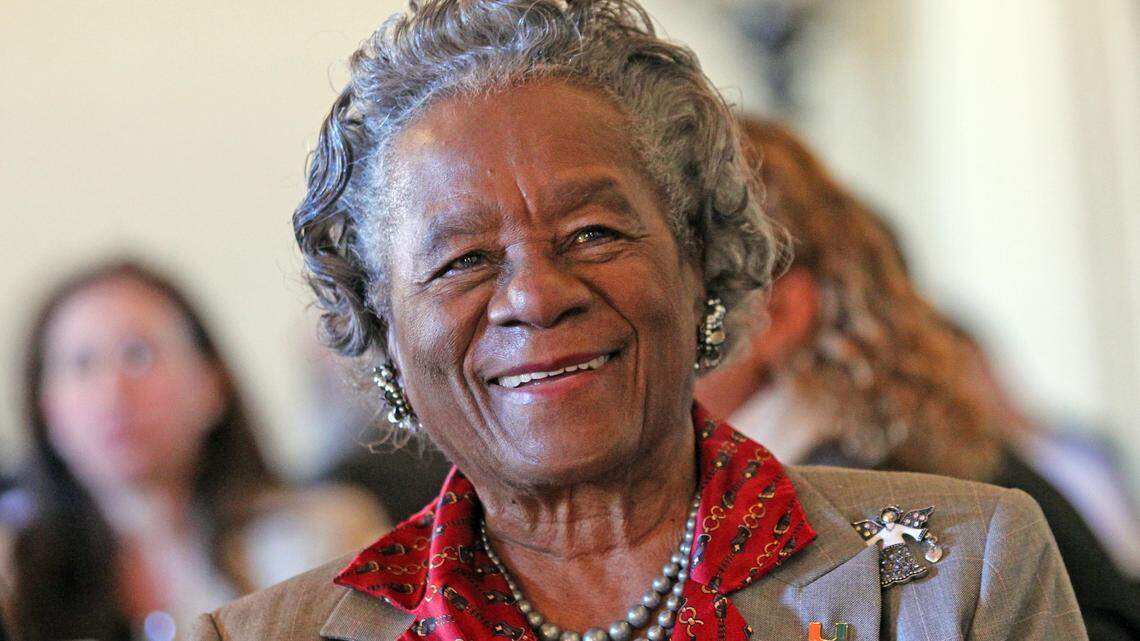
Thelma Gibson at the Women’s Chamber of Commerce of Miami-Dade at the Biltmore Hotel on January 23, 2014.
Al Diaz
Miami Herald Staff
Miami is better off because Thelma Gibson lived here.
A statement from her family after her death earlier this week called her “a community champion,” and she was. She was also a nurse and a businesswoman and a longtime Coconut Grove leader and the matriarch of her family.
And, importantly, Thelma Vernell Anderson Gibson was a civil rights advocate who improved Miami-Dade County. She died on Feb. 11 at 99.
Her influence was wide. Some people called her the “godmother of Coconut Grove,” and if anyone deserved that title, it was Gibson. She was born in the Grove in 1926 and grew up on Charles Avenue before she left home at 17 for nursing school, starting her on a life of service. She was among the first Black nurses at Jackson Memorial Hospital. She eventually became the first Black assistant supervisor of nursing in the Dade County Health Department.
With her husband, the late pastor and activist Theodore Gibson — a pioneer of desegregation who led the effort to integrate our public schools — she worked for the rights of Black people. She also founded the Thelma Gibson Health Initiative, a nonprofit to improve health outcomes and offset the effects of poverty, literacy, and other health and community challenges.
After the death of her husband, she continued her work helping others. She started the Theodore Gibson Memorial Fund to help connect the diverse communities in Coconut Grove. The fund has led to the opening of the Gibson Plaza Community and Educational Center, a senior living facility. As well as creating a youth-focused STEM education initiative.
Gibson was a force in the community, and she left her mark, advocating for causes including healthcare, affordable housing and preserving Black history and the heritage of Coconut Grove residents.
Gibson worked with the Coconut Grove Local Development Corporation to ensure affordable housing was built. She also worked to create youth programs and revive the Coconut Grove community. Her work helped preserve Black heritage of Coconut Grove, also known as “Little Bahamas.”
Gibson was also committed to making sure women joined forces for a shared purpose. In 1984, she founded the Miami-Dade Women’s Chamber of Commerce. “We’re going to have a women’s chamber of commerce, and it’s not going to be just Black women. It’s going to be Black and White and Hispanic that’s how we started the Women’s Chamber of Commerce of Dade County,” Gibson told CBS News.
Last December, Gibson celebrated her 99th birthday and told the Miami Herald, “The fact that God let me live this long is all that I’m really thankful for and the fact that I’ve been able to do whatever I could to help make change take place. But recognition is not something I’m looking for.”
Gibson may not have been interested in recognition, but it found her. Commissioner Raquel Regalado issued a proclamation declaring Dec. 19 Thelma Gibson Day in Coconut Grove to honor her service to the community.
We recognize her, too. For nearly a century, Gibson worked as a community advocate, pioneer and trailblazer in South Florida. Never waiting for permission, she advocated for the things that mattered, like inclusion, opportunity, access to healthcare, civil rights and standing up for what you believe in.
Gibson didn’t seek accolades, but she surely deserves them. She moved this community forward, always leading by example — and Miami is better for all of us because she did.
BEHIND THE STORY MORE What’s an editorial?
Editorials are opinion pieces that reflect the views of the Miami Herald Editorial Board, a group of opinion journalists that operates separately from the Miami Herald newsroom. Miami Herald Editorial Board members are: opinion editor Amy Driscoll and editorial writers Isadora Rangel and Mary Anna Mancuso. Read more by clicking the arrow in the upper right.
What’s the difference between an op-ed and a column?
Op-Eds, short for “opposite the editorial page,” are opinion pieces written by contributors who are not affiliated with our Editorial Board.
Columns are recurring opinion pieces that represent the views of staff columnists that regularly appear on the op-ed page.
How does the Miami Herald Editorial Board decide what to write about?
The Editorial Board, made up of experienced opinion journalists, primarily addresses local and state issues that affect South Florida residents. Each board member has an area of focus, such as education, COVID or local government policy. Board members meet daily and bring up an array of topics for discussion. Once a topic is fully discussed, board members will further report the issue, interviewing stakeholders and others involved and affected, so that the board can present the most informed opinion possible. We strive to provide our community with thought leadership that advocates for policies and priorities that strengthen our communities. Our editorials promote social justice, fairness in economic, educational and social opportunities and an end to systemic racism and inequality. The Editorial Board is separate from the reporters and editors of the Miami Herald newsroom.
How can I contribute to the Miami Herald Opinion section?
The Editorial Board accepts op-ed submissions of 650-700 words from community members who want to argue a specific viewpoint or idea that is relevant to our area. You can email an op-ed submission to oped@miamiherald.com. We also accept 150-word letters to the editor from readers who want to offer their points of view on current issues. For more information on how to submit a letter, go here.