
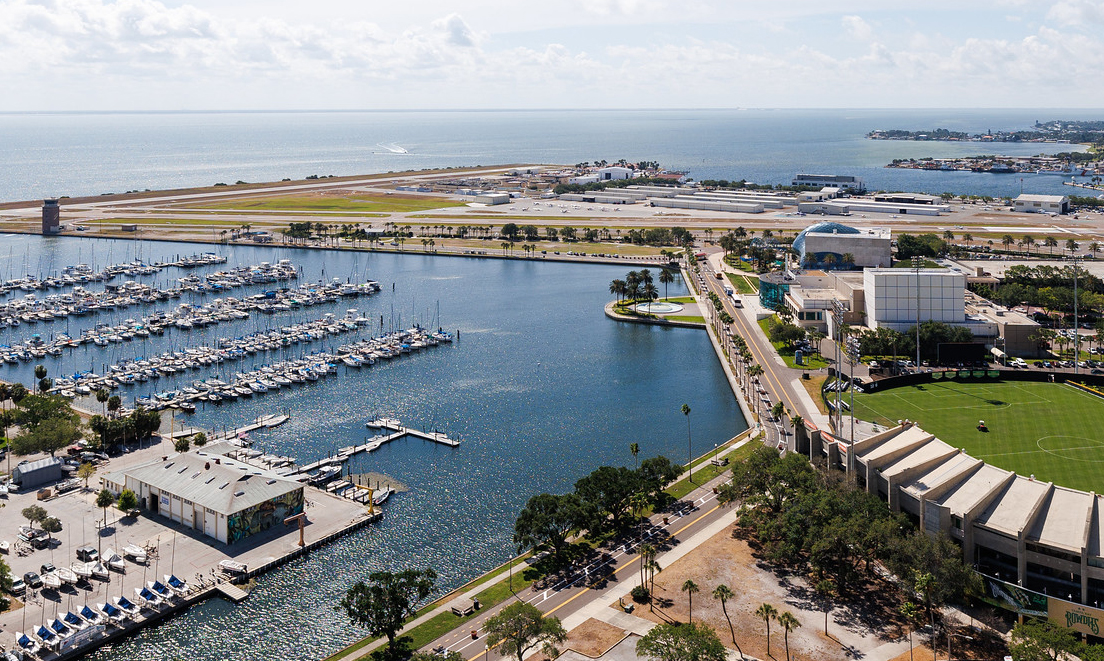
The City of St. Petersburg is conducting an empirical study of its seawall, looking for places where it is critically deficient or near failure. The task, spearheaded by director of engineering and capital improvementsBrejesh Prayman, will inform the repair and future guidelines of over 600,000 linear feet of concrete comprising the wall. This stout lip of concrete is what keeps our city from submerging.
Only about 80,000 feet of that wall falls under the purview of the City. Another 20,000 feet is owned by the federal government, the state or the county. The lion’s share – more than 500,000 feet – is privately owned.
Even if the city builds up its most critical areas, private owners – who are beholden to keep their walls structurally sound – may be a chink in the city’s armor. Prayman said the study will not involve inspecting private seawalls, but he expects the conversations and guidance that come out of it will help residents deal with their own.
The report is not finalized yet. “There are deficient walls throughout the city,” Prayman said. “A deficient section might be 10 feet in a 100-foot section. The whole section doesn’t necessarily need to be replaced.”
But which areas of the seawall, were they to fail, would most risk residents? “Anywhere we lose the wall, we risk losing services to people in that area,” he said, explaining that emergency access routes, wastewater concerns and other infrastructure will help determine where the city invests first.
That hierarchy is still being hammered out.
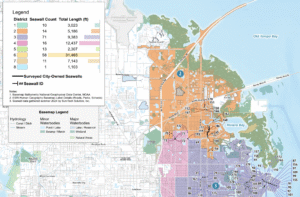
Seawall master plan map. Image: City of St. Pete.
Right now, there is no notion of what revamping the seawall will cost. Prayman said the city is “still digesting all the detail.” The objective of the program is to develop a plan and prioritization – then go after the funding. Penny for Pinellas is currently the only dedicated funding source for seawalls. The city could pursue state or federal grants, but only for city-owned sections (i.e. only 80,000 feet).
Meanwhile, sea level rise is making yesteryear standards look quaint. St. Petersburg has tide data going back to the late 1940s, collected from a NOAA tidal buoy. According to Prayman, the extreme high tide in the 1960s and 1970s is still lower than the extreme low tide now.
To wit: we are trending toward a consistently higher tide. Whatever standards are put in place, they not only need to address the tidal highs of today, but consider those of the future. Anyone still entertaining a seawall height from the past will want to measure up a bit more for posterity.
Depending on the area, a different solution may be effected to best insulate the city from disaster – from textured concrete finishes meant to facilitate barnacle and marine growth to softer, natural shorelines. “The different solutions will be based on site conditions,” Prayman added.
Major waterfront stakeholders like the Mahaffey Theater, the Dalí Museum and the Vinoy are part of the same conversation, but Prayman said they are not getting special treatment. The decisions will be based on “purely empirical analysis of criticality of risk to overall public.”