
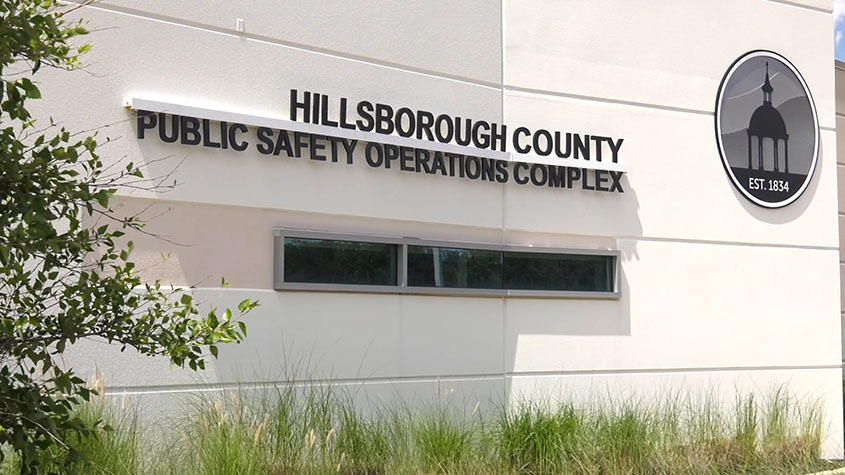
Public Safety Operations Complex Sign, courtesy of Hillsborough County’s media kit. Feb. 2026
Listen:
Hillsborough County announced in December an increase of lithium batteries in the County’s waste stream.
The increase is leading to what the county calls “hot loads.” These are battery-induced fires that occur when batteries are compressed with each other in garbage and recycling trucks.
The compression creates a spark. Then, the spark leads to a fire.
“We have all this flammable material like paper and plastics in the back of a truck,” explained Daniel Gallagher, project manager with Hillsborough County. “It’s a recipe for a major disaster, and so it can be really scary and dangerous for these drivers, our infrastructure and the community.”
Over the last three years, the county has recorded 30 battery-induced fires. Fifteen of those happened in 2025 alone. Officials expect the trend to continue growing.
According to Gallagher, battery-production is a booming industry. He says the industry was worth about 20 billion in dollars in 2020. By 2024, that amount had doubled.
For this year and the next, it is expected to be around 70 billion.
Lithium batteries are found in common items like household appliances, e-bikes, laptops and phones. These devices carry rechargeable batteries with lifespans of three, five and seven years.
What is the campaign about?
Hillsborough County partnered with neighboring counties to launch the website TampaBayRecycles.org, where residents can easily find collection centers and proper disposal information.
Hillsborough offers five centers that open six days a week. There, residents can turn in their batteries for free by showing their photo ID. The centers ask for batteries to be turned in Ziploc bags with tape in the terminal ends. This avoids the batteries from entering into contact with each other. They also accept devices without the batteries removed.