
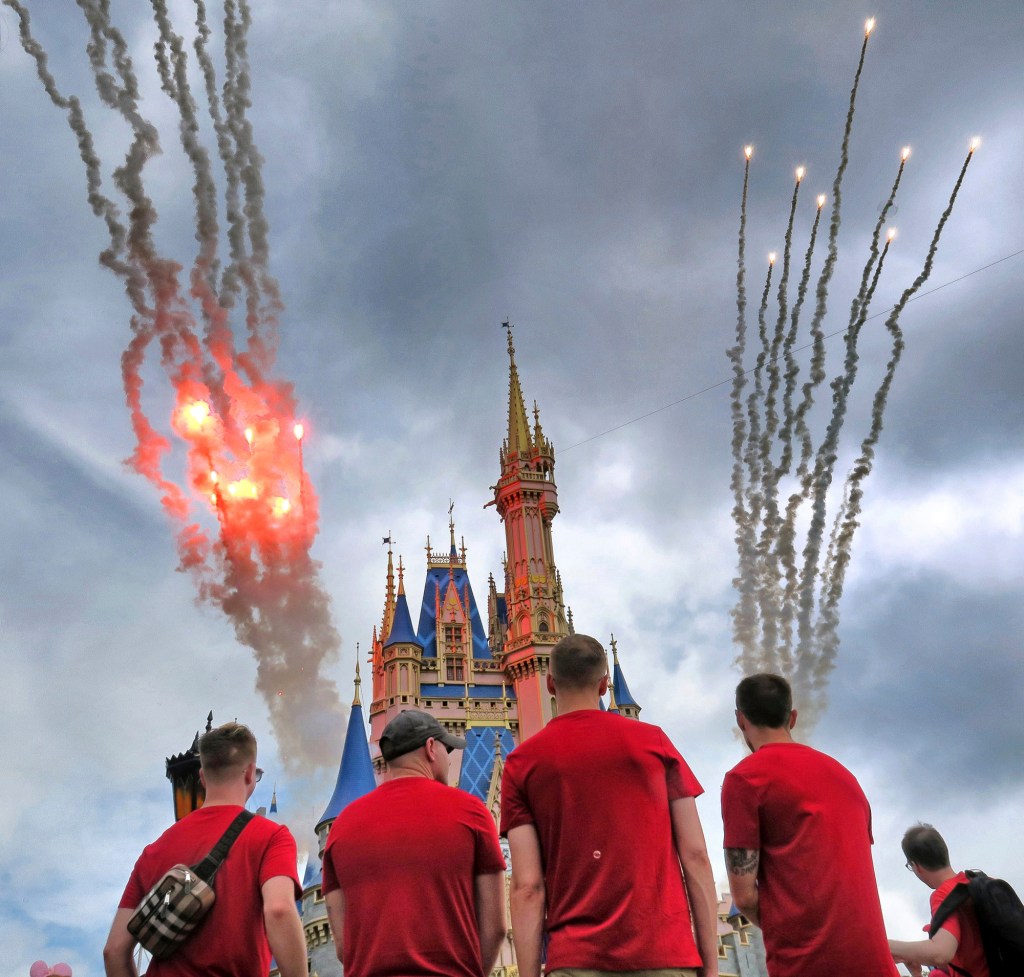
The first weekend of June again will feature red T-shirts and multiple festivities for the LGBTQ community despite the absence of the GayDays Orlando group, longtime event organizers say.
GayDays recently announced that plans for its parties are “on pause” for 2026. Some people may confuse GayDays Inc., an event promoter, with the more generic “gay days” terminology that casually and collectively refers to all planned activities for the weekend, including the traditional gathering at Magic Kingdom theme park. All those events are still planned for this year.
“We’ve been trying to communicate what’s going on for 20-plus years — that we are not the same party,” said Ethan Suarez, producer of One Magical Weekend. “We are a different party, and we’re a separate event. … I’m very used to the confusion all the time.”
His One Magical Weekend presents gatherings such as pool parties, DJ-driven dance parties, a drag brunch, a vendors expo and a nighttime outing to Typhoon Lagoon, a Walt Disney World water park. Last year, it drew about 10,000 participants, Suarez said, and ticket sales for the 2026 event are ahead of last year’s pace.
“Our host hotels are almost sold out,” he said. “We were already announcing our DJs. We were announcing our party themes. We start planning over a year in advance of our next year. So we’re deep into production.”
Orlando Gay Days ‘paused’ this year as sponsors bailed, group says
Alison Burgos is a co-founder of the Girls in Wonderland, a four-day event covering that June weekend. There is some confusion online about the status of this year’s events, given the GayDays announcement, but she feels her clients — predominantly women — are aware that the organizations operate separately.
The Girls in Wonderland events will be at multiple International Drive venues with themes such as Sapphic Safari, Space Cowboy and Love Island.
The gay day phenomenon dates back to a single day in 1991, when online friends agreed to meet at Magic Kingdom. They wore red shirts to help them spot one another. Its popularity grew, extending to additional days and theme parks and packed crowds at Mannequins, a now-closed nightclub at Disney’s Pleasure Island.
The gatherings were not official functions of the attractions. Eventually, local nightclubs threw related parties and independent promoters started bigger events, for a price, at hotels and parks, drawing international audiences.
“The informal tradition of guests visiting the parks and wearing red is a community-driven gathering and is not produced or managed by GayDays Inc.,” the organization’s website says, acknowledging that gay days is more than GayDays Inc.
Burgos, whose South Florida-based Pandora Events company organizes events for lesbians, recalls attending the Magic Kingdom gathering as a patron years ago.
“We were at Disney, walking around, and people saw us and knew that we held parties in Miami, and girls were walking up saying, ‘Oh, my God, are you guys doing a party?’” she said.
“It was that light-bulb, epiphany moment. We looked at each other like, ‘Wow, we need to do a party,’” Burgos said. This year is 26th edition of Girls in Wonderland.
In the announcement about this year’s GayDays pause, owners said a loss of sponsors and other broader, nationwide challenges were at play.
“Over the past few years, many organizations have taken a more conservative approach to sponsorships, travel, and discretionary spending,” GayDays co-owner Josh Duke said in an email to the Orlando Sentinel recently. “That shift has affected community events across the country — and not just LGBTQ+ events, but festivals, conferences, and large gatherings in general.”
Suarez says that two previous sponsors — both alcohol companies — of One Magical Weekend pulled out this year, pointing to budget cuts.
The current geopolitical atmosphere also creates challenges, he said.
“There is, every once in a while, in our comments, ‘Oh, well, we’re not going to Florida. Come to California, where it’s more liberal,’” Suarez said. “What I say to those people is that, well, there are queer people that live in Florida. We have to stand up and take action and show that we are here and we’re not going anywhere.”
Florida is “a red state right now,” Burgos said. “And the industry itself, I think, is having a few challenges. But now more than ever, things like One Magical Weekend and Girls in Wonderland and pride festivals are important, making sure we have safe spaces for the LGBT community to celebrate — and celebrate with joy in a safe place.”
The weekend has always evolved with ownership, cultural and lineup changes.
Relatively new to the scene is Pride Cup, athletic competitions organized by the non-profit KindRED Pride Foundation. Sports include basketball, kickball, pickleball, soccer and volleyball.
“We are looking forward to having over 1,000 athletes this year,” said Burgos, who serves on the KindRED board.
A broader array of activities shows the willingness to appeal to more people, said Ed Salvato, a New York-based LGBTQ marketing specialist.
“I do think there’s a lot of room for growth and change in many of the LGBTQ brands that are out there,” Salvato said. “If you want to survive in this crowded, competitive marketplace, you have to keep inventing yourself and creating value for your customers and potential customers.”
In its fourth decade of existence, Orlando’s gay days remain in the zeitgeist, Salvato said.
“This is a very important historical event, but it’s also a relevant event,” he said. “Part of that is attributed to that broad acceptance. It’s not just rich, gay, white men. Really, everyone.”
And with an uptick of gay and lesbian people with kids, a family-friendly theme-park atmosphere is appealing.
“They feel very comfortable going there,” Salvato said. “They probably went themselves when they were kids.”