
Broward School Board members are seeking outside legal advice on whether they can claw back bonuses that high-paid administrators received from a voter-approved referendum.
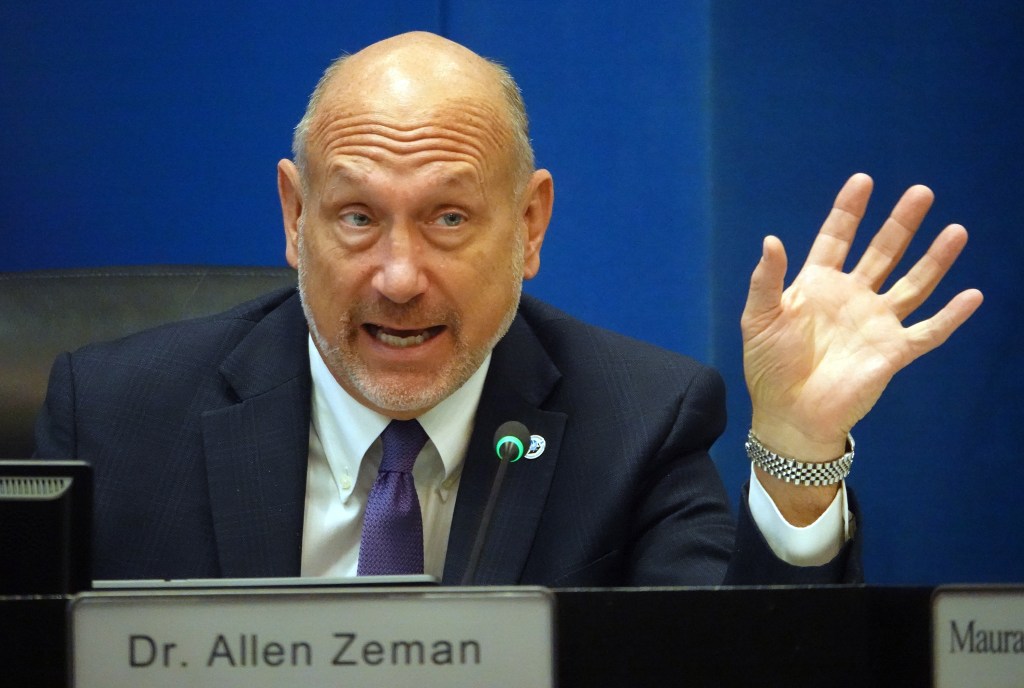
It’s far from certain that the School Board has the votes to seek reimbursement, even if a lawyer says it’s legal. But board members say they need to understand their options, after School Board member Allen Zeman said he plans to bring a formal request at the March 10 to require any employee still working for the district to repay the bonuses.
The School Board voted Jan. 6 to stop future payments, and they asked the district’s chief auditor, Dave Rhodes, to conduct a review, which the School Board discussed on Tuesday.
The referendum, which was approved in 2022, must be renewed in November, or the dollars go away. Zeman told the School Board that while the referendum easily passed with Broward voters the last time, he’s worried this controversy may hurt the chances of passage this year.
“Not recouping that money means you are now going from a 60% referendum that passed in 2022 to an unknown number that no doubt will be less than 60% this year, and I’m not willing to take that risk,” Zeman told the board. “And I don’t think anyone who got that money wants us to take that risk.”
The money in question is about $500,000 paid collectively to about three dozen senior administrators from a 2022 referendum that was pitched as a way to provide supplements to teachers and lower-paid staff to help them afford to live in South Florida.
In 2023, the School Board voted to provide fixed annual supplements for teachers of up to $12,000, as well as supplements equal to 5.5% of annual pay for most other employees. That year, the School Board voted to exclude the highest-paid employees.
But the School Board took action in July 2024 that resulted in the supplements being expanded to everyone, regardless of their salaries or job classification. About three dozen employees, including some making more than $200,000 a year, started collecting annual supplements ranging from $7,761 to $14,612, following the 2024 vote.
Some current School Board members say they had no idea that’s what they were approving, due to unclear language in an agenda item, although some former board members told auditors they were aware that all employees would benefit.
Board member Rebecca Thompson said she didn’t support trying to claw back the money already paid.
“I think it is clear that this board should be required to craft language or craft a policy … to make sure that this never happens again,” Thompson said. “However, it happened because the board approved it. Point blank. I’m not in favor of forcing employees to pay back money that the board approved.”
Leonardi, who proposed seeking the legal opinion, said she agreed with Thompson. However, she wanted to seek legal advice after learning about Zeman’s plans, which he shared with the South Florida Sun Sentinel last week.
“I don’t feel comfortable voting on that item without clear legal guidance on whether or not that is allowed,” Leonardi said.
She said she wanted to seek the advice of outside lawyers, because the lawyers who are district employees received referendum supplements.
“I don’t mean this as a slight to our general counsel or our staff, but I don’t think that the public would be satisfied with someone who has received those funds weighing it on whether or not they should be forced to pay those funds back,” Leonardi said.
Kathelyn Jacques-Adams, the district’s interim general counsel, told the School Board she would reach out to an outside law firm that specializes in labor and employment issues.
The School Board rejected a request by Board member Adam Cervera to hire an outside law firm for another reason — to review the incident and determine who was responsible.
The audit determined that district staff was not transparent when seeking approval for the expanded pool of referendum recipients, but it didn’t blame anyone specifically.
“We have to have accountability here,” Cervera, who was not on the School Board when the bonuses were approved, said at the meeting. “If we don’t get to the bottom of this and find out who was told what or who said what, the public is not going to trust us in November with this.”
His motion died due a lack of a second. Leonardi said she felt it was unnecessary because the board already agreed Jan. 6 to refer the matter the county’s Office of Inspector General, which can conduct a more thorough investigation.
“The OIG has more authority to compel testimony and things like that than an outside counsel would,” she said.
The School Board also voted to direct Superintendent Howard Hepburn to implement recommendations from the chief auditor’s report. Hepburn said he’s already doing that. The recommendations are:
— Set clear eligibility rules that specify which positions qualify for referendum-funded supplements, what salary thresholds apply, and which roles are not eligible unless the board explicitly approves their inclusion.
— Require board approval for any changes to those eligibility rules, including adding or removing employee groups, adjusting salary levels, or changing how eligibility is interpreted.
— Document all changes and decisions related to referendum allocations, including drafts, redlines, version histories, authorship, and meeting notes, with proper retention to ensure a full audit trail of the actions taken.
— Hold a public briefing workshop before the board sees any major change, such as adjustments affecting salary bands, eligible groups, or compensation amounts, with clear explanations and a pronounced rationale.
— Develop processes to ensure that all staff follow this policy and maintain the documentation, transparency, and briefing practices required. No referendum-funded supplements should be issued contrary to the eligibility criteria and governance standards established by the board.