
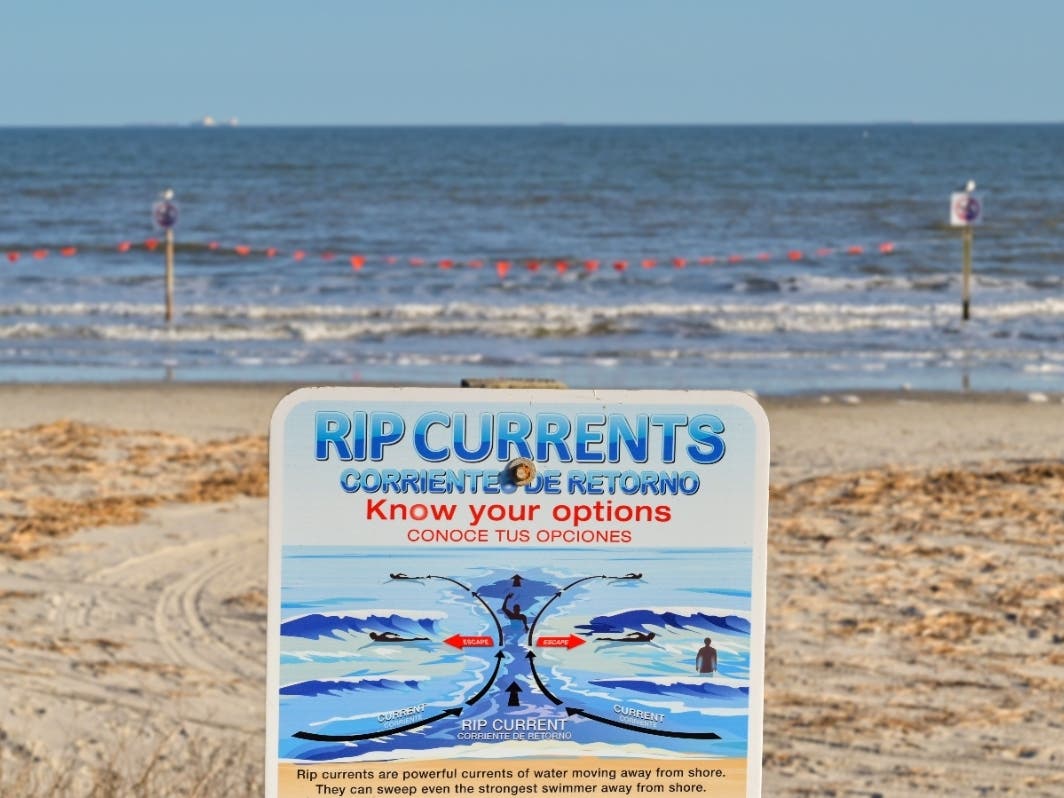
The National Weather Service is warning beachgoers in several Florida counties to exercise caution due to an elevated risk of dangerous rip currents.
Starting Sunday afternoon through late Sunday night, a rip current statement is in effect for Pinellas County, as well as coastal Hillsborough, Manatee, Charlotte and Lee counties, according to the National Weather Service.
“Rip currents can sweep even the best swimmers away from shore into deeper water,” NWS forecasters warned.
How To Spot A Rip Current
According to the National Weather Service, rip currents are strong, narrow, seaward flows of water that extend from close to the shoreline to outside the surf zone. They are found on almost any beach with breaking waves and act as “rivers of the sea,” moving sand, marine organisms, and other material offshore.
While officials say the best way to avoid getting caught in a rip current is always to swim near a lifeguard, a lifeguard may not always be available. The key to safety is understanding what a rip current is and how to spot one. The following list provides tips on how to best spot rip currents:
Spotting rip currents from an elevated position overlooking the beach is much easier. This might be from a parking lot, beach access, sand dune or headland.Channelized rip currents are the easiest to identify as they typically appear as darker, narrow gaps of water heading offshore between areas of breaking waves and whitewater. They can appear as darker paths heading out through the surf, so look for gaps in the lines of breaking waves.Look for narrow regions of choppy, rippled water heading offshore. Waves moving toward shore may steepen due to opposing offshore rip current flows, leading to a different surface water texture.Look for plumes of sand or foam offshore of the breakers, often moved away from shore by rip currents.Some types of rips, such as flash rips, can appear as narrow sections of turbulent whitewater heading offshore.Wear polarized sunglasses to help identify contrasting colors in the water — deep rip current channels stand out as darker water.Ask a lifeguard if there are any rip currents and to point them out for you.
Check out this National Oceanic and Atmospheric Administration video on spotting a channelized rip current. See photos of examples of rip currents.
How To Escape A Rip Current
Here’s what National Weather Service officials say swimmers should do if they find themselves caught in a rip current: