
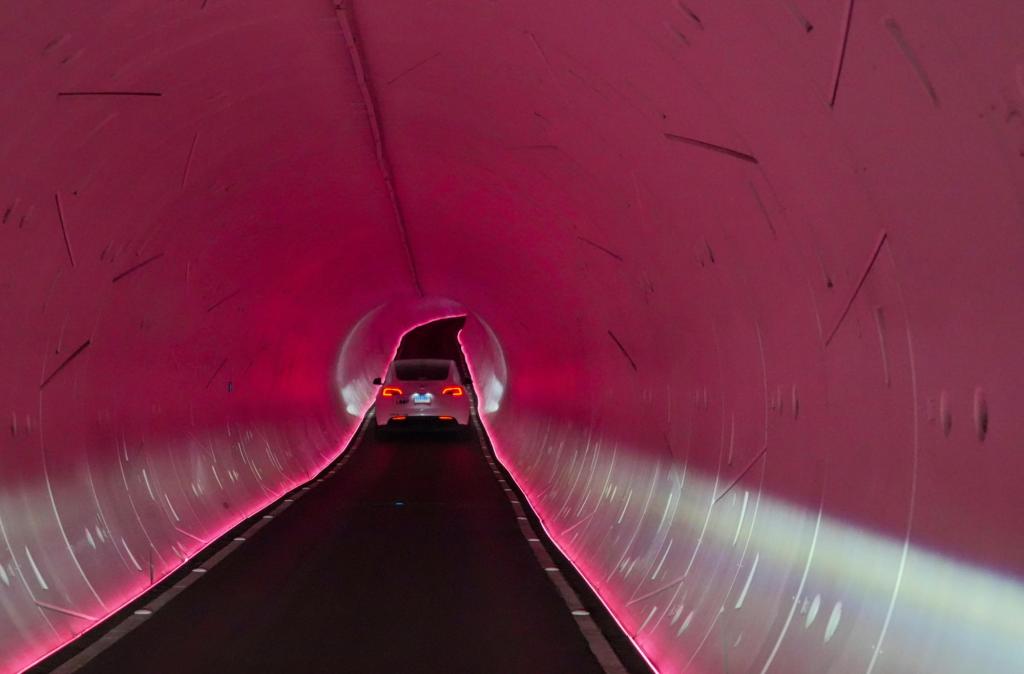
Billionaire Elon Musk’s The Boring Company touted its network of Las Vegas tunnels carrying Tesla vehicles as it sought a lead role in Universal Orlando’s transit future, offering insights into what theme park attendees may one day use to travel among the company’s attractions.
The pitch appeared to impress a board planning a transportation project linking Universal’s parks and hotels.
At a Wednesday meeting, the panel favored The Boring Company over two competitors, one of which expressed concerns about the practicality of drilling tunnels in Florida, according to public records obtained this week by the Orlando Sentinel.
Boring’s presentation didn’t reveal specifics of what it would build in Central Florida, but it highlighted its Las Vegas Loop system as proof of its capabilities.
If such a system were in place at Universal, theme parkgoers would enter a station, hop into a Tesla Model Y or Cybertruck and zoom through an underground tunnel, exiting through a side tunnel once they get to their destination. Boring boasted that its Vegas Loop can transport more than 4,400 passengers per hour with a 70-vehicle operating fleet and three stations.
Future model vehicles could be added, including the Robovan designed for up to 20 people.
The Loop system has been a hit with some Vegas visitors, but it’s also drawn scrutiny from Nevada lawmakers who have raised concerns about alleged workplace safety and environmental violations. The company’s proposed projects in some other cities, including Fort Lauderdale, have not come to fruition, but it is currently embarking on new endeavors in Nashville and Dubai.
For now, guests at Epic Universe can travel between the new park which opened in May and Universal Studios, Islands of Adventure and the adjoining City Walk entertainment district only by car or dedicated buses. Universal Studios and Islands of Adventure are adjacent to one another and visitors can travel between them on foot or aboard the Hogwarts Express, a Harry Potter-themed train.
Planning documents obtained by the Sentinel specify that the Shingle Creek Transit and Utility Community Development District (CDD) would own the new transit system linking Universal’s properties. Once negotiations are finished, the team selected for the project will be required to enter into an agreement that includes a maximum construction price and guaranteed completion date. This design, build, operation and maintenance entity will operate the system for 25 years.
It is not clear how the project would be paid for, although the CDD would have the ability to issue bonds and tax landowners to pay them off.
Elon Musk’s tunneling company tapped to link Universal parks
In a detailed request for qualifications issued last year, which was also obtained by the Sentinel, the Shingle Creek district wanted applicants to provide licensing, certification and insurance information; transportation construction experience; and other details, including whether they’d been sued or failed to complete a project within the scheduled contract time. It did not ask them to make a specific proposal for what they would build at Universal.
The district also wanted to know the total cash value of applicants’ work for 2022, 2023 and 2024.
Many portions of the replies from the prospective applicants were redacted as confidential or proprietary information in the copies of forms and documents the district provided to the news organization, which first filed a request with the district in December but only received material Thursday.
The Boring Company’s 52-page pitch contained fewer details than the other two proposals. Much of the submission focused on the company’s Vegas Loop.
Asked Friday by the Sentinel about the challenge of tunneling in Florida, a spokesperson for The Boring Company replied via email: “Tunneling under the water table is challenging, but quite common. Despite thinking of Vegas as a desert, its water table is quite shallow and 100% of TBC tunnels (and station/ramps) are submerged and thus have required comprehensive water management plans and infrastructure.”
The email also said “extensive geological and hydrological diligence/survey would be performed before completing design and certainly before beginning construction,” and said the company would work for a firm, fixed price contract, at a figure the email did not disclose.
The documents show the board reviewed two other submissions. One, spearheaded by the construction-giant ACS Infrastructure Development and autonomous-transit company Glydways, warned that tunneling in Central Florida could lead to delays, cost overruns and other issues.
“Although Glydways frequently utilizes tunneled infrastructure, based on our review of the route and local geotechnical conditions, we do not recommend tunneling for this project,” the group advised.
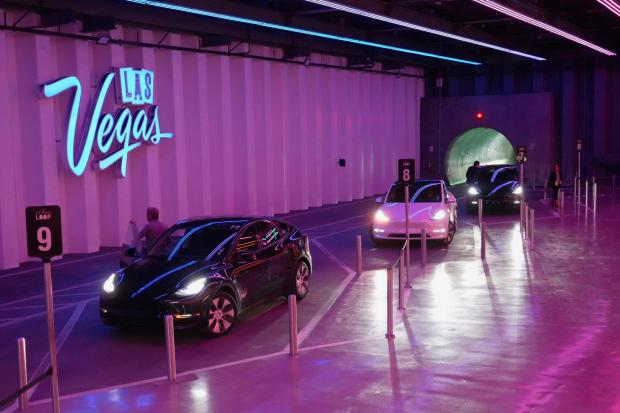 Teslas are lined up inside the Vegas Loop Wednesday, Feb. 4, 2026, in Las Vegas. (AP Photo/Ty ONeil)
The team’s 200-page response listed a variety of potential issues with tunnels, including Orlando’s unstable formations and high-water table and “legacy” pollution from surrounding sites. It noted that future expansions of a tunnel system could be costly and disruptive, and emergency responses are significantly harder underground. Tunnels are also not truly watertight, requiring drainage measures like sump pumps and creating maintenance and reliability issues, the group advised.
The plan envisioned a 6.7-mile transit system that would connect Universal’s major hubs. Passengers would travel in autonomous pods on a dedicated path that doesn’t intersect with regular traffic. The pods would operate at and above ground level.
The system projects wait times of two minutes or less for 95% of passengers.
The submission included a long list of transit projects its partners have completed. Most recently, Glydways broke ground on a half-mile automated transit network at the Georgia International Convention Center near Atlanta.
The third team that submitted a reply to Shingle Creek Transit’s request identified itself as V2R, short for Vision2Reality, a partnership led by builder Balfour Beatty. It also includes the autonomous mobility company Beep, which has run self-driving buses in downtown Orlando and Lake Nona.
Ready for an AI taxi to do the I-4 driving for you? It should be possible next year.
The group described itself in its 121-page pitch “as the same trusted partnership that successfully delivered the Jacksonville Transportation Authority’s Ultimate Urban Circulator program, one of the nation’s most advanced autonomous vehicle initiatives.”
Much of the group’s highlighted work in Central Florida has been on highway projects, including Florida’s Turnpike and the Wekiva Parkway, the tolled beltway around Orlando that features elevated sections designed for wildlife to pass safely underneath.
Its response noted, “The V2 team understands that this system must be more than transportation. It must serve as a gateway to the destination, a connector of economic opportunity and a reliable mobility option that reduces traffic impacts associated with tourism growth.”