
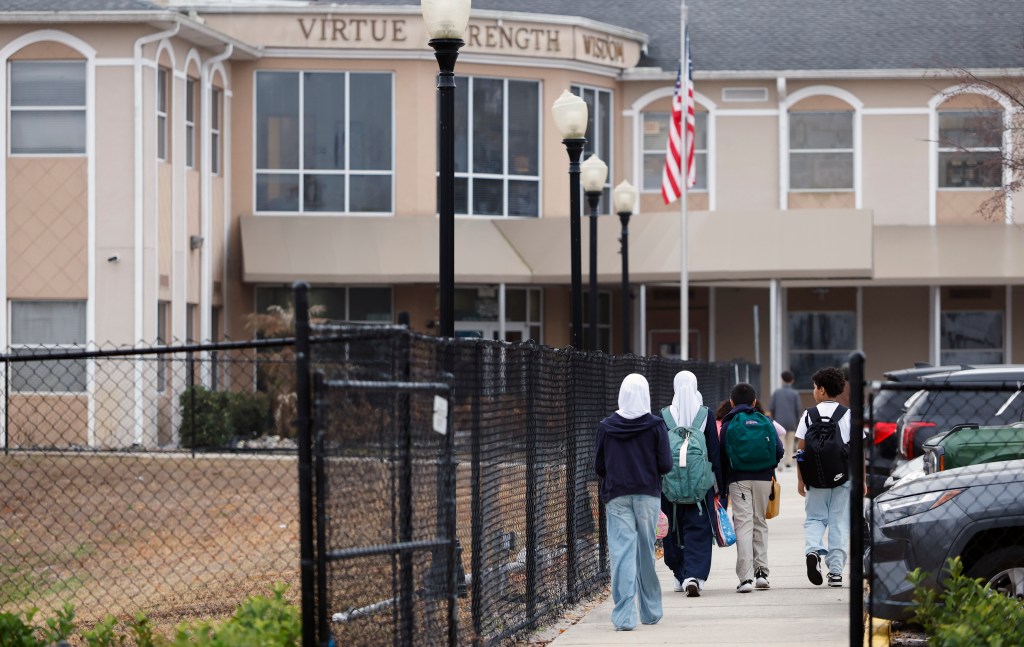
Florida lawmakers are pushing new legislation targeting groups they consider “terrorist,” but some fear the proposals will cost Islamic schools millions of dollars by cutting them out of state voucher programs.
The Republican-backed bills, which have won preliminary approval during committee sessions earlier this month, would allow the Florida Department of Law Enforcement’s chief of domestic security to designate terrorist organizations and would prohibit schools affiliated with them from receiving vouchers that pay for children to attend private campuses. The Florida Cabinet, which the governor chairs and is made up of three other statewide elected officials, would have to approve the designation.
While the bills do not single out specific organizations, the proposals mention sharia law, the duties required of all Muslims, and that wording has alarmed supporters of the state’s Islamic schools, especially as they follow comments from state leaders tying Islam generally to terrorism.
Gov. Ron DeSantis issued an executive order in December designating the Council on American-Islamic Relations, or CAIR, as a terrorist organization, writing it was created “to conceal ties to Islamic extremist groups.”
Attorney General James Uthmeier last fall posted on X that “the use of taxpayer-funded school vouchers to promote sharia law likely contravenes Florida law and undermines our national security.” Uthmeier is a cabinet member, and thus would play a role in determining which groups are considered “terrorist” organizations, if the legislation is approved.
CAIR decried the governor’s order as “defamatory and unconstitutional.” The group, which describes its role as increasing understanding of Islam and advocating for American Muslims, is sounding the alarm about the Florida bills.
“If we do not speak up now, decisions will be made for us,” the group wrote in an email last week. “Decisions that affect our children, our schools, and our right to practice Islam without fear.”
Other advocacy groups oppose the bills, too, including the Florida Conference of Catholic Bishops, the NAACP and Equality Florida, an LGBTQ civil rights group.
Florida’s voucher program is very popular, as nearly 2,500 private schools across the state received more than $2.8 billion from it during the 2024-2025 school year. Though the awards, which are valued at about $8,000 per student, were initially reserved for low-income students and those with disabilities, the program is now open to all.
Christian schools and the students who attend them are, by far, the biggest beneficiaries, according to data from Step up for Students, a non-profit organization that administers most of the program. About 69% of the nearly 360,000 Florida students who participated in the program attended Christian schools. In all, the state sent more than $1.9 billion to Christian campuses.
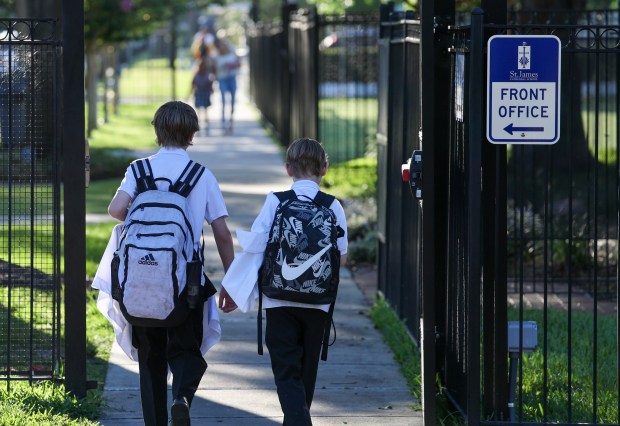 The majority of the schools that receive vouchers in Florida are Christian, including St. James Cathedral School in Orlando (Rich Pope/Orlando Sentinel).
Islamic schools make up a tiny share — roughly 1% — of the campuses that accept vouchers. Just over two dozen Islamic schools across the state, including six in Orange and Seminole counties, take the state-backed payments, educating about 6,000 students and receiving about $46 million.
Sen. Erin Grall, R-Fort Pierce, a sponsor of one of the bills, said that only those associated with groups committing crimes would be affected by the proposals.
Asked by a Democratic lawmaker why criminal activities wouldn’t be covered by existing laws, Grall said the legislation sought to ensure “the safety of the state” and treat domestic terror organizations the same as foreign ones.
“It speaks about crimes specifically in the vein of terrorism, which have a different definition than our other crimes for a reason, because it seeks to undermine, in a violent way, the laws of this state or the United States, through intimidation, coercion, affecting destruction of property. ” Grall said.
The committee voted along party lines to approve the bills.
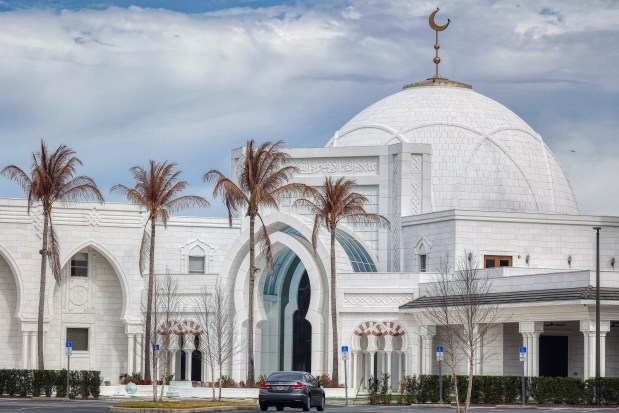 WISE Academy, which shares a campus with Masjid Al Hayy in Sanford, is an Islamic school that participates in Florida’s voucher program. (Ricardo Ramirez Buxeda/ Orlando Sentinel)
In his October social media post, Uthmeier decried the flow of tax dollars to a Tampa school that he said practiced sharia law. He shared a video showing the principal of Hifz Academy discussing the voucher program, his school’s religious teachings and the challenges facing Islamic educators.
The principal of that school, Mohamed Ahmed, testified in Tallahassee during a Senate committee meeting on Feb. 3 that the decision to label a group as a terrorist organization should not be placed in the hands of a small group of people, including some who have publicly attacked Islamic education.
“I’m telling you, we do not practice sharia law,” Ahmed said. “Please visit us to understand what is going on.”
Janet Curry, who teaches history at Hifz Academy, said she is Jewish but chooses to work at an Islamic school because of the students’ dedication to their studies and their humility. If the legislation is approved, groups could be unfairly stamped with a “partisan and secretly evidenced designation,” she said.
“It has always been education that tempers extremism of any kind, and adversely, fear and ignorance that fuel it,” she added.
But John Labriola, a lobbyist for the Christian Family Coalition, said he believes Hifz Academy is part of a mosque network that “trains children to reject American teachings,” and schools like it should not receive public money.
“Florida families should never be forced to subsidize the very ideologies that threaten their safety and this bill will stop that,” Labriola said.
The Orlando Sentinel reached out for interviews to seven Islamic schools in Central Florida that take state vouchers. None responded.
Many of the schools that participate in Florida’s voucher program enforce rules that reflect the organization’s religious beliefs. In 2020, for example, the Sentinel reported that 156 private Christian schools with anti-gay views educated more than 20,800 students with tuition paid for by state scholarships. School leaders said their rules reflected Biblical teachings.
At many faith-based schools, religious instruction is a key part of their curriculum. Some also require students and parents to sign a statement of faith upon admission.
Faith Christian Academy, founded by an Orlando church, for example, touts on its website weekly chapel and “a spirit-filled ministry to encourage students’ personal relationship with Jesus Christ.” More than 600 students used vouchers to pay tuition at Faith Christian last year, sending $5.1 million to the campus.
Similarly, Muslim Academy of Greater Orlando seeks to instill “Islamic values and morals,” and help students develop a “connection to Allah and desire to serve their creator,” according to the school’s website. Last year, the school served more than 300 students who used tuition vouchers and received nearly $2.5 million from the program.
Megan Amer, the policy director for CAIR in Florida, said she is a Catholic who married a Muslim and whose children attend an Islamic school. Many Christians would likely find Muslim values, including giving to charities and teaching children to obey their parents, similar to those found in their own faith.
Muslims are a politically diverse group, she said, making it all the more puzzling that state Republicans are targeting them. CAIR operated in Florida for 20 years without issue before it was deemed a terrorist organization, she said.
“It’s a complete scare tactic and it’s designed to divide,” she said.
While the bills — one each in the House and Senate — use a definition of terrorism already in state law, which includes activities “dangerous to human life which violate state or federal law,” opponents of the legislation say allowing relatively few people to determine if a group meets the criteria is problematic. In addition, two related proposals would exempt records concerning the decision to designate groups as terrorist organizations from public disclosure.
The bills also say that schools and colleges that “advocate for” these groups might have their performance funding withheld. Additionally, anyone who works for state-designated terrorist organizations could face felony charges.
“Equality Florida strongly opposes the overreach, censorship and unconstitutionality of this bill,” said John Harris Mauer, the group’s public policy director. “Our primary concern is the vagueness and wide sweep of this bill paired with steep felony penalties.”
anmartin@orlandosentinel.com