
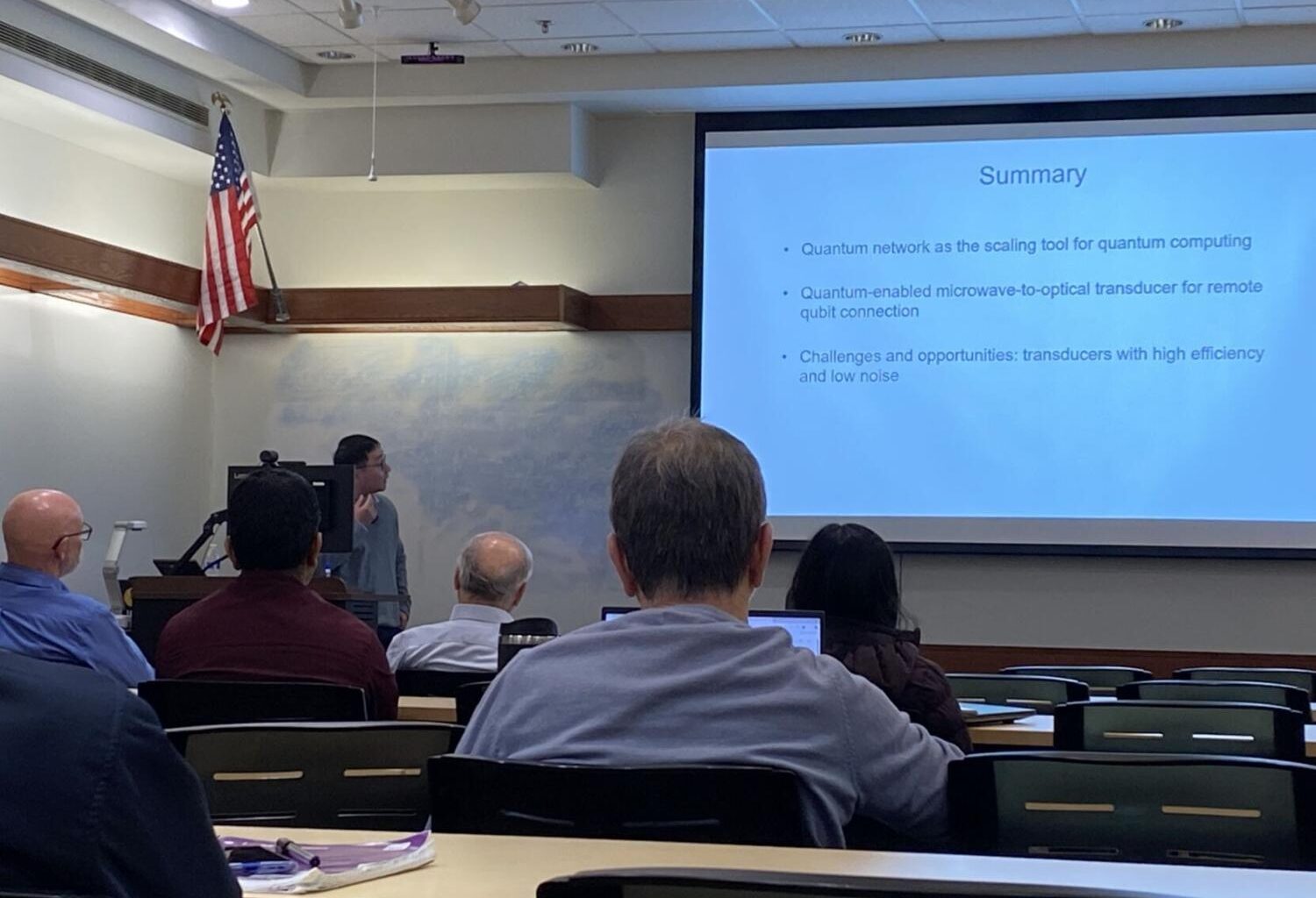

Dr. Han Zhao wraps up his presentation at the College of Optics and Photonics on Tuesday, Feb. 10. On the slide is a brief one-sentence summary of the presentation, where he explained his previous work at the California Institute of Technology and his current work in quantum networks at UCF.
Fabio Braggion
A mixture of students and faculty watched as assistant professor Dr. Han Zhao hosted a colloquium in the College of Optics and Photonics on Feb. 10.
There, Zhao spoke about his research at UCF to develop a quantum system network on campus.
“What we are trying to focus on is not the technology that has been adopted by everyone else; we want to make a new approach that has special, unique advantages that can solve some emerging problems,” Zhao said.
Zhao is a recent addition to the Department of Physics, joining the college from the California Institute of Technology at the beginning of last year. Despite his short time here, Zhao has already begun developing a lab at UCF that could house his experiments into quantum computers.
“Our current plan is basically a so-called ‘heterogeneous quantum network’. Basically, integrating superconducting qubits with photonic qubits with silicon defect centers and other kinds of quantum hardware other than superconducting qubits,” Zhao said.
A quantum computer is just like any other computer, but with a couple of noticeable changes.
It runs on qubits, which are the binary ones and zeros that other computers use, but can sometimes be in a state of both one and zero, according to an International Business Machines article. This allows for quantum computers to store more data and perform much more complex computations than an average computer.
“The problem is quantum computing has a significant amount of errors if you run it, and that is exactly because we have a limited ability to scale up the size of the quantum computer,” Zhao said.
His research on quantum system networks is trying to bypass that bottleneck by not housing all of the qubits in one large refrigerator.
Quantum computers need to be housed in a dilution refrigerator that can go down to 10 millikelvin to turn the computer on. A millikelvin is about minus 459.49 degrees Fahrenheit, about the temperature of space, according to Space.com.
Zhao said that the power and infrastructure it would take to run something like a thousand-qubit quantum computer is not worth it. It would be possible to build a thousand-qubit quantum computer by spreading 100 qubits across 10 fridges instead of housing them all in one place.
“At some point, it’s too expensive to accommodate everything in a single big fridge,” Zhao said. “For ten fridges, each fridge still costs a lot, but at least it’s something that you could do.”
This, theoretically, could bypass the bottleneck, leading to bigger and better quantum computers. But this isn’t the full extent of Zhao’s research.
“We’ll do a little bit of collaboration with other faculty members here at UCF to connect the superconducting qubits to other types of qubits, like photonic qubits that CREOL faculty members are doing,” Zhao said.
To help him with this endeavor is his research assistant and graduate student, Shantanu Chaudhary. He applied to become Zhao’s research assistant a month after Zhao came to UCF.
Originally earning his bachelor’s at the Georgia Institute of Technology, Chaudhary is working toward his master’s and doctoral degrees simultaneously at UCF. His main responsibility at the moment is to calibrate the different machines used to run the quantum network experiments.
“You need very precise materials, very precise measurements, which is mainly what we’re trying to set up right now because it’s a brand new lab; we started with literally nothing in the lab,” Chaudhary said.
Zhao explained that he just finished buying all the equipment. Now, he needs to assemble the pieces.
For Chaudhary, this is not just a lesson in quantum networks, but a crash course in setting up a lab from scratch.
“Setting up a lab is something I’ll have to do at some point, probably down the line,” Chaudhary said. “So it’s good having that experience of how to talk to a company about pricing, how to talk to other people and collaborate, and how to know what parts to order.”
As Zhao wrapped up the talk, he expressed his hope that one day he could build a quantum network at UCF using fiber-optic cables connecting different types of qubits.
Chaudhary believes that by the time that happens, he will be done with his doctorate and unable to witness it. Despite that, this is the first time he’s been able to take his knowledge of quantum theory and make it into something tangible.
“I think it’s that gratification of everything I know, I’m able to implement and be confident that what I’m learning is actually implementable, it’s not fake,” Chaudhary said. “And once you have that chip finally and you can test it and it works your like, ‘I know what I’m doing.’”