
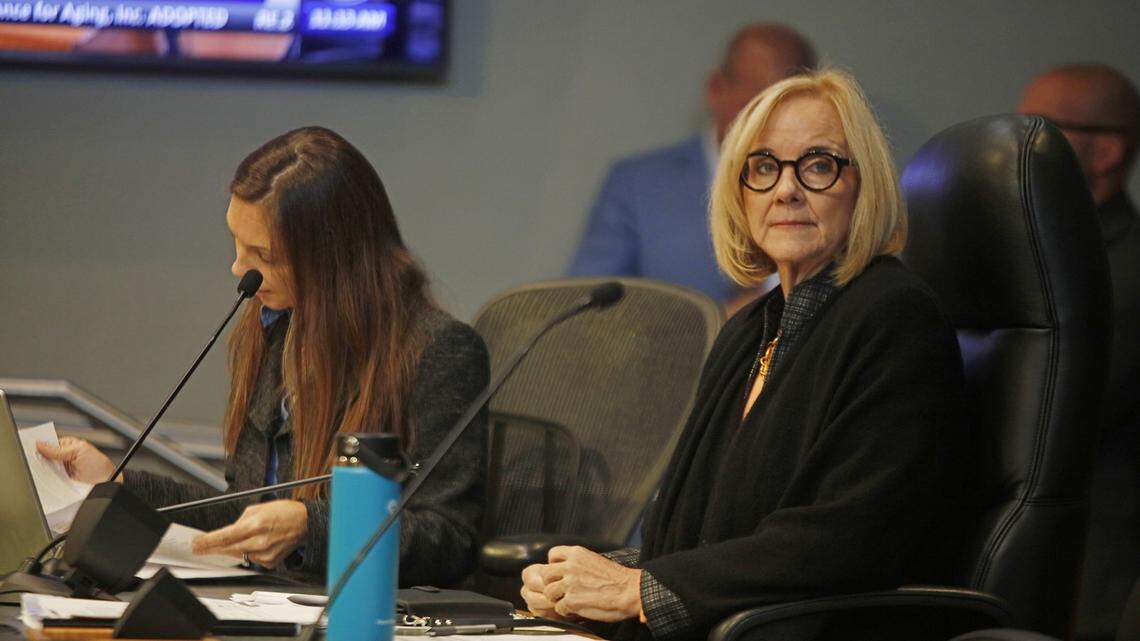
Miami Mayor Eileen T. Higgins during a Miami commission meeting at Miami City Hall on Jan. 22.
Alexia Fodere
for Miami Herald
In practical terms, Miami officials may be right not to call a vote to rescind city police cooperation with federal immigration enforcement. It’s uncertain whether they could legally do it, and they are avoiding a confrontation with Gov. Ron DeSantis, one that could end with officials being removed from office and replaced with the governor’s allies.
In moral terms, however, Miami would be showing a reluctance to stand up against the abuses of ICE under the Trump administration, especially after two U.S. citizens were killed in Minneapolis.
This is a city of immigrants, where thousands of Haitians and Venezuelans are at risk of having their legal status revoked. Ending Miami’s 287(g) agreement is the soundest move, even if so far only three police officers have been trained to perform immigration duties under the supervision of ICE.
This decision should be more than just about practicalities or how many officers are part of the program. This is about standing up for local control over communities. Resistance to DeSantis’ encroachment into local decisions and Trump’s erratic mass deportations, which have caught many migrants who don’t have criminal records, begins at the local level.
Miami Mayor Eileen Higgins won a December runoff after campaigning against the city’s involvement with ICE. She told a Herald reporter that she would approve legislation to undo the agreement the City Commission approved last summer. Higgins can sponsor legislation, but she kicked this political hot potato to commissioners, saying they should bring forward the item to leave the agreement. And none of them has stepped up to do so, the Herald reported.
“That’s their choice,” Higgins told the Herald. “They have to do that. They have to take the initiative. They voted for it. They have to undo it.”
If we were political consultants, we would tell the mayor and commissioners to keep quiet. Florida Attorney General James Uthmeier threatened Key West commissioners with removal from office after they voted to void their 287(g) agreement last year. Key West then decided to reenter the partnership. There’s also the risk that Miami could get cut off from state and federal funding.
But this isn’t only about political calculus.
The state is using scare tactics, and it’s working because few people will challenge it. Meanwhile, there’s no legal clarity on whether state law forced Miami to enter 287(g) in the first place, as the governor and others say. And no one has challenged the state’s authority to remove local elected officials from office if they revoke the agreement.
If the courts are going to settle these questions, at least one locality is going to have to balk at DeSantis and Uthmeier and then file a lawsuit. That comes with risks, of course. Court cases can take a long time and the outcome may not be in a city’s favor.
This is a mess Miami created for itself. Other Miami-Dade cities have not entered a 287(g) agreement, and it’s unclear why Miami felt it had to do it back in June, the Herald reported.
The commission approved the agreement on a 3-2 vote with the two commissioners who are Democrats, Damian Pardo and Christine King, voting against it. Then-Commissioner Joe Carollo voted for it but he’s since left office. He has been replaced by Rolando Escalona, who told the Herald he would consider cancelling the agreement if another commissioner proposed it.
At the time of the June vote, the city of South Miami had a pending lawsuit against DeSantis and Uthmeier to seek clarity on whether it was mandatory for local governments to enroll in 287(g). A judge dismissed the lawsuit because South Miami sued before it faced punishment from the state. However, the state conceded during oral arguments that the law does not require every municipality to have an agreement, as long as they don’t take a vote against it.
Whether that’s indeed the case would have to be decided in court. Until that happens, Uthmeier and DeSantis will continue to intimidate locals.
It’s understandable that Miami might not want to play with fire, but there would be no better city in Florida to take on this fight.
BEHIND THE STORY MORE What’s an editorial?
Editorials are opinion pieces that reflect the views of the Miami Herald Editorial Board, a group of opinion journalists that operates separately from the Miami Herald newsroom. Miami Herald Editorial Board members are: opinion editor Amy Driscoll and editorial writers Isadora Rangel and Mary Anna Mancuso. Read more by clicking the arrow in the upper right.
What’s the difference between an op-ed and a column?
Op-Eds, short for “opposite the editorial page,” are opinion pieces written by contributors who are not affiliated with our Editorial Board.
Columns are recurring opinion pieces that represent the views of staff columnists that regularly appear on the op-ed page.
How does the Miami Herald Editorial Board decide what to write about?
The Editorial Board, made up of experienced opinion journalists, primarily addresses local and state issues that affect South Florida residents. Each board member has an area of focus, such as education, COVID or local government policy. Board members meet daily and bring up an array of topics for discussion. Once a topic is fully discussed, board members will further report the issue, interviewing stakeholders and others involved and affected, so that the board can present the most informed opinion possible. We strive to provide our community with thought leadership that advocates for policies and priorities that strengthen our communities. Our editorials promote social justice, fairness in economic, educational and social opportunities and an end to systemic racism and inequality. The Editorial Board is separate from the reporters and editors of the Miami Herald newsroom.
How can I contribute to the Miami Herald Opinion section?
The Editorial Board accepts op-ed submissions of 650-700 words from community members who want to argue a specific viewpoint or idea that is relevant to our area. You can email an op-ed submission to oped@miamiherald.com. We also accept 150-word letters to the editor from readers who want to offer their points of view on current issues. For more information on how to submit a letter, go here.