
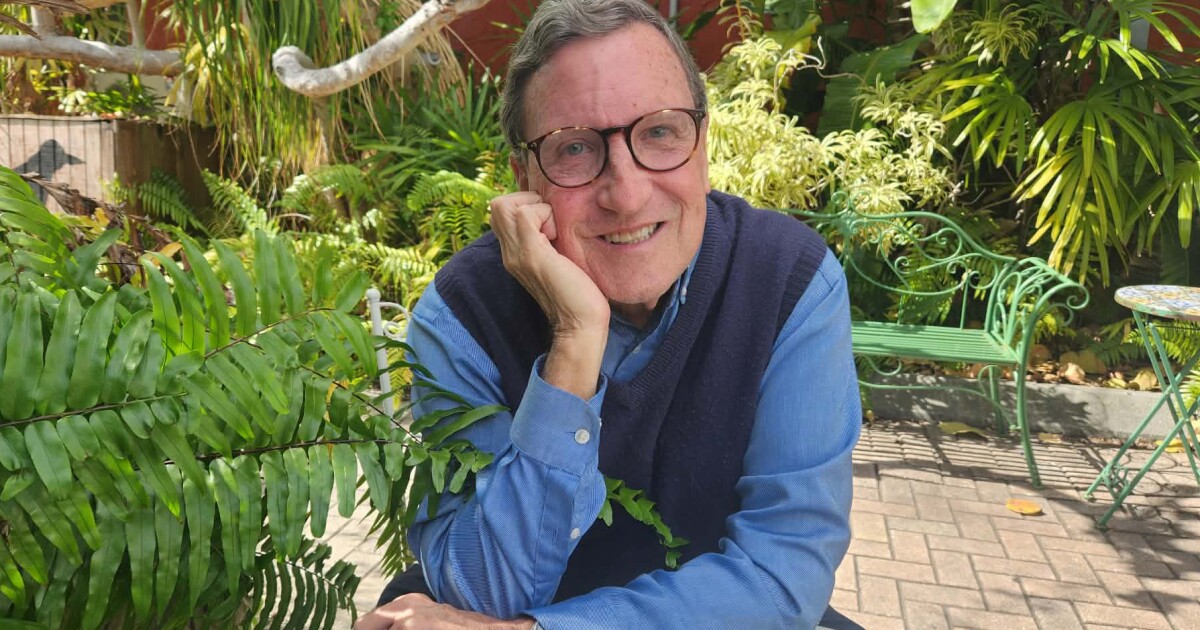
When H. Roy Adams accepted his first job at All Children’s Hospital in 1993, his wife called him out on it.
“Paula thought I was nuts,” Adams recalls. “ ‘You hate hospitals,’ she said. ‘You won’t even visit when we have friends in the hospital.’ My parents had died, and health care was not something I liked to hang around.”
Adams, however, had caught the community service bug during earlier stints at the American Red Cross and Pinellas Education Foundation.
“In the nonprofit world, in the [Tampa] Bay area, I felt like – and still to this day feel like – the No. 1 nonprofit is All Children’s,” he says. “That’s ground zero for the nonprofit world.”
Adams – his first name is Harold, but everyone calls him Roy – is retiring this month after 33 years at the hospital, which became Johns Hopkins All Children’s Hospital in 2016.
After signing on as volunteer director, he became community education and media liason. Since 2010, Adams has been senior communications specialist – any time someone from TV, online, radio or print needs anything from the hospital, they go through him.
He connects physicians and other health care professionals with the outside world, to get the messages out and the stories published. He answers questions. For many, Adams is the “face” of Johns Hopkins All Children’s Hospital.
Sometimes, however, even the most successful people just know when the time has come to explore life beyond the profession.
“I love what I do,” he explains. “So that’s the hard part. But I’m healthy – I don’t feel like I’m 68. My parents passed before they got to retire. We can travel. I can set my own schedule.”
He’s been through technological changes, staff changes and regime changes at the hospital, but never took his eyes off the prize, which is making someone (or something) else look good.
“My job,” Adams says, “basically revolves around what innovative things we’re doing at the hospital or what’s trending nationally. I get an expert, and I pitch it, and we pick up the local angle.”
In the current political climate, where health care is on both sides of the national discussion, it’s become “trickier,” he says. “Just last week, I spent the whole day last week working on measles media. …. Measles media.”
Hospitals are desperately trying to sidestep political debates. “But at the same time, our physicians want to get important medical information out. So it’s a different time.”
Wanted to sing on the morning show
Harold Roy Adams is a St. Petersburg guy, born and bred. As a kid, he remembers, his first ambition was to be a singing, smiling TV news personality, like Ernie Lee on the old WTVT morning show. He even took up the guitar to be more like Lee.
By high school, he was an accomplished drummer, playing the hits in local rock ‘n’ roll bands (he’s still something of a classic rockaholic).
Otherwise, he was aimless. At 16, Adams recalls, “I walked into Red Cross because I had a summer of nothing to do. And my handlers were concerned.”
Local Red Cross director Ernie Rose attended the family church, First Baptist. They said, ‘Have you got something to keep Roy busy, because he doesn’t have anything?’”
Adams says now he might well have wandered off the straight and narrow had he not started volunteering with the organization. He found he had an aptitude for working with the media. Soon he was tasked with leadership roles.
“I began to like it as I got involved with it. Red Cross just opened up more and more opportunities for me. To the point where, as a college student, I was appointed to a national board.”
A St. Petersburg High graduate (Class of 1976), Adams received a BA in mass communications from the University of South Florida. He married Paula in 1981 (their son Tyler, 38, is media director for Hillsborough County). They still attend First Baptist.
Between ’81 and ’88, he served as director of public affairs and financial development for the Red Cross. “I would handle everything from one-family fires – media needed to know we were there, taking care of the families – to the Bay Pines boat fire. We went in and provided a canteen for the firefighters, to make sure they had something to eat.”
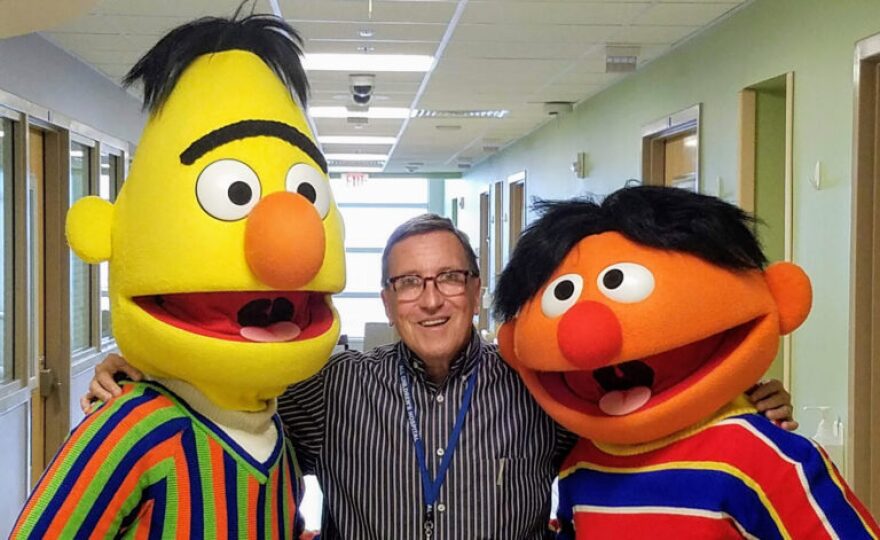
Taking guests through the hospital for bedside visits with children is H. Roy Adams’ favorite part of the job: “I get to be on the side that makes it fun.”
Adams was part of the Red Cross team that provided services for emergency workers at the Mullet Key Pier in 1980, as bodies were brought in from the Coast Guard vessel Blackthorn disaster (in January) and the Sunshine Skyway bridge collapse (in May).
By that point, it was abundantly clear than not only did he love his hometown, they were in a committed, long-term relationship. Adams wasn’t going anywhere.
“If I’d have stayed on with Red Cross, to move on in that system you would move around the country. But things just kept opening up here.”
Between 1998 and 1992, Adams worked as assistant executive director at the Pinellas Education Foundation.
‘I’ve still got the fire in my belly’
He came to All Children’s in the days of beepers and fax machines, stayed, adapted and thrived through the arrival of the internet and cellphones, through changes in protocols and laws and new buildings, the name change – and even the occasional controversy.
Adams also became the liaison between sports and show business visitors and the kids in the beds. Coordinating these floor-by-floor visits has been a regular part of his job for decades.
“When I walk into the room with either a sports hero or Spider-Man, and the little kid lights up, that’s my life at the hospital,” he declares. “When I accepted the job, I remember asking, “Is it going to be a depressed atmosphere? Is there a lot of dying?’ I was afraid every day was going to be sad.
“And it’s just the opposite. So many of the kids go home and do well, or they’re able to cope with what they had … the holidays here are a blast. And I get to be on the side that makes it fun.”
He is a past president of the Rotary Club of St. Petersburg and the Florida Association of Directors of Volunteer Services, and a graduate of Leadership St. Pete.
Post-retirement, Adams will be working with author Dave Scheiber, who’s writing on a book on the hospital’s upcoming centennial (it opened in 1927 as the American Legion Hospital for Crippled Children). He also expects to continue working on media relations, freelance, for nonprofits of his choosing.
“I wake up every day, and I’ve still got the energy,” he says with a smile. “I’ve still got the fire in my belly.”
And yes, he got over his hospital heebie-jeebies a long time ago.
“Now, I get home and I turn on the TV and I can say, ‘I helped make that story happen,’ ” he said. “So I guess it all worked out.”