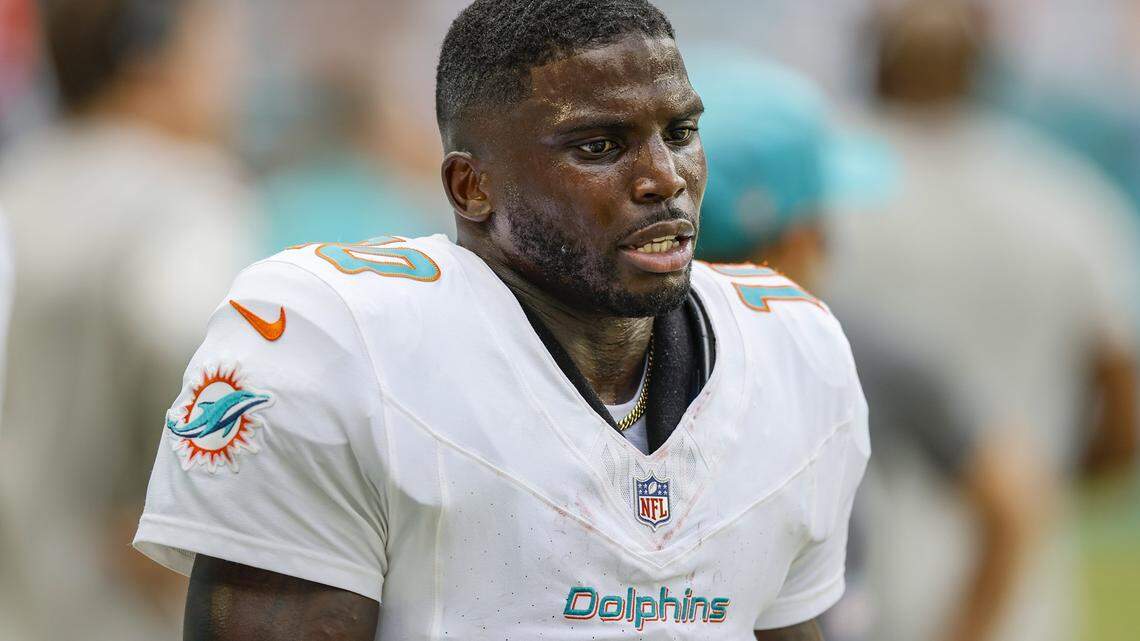
The Miami Dolphins new regime began the process of releasing players to trim the team’s payroll in an effort to fix the franchise’s troublesome cap situations.
Along with pass rusher Bradley Chubb and receiver Tyreek Hill, which were two easily predicted cuts because of substantial cap savings their departure creates, offensive lineman James Daniels and receiver Nick Westbrook-Ihkine, two free agents added last year who contributed little to the team’s offense in 2025, were cut on Monday by new general manager Jon-Eric Sullivan.
Hill’s release clears $22.9 million in cap space, and allows the Dolphins to avoid paying the All-Pro receiver the $35 million he was under contract for in 2026. Hill, who sustained a season-ending left knee injury in Miami’s 27-21 win over the Jets on Sept. 29, was due $5 million in a roster bonus at the start of the league year.
At his peak, Hill was arguably the most electric receiver to ever don the aqua and orange, racking up 4,733 receiving yards and 27 touchdowns on 340 catches in four seasons. Still, a slew of off-the-field issues have consistently followed Hill throughout his Dolphins tenure. Despite contemplating retirement, Hill plans to play in 2026.
Chubb’s release clears $7.3 million, and allows the Dolphins to escape the $20.2 million he was under contract for in 2026 because of the five-year, $110 million deal Miami signed him to after acquiring him for a first-round pick in a trade back in 2022.
The Dolphins restructured Chubb’s contract multiple times to create cap space, and trimmed his salary substantially in 2025. But Monday’s release means the seven-year veteran, who contributed 47 tackles and 8.5 sacks last year as Miami’s top pass rusher, will likely be playing elsewhere.
During his time in Miami, Chubb accumulated 22 sacks, nine forced fumbles and 133 combined tackles. One of the most valued voices in the Dolphins locker room during his tenure, Chubb would likely search for opportunities to remain a starter.
Players released by NFL teams can sign with another franchise at any time, and don’t need to wait for the start of free agency.
Daniels, who was signed to a three-year, $24.5 million deal that guaranteed him slightly less than $7.3 million, played all of three snaps for Miami before suffering what turned out to be a season-ending pectoral injury.
His release removes $1.2 million in cap space, and the Dolphins came into this week $17.4 million above the projected salary cap, which every team needs to be under for the start the new league year on March 11.
Fortunately for the Dolphins, the release of Westbrook-Ikhine, who sparingly contributed last season even though Miami’s receiver unit was decimated by injuries in 2025, creates $1.5 million in cap space.
The five roster moves Miami made on Monday should put the team roughly $13 million under the NFL’s projected salary cap.
However, it leaves the Dolphins with massive holes on the roster.
Heading into the offseason the Dolphins have one seasoned pass rusher on the roster in Chop Robinson, a 2024 first-round draft pick who had a disappointing second season in the NFL.
Jonah Savaiinaea, who struggled massively as Miami’s rookie starting left guard, and Kion Smith as the only veteran offensive guard on the roster because Cole Strange, Larry Borum, and Daniel Brunskill are all impending free agents.
And Jaylen Waddle, Malik Washington, Tahj Washington and Theo Wease Jr. are the only returning receivers on the team, which typically carries five or six on the 53-man roster, and 10-12 into training camp.
Miami also must figure out how to address the future of quarterback Tua Tagovailoa, whose tenure with the franchise is on unstable ground because of his struggles in 2025, bloated salary, and the regime change.
Last week Sullivan admitted Tagovailoa’s future in Miami is undecided, and the Dolphins have publicly let it be known that Tagovailoa, who is due $54 million in 2026, is available via trade.
If the Dolphins can’t trade Tagovailoa their choices are to carry him on the roster next season, release him in March, which would reduce the team’s cap space by nearly $43 million, or to designate him a June 1 release and split his dead cap money ($99 million) over two seasons, which would reduce Miami’s cap space by $11.1 million in 2026.
This story was originally published February 16, 2026 at 12:27 PM.