
A partisan fight over Immigration and Customs Enforcement (ICE) has officially shut down the Department of Homeland Security (DHS). But could that also put critical spending projects, including some championed by Democrats, on thin ice?
With lawmakers not scheduled to return to Washington until next week, the situation remains unresolved. Republicans have started criticizing Democrats who voted against funding for key Florida needs, setting in motion the third government shutdown in the last four months.
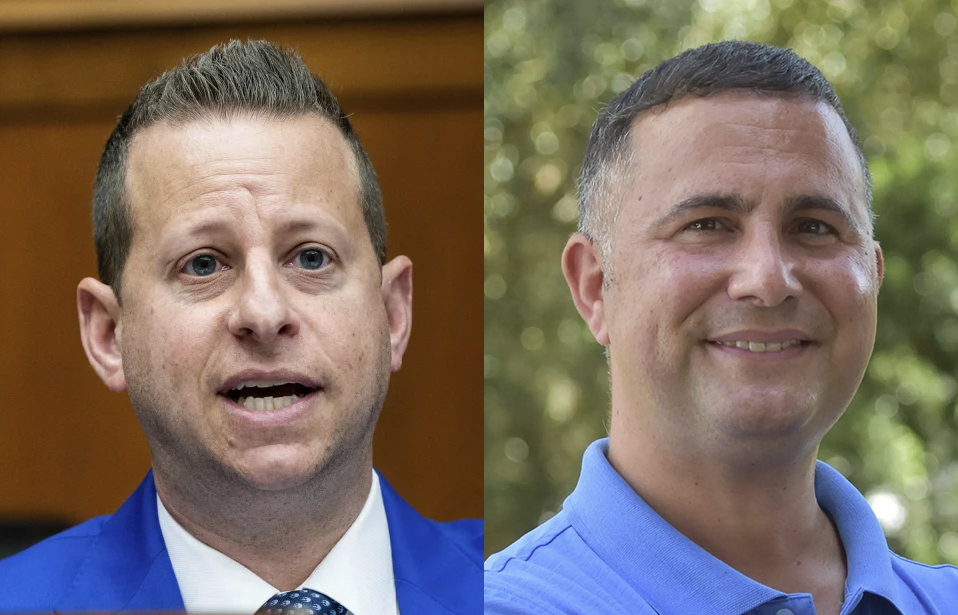
The National Republican Congressional Committee (NRCC) specifically slagged U.S. Reps. Jared Moskowitz and Darren Soto, targeted Democrats in battleground districts.
“Radical Democrat Darren Soto and his lazy colleague Jared Moskowitz voted to block critical funding for Floridians,” said NRCC spokesperson Maureen O’Toole. “Their radical crusade to defund law enforcement at the expense of their constituents’ safety and betterment of their communities is wrong, and voters will hold them accountable.”
Soto this year pursued some $10.45 million through community project funding that made it into budgets voted on this year. That includes projects related to flooding in Central Florida, such as $2 million for a stormwater project at Buenaventura Lakes, another $2 million for a similar effort at Narcoossee Road and Vista Lakes, and $850,000 for a Belle Isle flood mitigation project.

The budget also includes $1.2 million for a Columbia Avenue Complete Streets project in Kissimmee; $850,000 to help with land acquisition for Orange County’s Green PLACE land acquisition program; $850,000 for a Poinciana pedestrian safety project; $850,000 for Oakwood senior housing; $500,000 for an outdoor learning project at Valencia College; and $250,000 for LYNX digital signage.
Soto’s Office noted that the money for projects in his district came from other funding silos, including appropriations bills for Transportation, Housing and Urban Development; Commerce, Justice, Science and Related Agencies; and Energy and Water Development. That means most of the funding runs through the House and Urban Development Department and the Interior Department.
Because those budgets already were approved by the House and Senate, the funding should still flow to Florida. And all those budgets initially passed in the House on a bipartisan vote, with every Florida Democrat supporting the bills except U.S. Rep. Maxwell Frost of Orlando.
However, after the appropriations returned to the House during negotiations with the Senate, all that spending was included in an omnibus bill (HR 7148) that only narrowly passed in the House on a 217-214 vote. Every Florida Democrat voted “no.”
The Kissimmee Democrat defended his vote.

“I voted NO on the ICE budget,” Soto said. “This budget fails to include critical ICE reforms like no masks, ID requirements, prohibition on sensitive areas, stronger guardrails against their reckless abuses and more.”
The budget also contains $8.45 million in public safety projects in Moskowitz’s district. That includes $2 million for a Jeffrey Street railroad and highway grade-crossing, $1.5 million for park improvements in Parkland, $1.2 million for a mobility project at the Las Olas corridor in Fort Lauderdale, and $1 million for Port Everglades Bypass Road.
Other South Florida items include $850,000 for a Dixie Highway safety fence, $850,000 for improvements to Burt Aaronson Regional Park, $800,000 for Everglades Memorial Loop, and $250,000 to replace Lighthouse Point Bridge.
Moskowitz’s Office did not respond to emails about the spending items.
The Parkland Democrat has been considered the most moderate member of Florida’s delegation since his arrival in Congress. But he has remained in lockstep with Democrats using the budget as leverage to obtain reforms in DHS. Even outside the ICE issues, he criticized the DHS handling of disaster response.
When asked last week what could break an impasse on agency funding, he suggested top-down changes.
“I don’t know how the Kristi Noem resignation letter is coming,” Moskowitz said. “I don’t know if they’re one or two paragraphs in, but they should get that done. That might move the needle.”
The Senate and House ultimately approved spending for all agencies outside DHS, leaving only that agency in shutdown mode. That means unless funding was specifically included in the Homeland Security budget, it will move forward regardless how the individual Representatives cast their votes.
Lawmakers tend to boast about projects being signed whether they vote against the overall budget or not. Even Frost boasted about the $13.4 million in community projects for his district making the budget, and he voted against appropriations bills even before the Homeland Security budget landed in the omnibus package.
“These investments are a victory for the people of Central Florida,” he said when the budget passed last week.
“Every project we fought for was chosen because it directly strengthens our communities, whether by expanding housing stability, improving transportation, protecting our environment, or lowering costs. I’m proud of the collaboration with local leaders that made this possible, and I’m committed to continuing the work to deliver real results for families across our region.”
But as lawmakers brag at home about dollars coming to the region, it leaves the politically vulnerable to criticism after voting against the budget on the floor.