
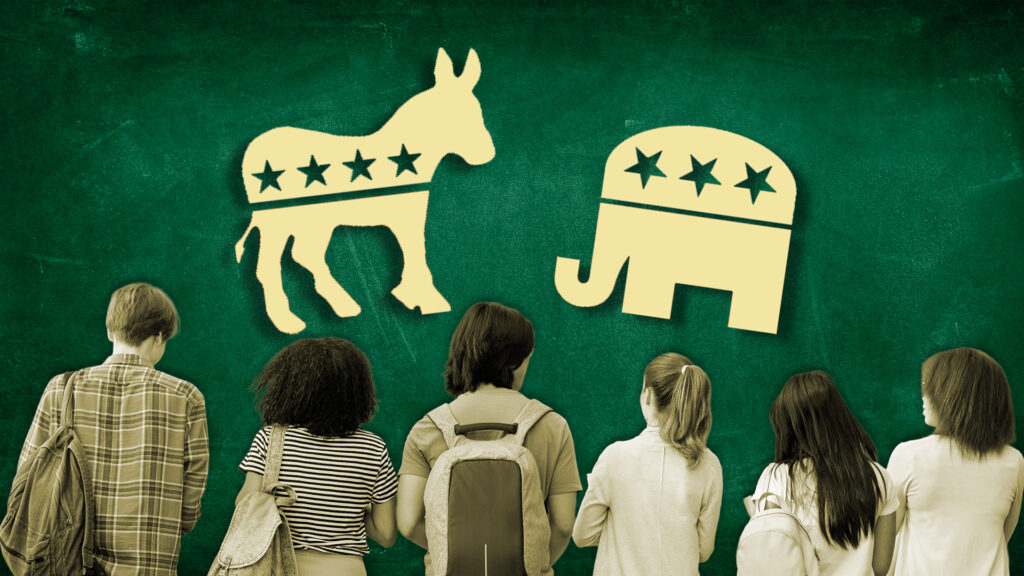
 Voicing your opinion on politics in the classroom doesn’t feel as safe as it should. ORACLE GRAPHIC/THOMAS MARRS
I’ve never been one to shy away from a debate or hold back my thoughts. I approach conversations with confidence and have always felt comfortable expressing my beliefs and opinions openly.
Valuing open discussion is always important. But when it comes to politics in the classroom, I often don’t feel safe speaking up.
The intensity of other students’ opinions, along with uncertainty about how instructors might respond, can make the environment feel intimidating rather than welcoming.
Instead of encouraging thoughtful discussion, the atmosphere sometimes feels charged, discouraging honest participation.
I had never felt this way until I started my beginning reporting class this semester — which prompts students to think about their peers’ ethical values and the world we live in.
But as soon as politics was mentioned on the first day of class, I knew the topic wasn’t going to be easy to discuss.
USF policies on freedom of expression state that students are free to express any ideas they wish, even if others disagree, according to the Student Equal Opportunity Office.
Still, I have seen students being ridiculed in class for their political opinions and ideas.
Related: OPINION: Why USF political clubs matter for democracy
The harsh environment and judgmental classmates make it hard for me to feel I can speak freely and be respected by all.
I have struggled to speak up in class because current education limits how political viewpoints can be expressed in discussions and instruction.
Gabriella Ruiz, a senior and mass communications major, said politics is often discussed in her communication ethics class.
Still, Ruiz said she feels there is little diversity in the class conversations.
“The conversations that arise about politics during class usually involve just one standpoint, usually about the same subject of [Donald] Trump, war and the current ongoing situation of ICE,” Ruiz said.
Ruiz also said she feels uneasy in the classroom when politics are brought up.
“I personally don’t feel comfortable sharing my views, and I often try not to give my opinions because I don’t know how others feel,” Ruiz said. “I have personally had interactions that make me feel bad for my point of view or get shut down for my take on politics that later on affects me.”
Related: OPINION: College students should participate in local elections
Instead of encouraging open discussion, bringing up politics in class often means being labeled or misunderstood.
The discomfort doesn’t come from a lack of knowledge on politics, but from a desire to feel heard and seen without consequences.
Considering that a classroom is a space for learning and sharing, hesitancy to share opinions can feel discouraging.
That feeling is evident not only in college but also in broader contexts, where educational materials have become politically charged.
Public schools across the U.S. have removed and restricted over 23,00 books that deal with race, identity and politics since 2021, according to PEN America.
When stories and perspectives tied to politics are removed from classrooms, students may feel that those conversations are off-limits and can’t be discussed.
Ava Merle, a junior education major, said she currently works for an elementary school in Polk County, Florida.
There, Merle said she has seen a reduction in political discussion in classrooms.
“School boards are limiting our abilities to teach about history and politics,” Merle said. “This has caused some teachers to be scared to talk about it or bring it up.”
Polk County, where Merle works, banned more than 30 books from its school libraries as of 2024, according to The Ledger.
Related: OPINION: Student activism at USF matters. Here’s why.
Additionally, a Faculty in the South survey conducted with university professors found that 31% of Florida respondents have applied for a job outside the state since 2023, according to WUSF.
Some of the respondents cited the state’s political climate as a reason to leave Florida, according to WUSF.
If teachers and professors feel their ability to discuss politics is being limited to the point where they’re leaving the state, it makes sense that some may avoid the topic altogether.
Students notice when professors are hesitant to bring politics up in the classroom.
Noticing professors’ hesitation reinforces the fear that speaking openly could lead to consequences from either the educator or the students around them.
Classrooms are meant to challenge us, not silence us. Students should feel comfortable bringing up politics in the classroom, and educators should encourage peaceful conversations.
I know that political conversation will never be an easy subject in the classroom. But the whole point of getting an education is being educated.
No student should be scared or notice that educators are hesitant to share their opinions.