
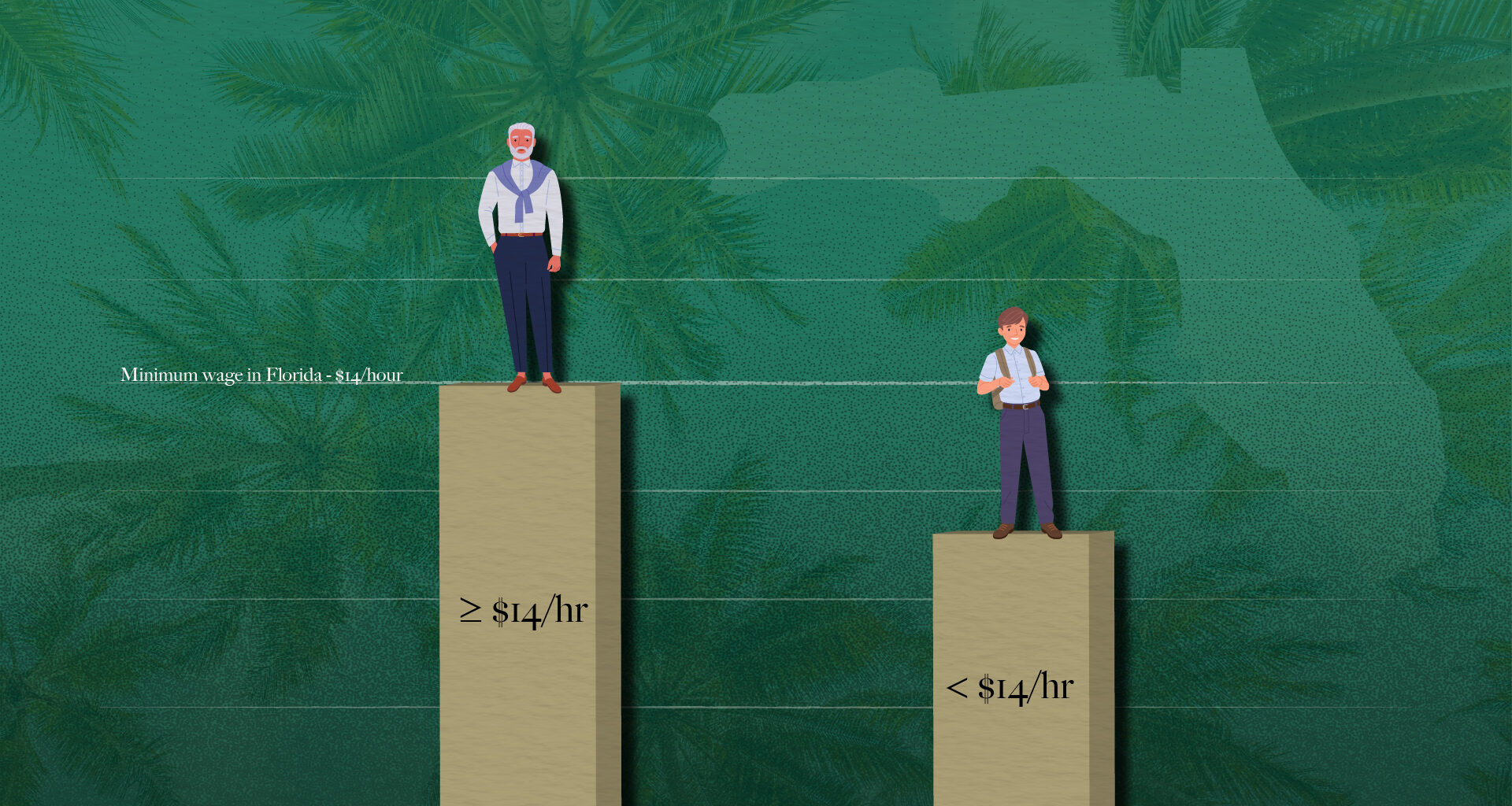
 House Bill 221 would allow employers to pay interns less than the state’s minimum wage. ORACLE GRAPHIC/CAROLINA MOLERO ROCA
Florida employers could soon be allowed to pay interns and work-study students less than minimum wage.
House Bill 221 would allow interns to voluntarily opt out of minimum wage requirements by submitting a waiver while prohibiting employers from coercing or pressuring them to do so, according to the bill.
Each waiver would be valid for nine months after employment begins. This means if an intern continues with the company after this period, they must be paid “at or above” minimum wage, according to the bill.
Florida’s minimum wage is $14 per hour, while the federal minimum wage is $7.25 per hour.
HB 221 was filed in October and is now in the Commerce Committee, according to the Florida Senate. If passed, the bill will take effect on July 1.
While some internships offered through USF wouldn’t be affected, some students said they worry the bill could financially hurt them.
Related: USF students share setbacks, successes in internship hunt
Michael Shuman, the internship director for USF’s Department of English, said he feels the bill would not have a “significant” effect on the department’s internship program.
Shuman said that’s because payment has been a “low priority” for students in the internship program.
“I think the interns are more interested in the experience rather than payments,” Shuman said. “So I just don’t see the bill having a great impact one way or the other, on our specific program.”
Shuman said he advises two internship programs at USF — the Legacy Program and Mellon Humanities Internship Program.
The Legacy Program is offered through local businesses to Tampa-based students in the department and provides in-field experience, according to USF.
Shuman said the Mellon Humanities Internship Program offers students positions at nonprofit companies and compensates them through the Mellon Foundation scholarship.
The scholarship is supported by the Andrew W. Mellon Foundation, which awarded the College of Arts and Sciences a five-year, $4.8 million grant last spring, according to USF.
Laurel Friedman, the director of the Mellon Humanities Internship Program, said its internships are “tied” to a grant with established compensation standards.
Friedman said students are paid $20 per hour to ensure they are “compensated fairly” for their work and professional experiences.
This means HB 221 would not affect paid internships in the program, whether it passes or not, she said.
Still, Shuman said he believes advisers in the Department of English would need to advise students if the bill were to pass.
“I think we would have to educate the students on the waiver that the bill has,” Shuman said. “And I think we would have to monitor the employees to make sure that they’re being compliant with that.”
Related: USF’s future leadership unclear as bills to limit governor’s role are delayed
Grace Topouzoglou, a junior environmental science major, said she doesn’t support the bill because she believes it is unfair to interns in workplaces.
Topouzoglou said her major requires students to complete an internship or research project for credit before graduation.
Still, she said internships are scarce, and environmental science students are either “severely” underpaid or unpaid while being expected to commit full-time.
“I feel it’s unfair because interns do a lot of the busy work, and they’re still contributing and working,” she said. “I feel like it should at least be minimum wage.”
Topouzoglou said she is seeking an internship in environmental science but has not yet secured a position.
Therefore, Topouzoglou said she would consider lower-paying internships as she needs to secure a position to meet her degree requirements.
She added that employers should be clear about compensation in internship applications and interviews.
“I think it would be better for employees to disclose the amount before continuing with the interview,” she said.
Related: USF graduate assistants share financial struggles as union seeks higher pay
Adam Elasri, a senior biomedical sciences major, said the bill is not good for the “majority” of students.
Elasri said monetary compensation was an important factor when he was searching for internships and jobs.
Still, he said his priority was to find a position with networking opportunities rather than high pay.
“If I had two options and they had similar experience and similar networking, I would be fine picking the one that pays more,” Elasri said.
Elasri said he believes HB 221 would not affect the job market overall because students are still filling unpaid internship slots.
“Employers could only go so low before they reach a level or a payment that no one would accept, or a very small majority would accept,” Elasri said. “There are definitely a lot of ambitious students that would take the opportunity, even if they’re not getting paid.”
Additionally, Elasri said that because the bill would allow employers to pay less per student, it could create more internship opportunities.
“If the bill makes it easier to get everyone on a level playing field find an internship position, I think that could be very positive,” Elasri said.