
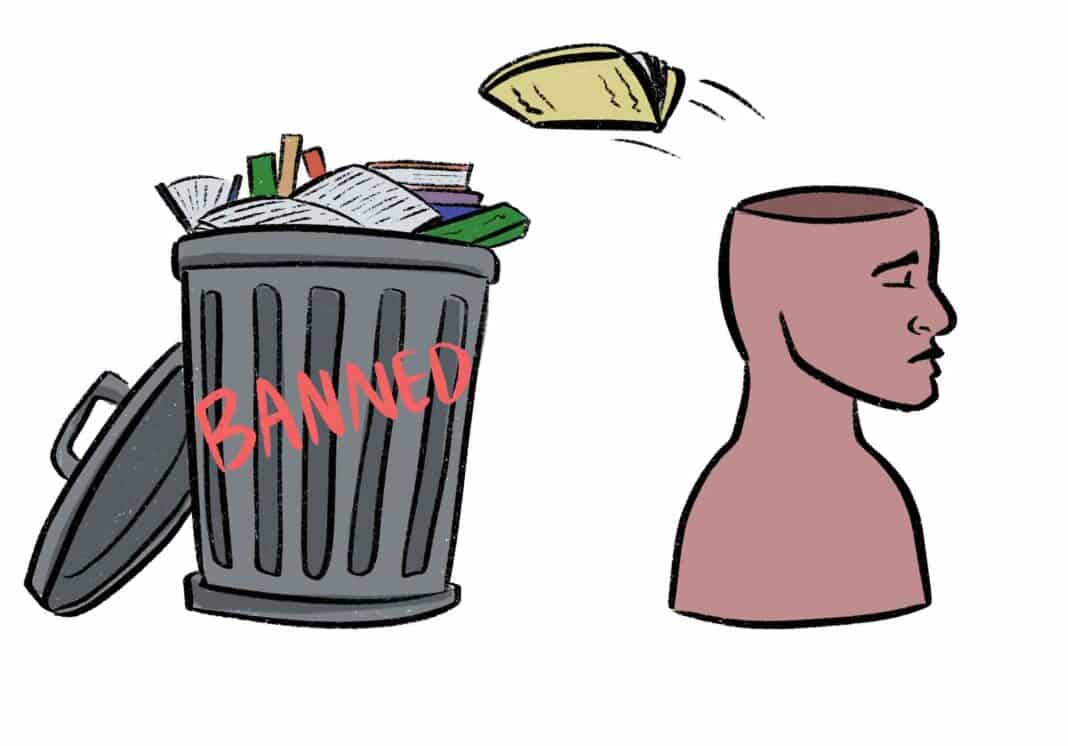
 Graphic Credit // Sovannreach Po
Florida lawmakers have proposed a new bill that would expand the state’s laws on removing books from public schools libraries.
House Bill 1119 (HB 1119) passed its final committee stop on Jan. 27 with a 16-5 vote and is set to be heard on the House floor on Feb. 11, 2026. The bill has sparked discussion among University of Miami librarians about how the legislation could affect students, educators and libraries across Florida.
The bill aims to restrict reading material deemed harmful to minors, specifically books that contain or depict “nudity, sexual conduct or sexual excitement.”
Before 2021, challenges to books were largely handled at the local level by individual school districts. However, that changed as debates over race, gender and LGBTQ+ themes intensified statewide.
“If the book is removed from the school library entirely, it lessens one parent’s ability to help educate their child because someone else thought the book was inappropriate,” said Lauren Fralinger, head of Richter Library’s Learning and Research Services and member of UM’s Banned Book Week committee.
“This restricts the professional judgement of librarians in terms of what to include in a book collection,” Fralinger said. [It also affects] university students by potentially restricting their access to literature or information when attending K-12 schools and arriving in college less prepared.”
Florida ranks No. 1 in the country for most books banned at the state level. Although the University of Miami is a private university — giving it broader autonomy of policy — public institutions will be directly affected by this proposed bill.
As of now, these efforts only are affecting public schools, but the outcome of the bill can have further effects.
“There have already been attempts made to attack public libraries and even bookstores,” said Terri J. Robar, UM Communication, Media, Geography and Maps Librarian. “If they aren’t stopped, they will eventually get around to harassing university libraries as well.”
The main piece of legislation that explains the reasoning and expansion of HB 1119, is House Bill 1069. In 2023, HB 1069 was made a law, allowing for any person to challenge books in school libraries.
PEN America, a non-profit organization that advocates free expression for writers and readers, heavily tracks and reports book bans all across the country.
Sophia Brown, program coordinator at PEN America’s Florida office, said that HB 1119 “[changes] the process by which school districts may review a book once it has been challenged. HB 1119 does this by attempting to do away with the third prong of something called the Miller Test.”
The Miller test, established by a U.S. Supreme Court ruling, is a three-prong standard used to determine whether material is legally obscene and therefore unprotected by the First Amendment.
For material to be considered obscene, it has to meet three criterias: it is meant to sexually excite people in an inappropriate way, clearly go beyond what people think is socially acceptable and have no serious value in education, art, politics, or science.
The third rule, lack of value, is judged by what a reasonable person would think, not by what a specific town or community thinks.
“HB 1119 wants to get rid of that prong,” Brown said. “[That] would mean that once a book has been challenged and a school district is considering whether to retain it or not, they cannot consider the book’s literary value as a reason to keep it. They cannot consider the value of the entire book.”
This would mean that if a book is challenged, the school district would not be allowed to keep it just because it has important literary, educational or artistic value. They would not be allowed to look at the book as a whole, but only the specific section that was targeted.
“[Lawmakers] claim that they are trying to fight “the indoctrination of our children,” said Robar. “The truth is that they are the ones trying to indoctrinate the next generation. They are the ones who want to control what children can read and be taught so that they can control what they will think.”
As debates continue over book restrictions, statewide efforts to restrict books may influence how public and private institutions like UM approach curriculum decisions and library collections. The impact will depend on how private institutions balance institutional independence with public pressure.