
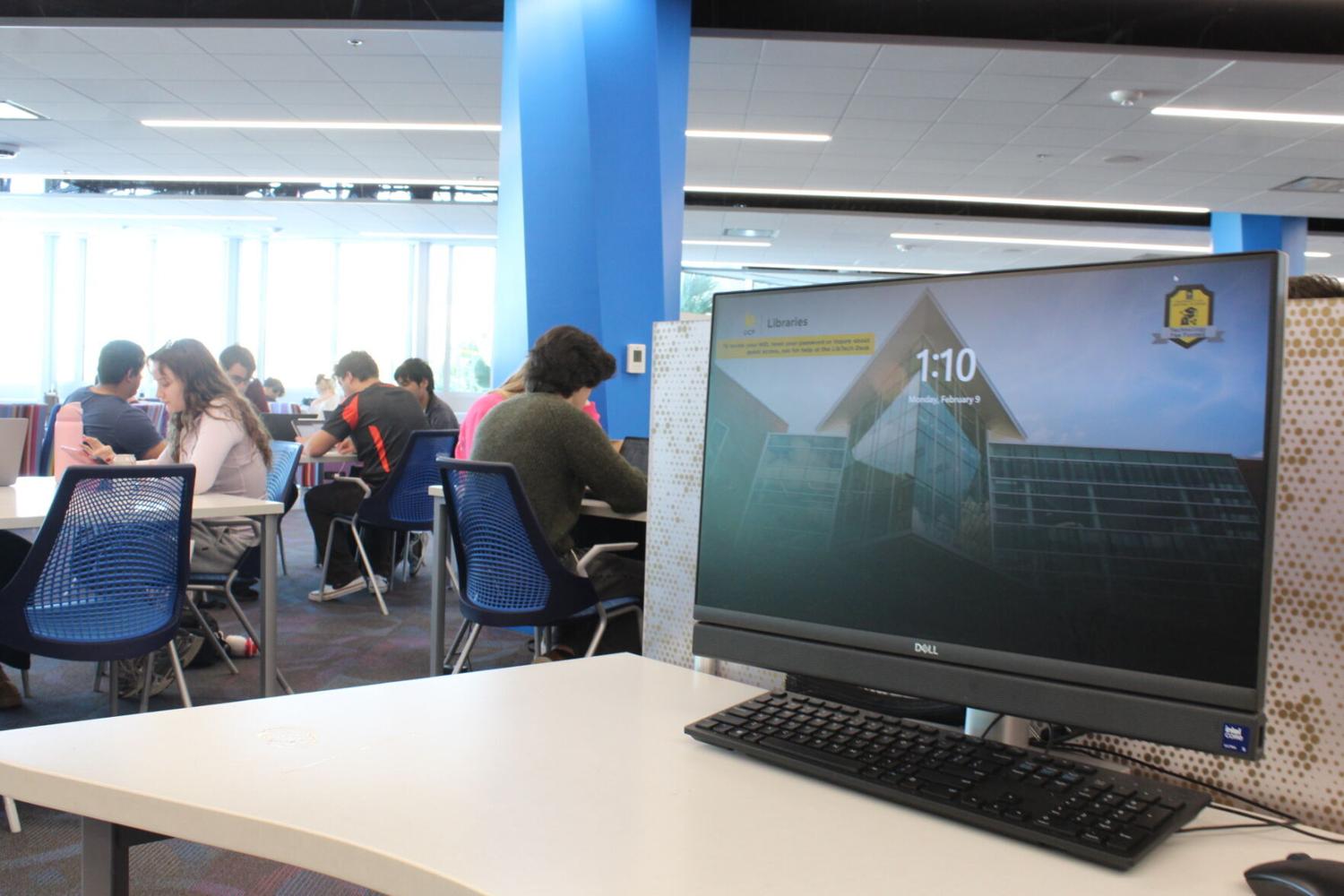

Students study inside the John C. Hitt Library on UCF’s main campus as online and in-person coursework continues throughout the semester. UCF ranked sixth nationally in the 2026 U.S. News & World Report Best Online Program Rankings, highlighting the university’s growing investment in online education and student support services.
Samantha Sambucharan
U.S. News & World Report released its 2026 Best Online Program Rankings earlier this year, placing UCF sixth overall among online bachelor’s programs.
Several individual programs also ranked nationally, including online psychology, instructional design and hospitality management.
Behind these highly ranked online programs are students balancing military service, full-time jobs and family responsibilities, according to university officials and faculty.
Danielle Mahabir, a second-year biology major with a minor in psychology, said taking psychology courses online allowed her to focus on the more time-intensive classes required for her major.
“Online classes let me prioritize my harder, content-heavy biology courses while still progressing in my minor,” Mahabir said.
Sociology professor Dr. Elizabeth Mustaine said adapting coursework for online delivery requires a different approach than face-to-face instruction.
“The biggest difference is the lack of spontaneity,” Mustaine said. “In person, you can see confusion immediately and adjust. Online, you rely more on discussion posts and course data to understand where students are struggling.”
Mustaine said UCF has shown an ability to adjust its online teaching approach as technology and student needs evolve.
UCF’s early investment in online education, Mustaine said, has allowed the university to adapt more quickly than other institutions.
She added online programs rely on intentional design and institutional support, an approach she said is especially evident in the university’s master’s in instructional design and technology program, which ranked sixth nationally.
According to a UCF Today article, more than 900 faculty members have gone through training at UCF to teach courses that are entirely or partially online.
Dr. Richard Hartshorne, professor and department chair in the instructional design and technology program, said the degree emphasizes learning science, including how students process information and engage with course material, rather than focusing solely on technology.
“It’s about the science and art of creating effective learning environments,” Hartshorne said.
A UCF student navigates the UCF Online website while working on coursework inside the John C. Hitt Library on UCF’s main campus. UCF placed sixth nationally in the 2026 U.S. News & World Report Best Online Program Rankings, with university officials citing academic success coaching and program design as key factors.
Samantha Sambucharan
Hartshorne said the program combines collaborative projects and independent work to reflect real-world instructional design practices.
“What stands out about UCF is its leadership commitment to online education,” Hartshorne said. “We practice what we teach.”
Dr. Kevin Murphy, professor and Darden Endowed Chair in Restaurant Management, said UCF’s No. 6-ranked online hospitality management program was designed with working professionals in mind.
“It’s a great fit for students already working in the restaurant and lodging industry who want to advance their education,” Murphy said.
Murphy said while some hands-on components are better suited for in-person instruction, the core curriculum — including management theory, finance and accounting — translates effectively online. He added that industry partnerships and alumni engagement help keep coursework aligned with workforce needs.
Support systems also contributed to UCF’s high ranking for online bachelor’s programs for veterans, Michael Kepner, director of Military and Veteran Student Success, said. He said online education allows military-connected students to balance academic goals with service obligations.
“Student veterans and active-duty military often have families, jobs and competing requirements,” Kepner said. “The flexibility of online programs gives them the best chance to complete a degree.”
Monique Carter, associate director of student coaching at UCF Online, said success coaches serve as a bridge between online students and campus resources.
“We help students navigate admissions, transfer credits, benefits and course planning,” Carter said. “Our goal is to make sure they don’t feel disconnected.”
Carter said veteran students often bring complex academic histories, including coursework from multiple institutions and military transcripts. She said consistent check-ins and individualized planning help students stay on track as life circumstances change.
“We want them not just to enroll, but to finish and earn a degree that leads to a career,” Carter said.
Carter said UCF’s approach to online education emphasizes intentional course design, consistent student outreach and coordination across departments to help students persist through graduation. She said those structures are designed to support students balancing careers, family responsibilities and military service.
While faculty and staff across UCF emphasized student support, Kepner pointed to the personal impact of online education.
“Hearing from students about the benefits of online programs — those are the things that really, at the end of the day, make you proud to be a member of UCF,” he said.