
Home » AIRLINE NEWS » Travellers Stranded at Fort Lauderdale International Airport in Broward County, Florida, US as 110 Flights Are Delayed and 9 Cancelled, Disrupting Spirit, Delta, JetBlue, and More Across New York, Dallas, Toronto, Chicago, and Atlanta
Published on
February 19, 2026
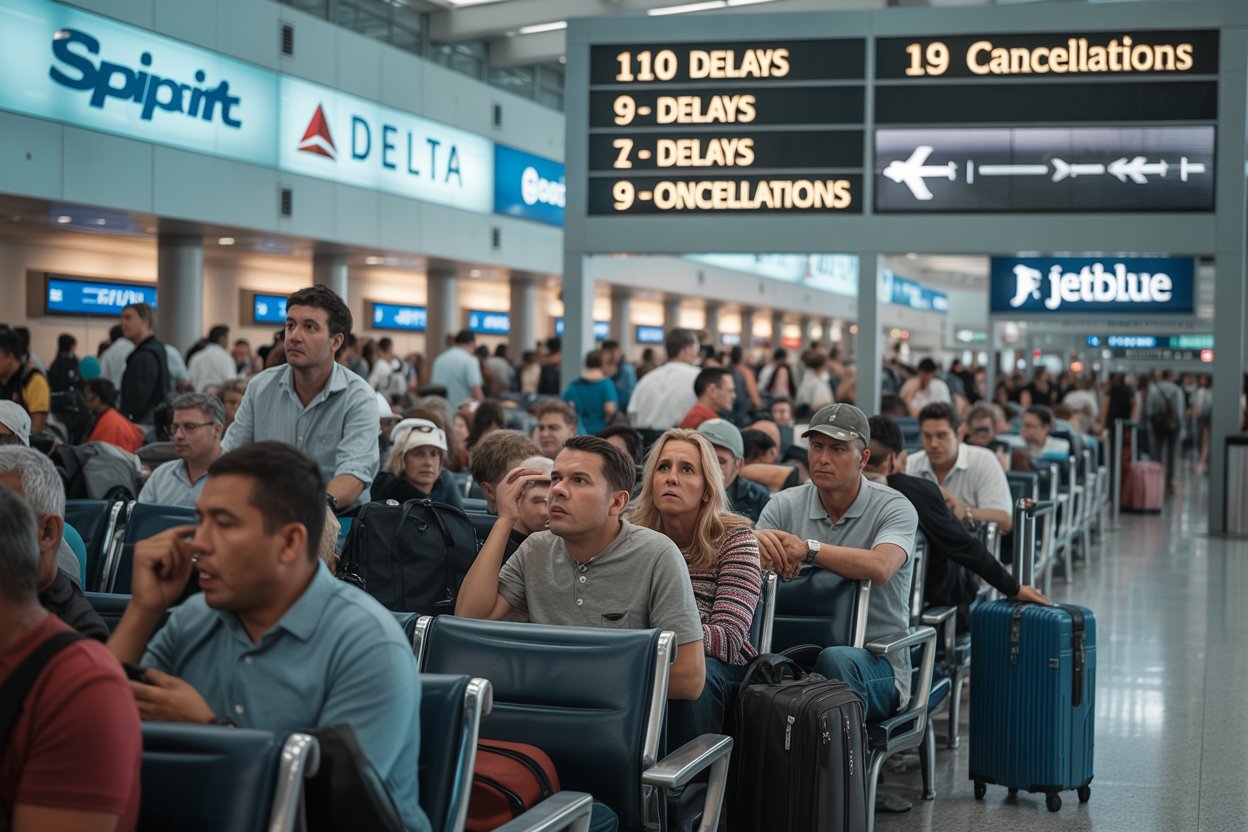
Image generated with Ai
Fort Lauderdale International Airport (FLL) is currently facing a significant day of travel disruptions, with 110 flight delays and 9 cancellations affecting both domestic and international routes. Major airlines, including Spirit, Delta, JetBlue, and Southwest, are among those most impacted, with travelers enduring extended wait times and changes to their flight schedules.
The delays have affected a wide range of flights, from short domestic trips to longer international connections. The cancellations, though relatively few compared to the delays, have still left passengers scrambling to find alternative travel arrangements. While not every airline was affected equally, the sheer volume of disruptions at one of Florida’s busiest airports has raised concerns for travelers hoping for a smooth travel experience.
Airlines Most Affected by the Delays and Cancellations
Among the most impacted airlines today is Spirit Airlines, which has seen 23 delayed flights (13% of its scheduled departures) and 5 cancellations (2%). Spirit’s budget-friendly services are a popular choice for both domestic and international travelers, and many passengers today faced longer-than-expected wait times or were forced to rebook due to cancellations. Spirit Airlines is working hard to accommodate affected passengers, but with the high volume of delays, the process has been slower than usual.AirlineDelayed FlightsDelayed %Cancelled FlightsCancelled %Spirit2313%52%Air Canada Rouge (ACA)00%225%Porter Airlines215%00%Alaska Airlines250%00%Avianca116%00%Aztec Airways450%00%Bahamasair67%00%Delta Air Lines67%2100%Flair Airlines00%00%JetBlue3419%00%Breeze Airways58%00%Southwest67%00%Air Transat00%00%United1017%00%WestJet250%00%Western Air00%00%
JetBlue, another major carrier at Fort Lauderdale International, has also experienced 34 delays (19% of its scheduled flights) today. While the airline has managed to avoid widespread cancellations, the delays have disrupted travelers’ plans, particularly those flying from Fort Lauderdale to other key cities like New York, Boston, and Dallas. As with Spirit, JetBlue passengers have faced difficulties rebooking flights, and customer service lines have seen significant traffic.
Delta Air Lines has been hit with 6 delayed flights (7% of its total scheduled departures), but the airline has also faced 2 cancellations. As one of the most well-known and widely-used airlines in the U.S., Delta’s disruptions have affected passengers on both domestic and international routes, including flights to cities like Atlanta and New York.
Southwest Airlines, one of Fort Lauderdale’s busiest carriers, has also seen 6 delays (7% of its scheduled flights). While no cancellations have been reported, passengers flying to major Southwest destinations, including Dallas and Chicago, have faced delays that have affected their connections.
Advertisement
Advertisement
The Ripple Effect of Delays Across U.S. Airports
The disruptions at Fort Lauderdale International have had a ripple effect on airports across the U.S. Travelers connecting to other U.S. cities from Fort Lauderdale have been hit hardest by delays. For instance, flights from Fort Lauderdale to Hartsfield-Jackson Atlanta International Airport (ATL) saw delays, with 3 flights delayed (12% of the departures). Similarly, New York’s John F. Kennedy International Airport (JFK) and Newark Liberty International Airport (EWR) saw minor delays due to late arrivals from Fort Lauderdale.
Additionally, passengers heading to international destinations like Toronto Pearson International (YYZ) and Louis Armstrong New Orleans International (MSY) also experienced disruptions, with delayed flights affecting their scheduled departures. These ripple effects, although more limited in terms of cancellations, have caused stress and frustration for many travelers who were hoping for seamless connections.Origin AirportDelayed FlightsDelayed %Cancelled FlightsCancelled %Fort Lauderdale Intl (FLL)6413%30%Toronto Pearson Int’l (YYZ)440%220%Dallas-Fort Worth Int’l (DFW)111%111%Louis Armstrong New Orleans Intl (MSY)00%00%Atlantic City Intl (ACY)116%00%Tampa Intl (TPA)150%00%Albany Intl (ALB)00%150%Hartsfield-Jackson Intl (ATL)312%125%Austin-Bergstrom Intl (AUS)110%110%Baltimore/Washington Intl (BWI)19%00%Reagan National (DCA)114%00%Newark Liberty Intl (EWR)531%00%William P Hobby (HOU)00%00%John F Kennedy Intl (JFK)17%00%
Weather and Operational Issues Contribute to the Disruptions
The disruptions at Fort Lauderdale International today are attributed to a combination of operational issues and weather-related delays. While weather conditions are not the sole factor causing delays, low visibility and strong winds have contributed to a slowdown in aircraft movements. This has led to delays in takeoffs and landings, as well as increased taxi times on the tarmac.
Moreover, high passenger volumes during peak hours have placed additional pressure on the airport’s infrastructure. With long lines at check-in counters and crowded terminals, the airport has struggled to maintain its usual efficiency, contributing to delays that are affecting multiple airlines.
Air traffic congestion, especially during busy periods, has compounded the situation. Although the airport is taking steps to streamline operations, the volume of delayed flights has overwhelmed ground staff and airlines, further extending the waiting times for passengers.
What Passengers Should Expect Today
Passengers traveling through Fort Lauderdale International Airport today are advised to stay updated on their flight status by checking with their airlines or the airport’s official flight tracking system. With 110 delays and 9 cancellations, flight statuses can change rapidly, and passengers are encouraged to regularly monitor updates.
Travelers should expect longer-than-usual wait times at security checkpoints, as well as potential delays at gate areas. The airport is advising travelers to arrive early and be prepared for extended waiting times, especially for those with connections to other cities or international destinations.
Passengers with tight connections, especially those on international flights, should approach the airline customer service desk as soon as possible to inquire about rebooking options. While Fort Lauderdale International Airport is working hard to minimize the disruptions, the sheer volume of delays means that some passengers may face extended wait times for alternative flights.
Airlines Responding to the Disruptions
Airlines like Spirit, JetBlue, and Delta are working diligently to accommodate passengers affected by today’s delays. While the airlines are providing rebooking options for passengers whose flights were canceled, some travelers may face longer-than-usual wait times for rebooking assistance. Many airlines are offering hotel accommodations for passengers whose delays or cancellations require overnight stays, but these options are limited and subject to availability.
For those traveling on international flights, airlines are prioritizing rebooking passengers to the next available flight. However, given the congestion at the airport and increased travel demand, these rebooking options may not be immediate, and some travelers may need to adjust their travel plans accordingly.
Fort Lauderdale International Airport’s Efforts to Improve Passenger Experience
Fort Lauderdale International Airport continues to invest in improving its operational efficiency, with several initiatives aimed at reducing delays and improving the overall passenger experience. Recent upgrades to terminals, enhanced baggage handling systems, and better communication with airlines are all part of the airport’s ongoing efforts to handle high passenger volumes more efficiently.
Despite the challenges of the current disruptions, the airport remains committed to providing passengers with timely updates and minimizing delays. As Fort Lauderdale continues to grow in importance as a hub for both domestic and international flights, the airport is focusing on upgrading its facilities to better handle the increasing number of travelers.
Looking Ahead: A Better Travel Experience?
While today’s disruptions at Fort Lauderdale International Airport have caused significant frustration for travelers, the airport’s long-term improvements and ongoing investments in infrastructure should lead to smoother travel experiences in the future. Passengers are encouraged to remain patient and stay informed as they navigate the delays and cancellations.
In the coming months, Fort Lauderdale International is expected to continue expanding its capacity and enhancing its services, helping to reduce the likelihood of similar disruptions in the future. The airport’s focus on better communication, improved ground operations, and enhanced customer service will be crucial in managing the challenges posed by high volumes of air traffic.
Conclusion: Navigating the Chaos at Fort Lauderdale International Airport
Today’s disruptions at Fort Lauderdale International Airport, with 110 delays and 9 cancellations, highlight the challenges faced by both passengers and airlines in an increasingly congested air travel environment. While the delays have caused significant inconvenience, the airport’s efforts to improve its operations and the proactive measures taken by airlines to accommodate affected passengers offer hope for a smoother travel experience in the future.
As travel demand continues to grow, passengers are advised to stay informed, be prepared for delays, and maintain flexibility in their travel plans. While the disruptions have been frustrating, Fort Lauderdale International Airport’s commitment to improving passenger experience should ultimately lead to a more efficient and reliable travel hub for years to come.
