
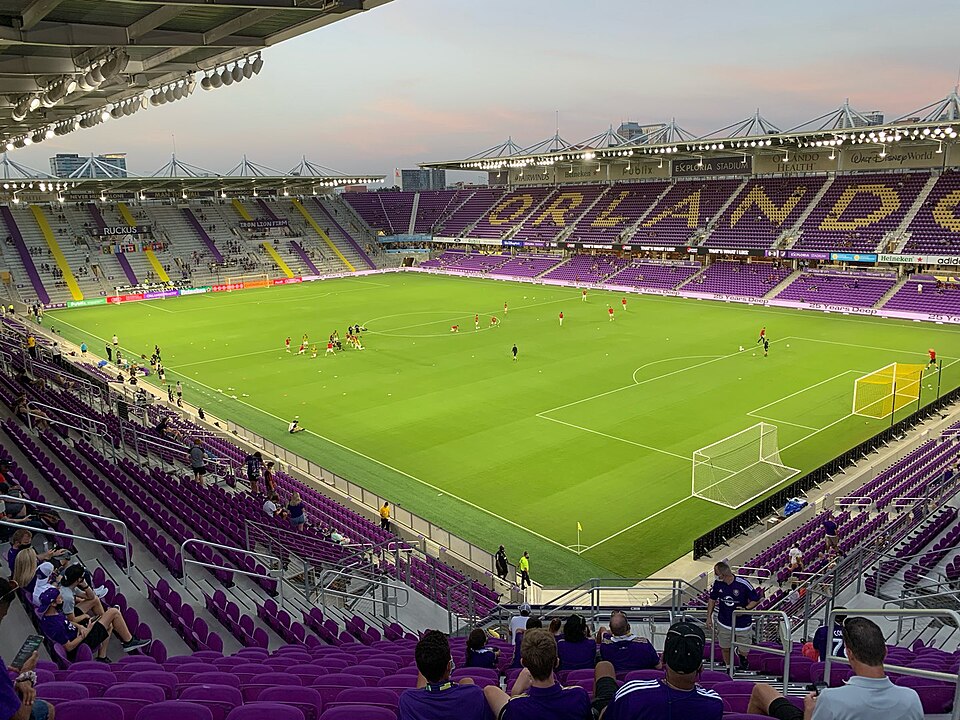
 timoteeburns on WikiMedia Commons
Written by Alessandro Hurtado.
As Orlando City SC prepares for the 2026 Major League Soccer campaign, the conversation around the club has shifted from the ambition of long playoff runs in the years before the uncertain present.
Has the roster actually improved, or simply turned over after the departures of Gallese and Alex Freeman, along with other expiring contracts?
Did the transfer window strengthen the squad with additions like Canadian national Maxime Crepeau and Braian Ojeda, or merely patch holes?
Is this squad still a secure playoff team, or one drifting toward the mid-table of the Eastern Conference?
For the Lions’ supporters, this preseason feels different. It is not fueled by headline signings or upward momentum, but rather defined by evaluation and transition.
The Core Concern: Stability vs. Regression
Orlando has built a reputation under Oscar Pareja for structure, defensive organization, and consistent playoff qualification. Such a structure relied heavily on the leadership of Pedro Gallese and had long-term projections through promising stars like Alex Freeman.
But like with any major league, the MLS does not reward stagnation. It rewards improvement.
With contracts expiring and experienced players moving on, the margin for error has severely narrowed. The Eastern Conference remains competitive, and clubs such as Inter Miami CF, FC Cincinnati, and Columbus Crew enter the season with better form.
Orlando’s challenge is not to reinvent itself but to prove its core foundations are both intact and deep enough to withstand tough situations.
Defensive Identity Under Pressure
Can Crepeau replicate the reliability Gallese provided between the posts?
Can Robin Jansson lead the back line and maintain cohesion?
Orlando’s defensive identity has long been its backbone. Yet beyond the starting eleven, squad depth overall has thinned out compared to years prior. The right side of the defense enters this season without long-term clarity, and depth along the back line is not as insulated as it once was.
If communication and chemistry dip early, the Lions risk conceding points early in a conference where margins are slim.
Transition defending may quietly define the opening months. In a league built on pace and counterattacks, hesitation is punished quickly.
If the defense remains organized and compact, Orlando remains competitive. Otherwise, the season shifts from ambition to damage control.
Attack: Good Enough or Elite Enough?
Can this attack consistently break down top-tier Eastern Conference defenses?
Is there a reliable match-winner in high-leverage moments?
When trailing late, does Orlando have another gear?
With an open Designated Player slot still available, flexibility remains, but so does uncertainty. Until that space is assigned, the burden falls heavily on Duncan McGuire as the primary No. 9 and on Martín Ojeda’s creativity in the midfield.
In MLS, simply being “solid” results in mid-table. To climb higher, difference-makers must emerge. Structure and possession can carry a team, but individual moments often decide playoff positioning.
Youth Integration: Growth or Necessity?
Is reliance on young players like Gustavo Caraballo a strategic investment in the future, or a response to a lack of team depth?
Can academy products provide meaningful MLS minutes without destabilizing results?
If a teenager becomes a regular starter, does it result in progress or roster imbalance?
The bench experience entering 2026 does not mirror previous seasons. Opportunities for youth may arrive quickly, and not always by design.
Development is valuable, but results still dictate perception.
2026 Season Predictions
Despite the numerous questions to answer and the shakeup in leading roles, Orlando is projected to go on a good run ending around 6th or 7th place. Still not securing a home playoff match, but just qualifying.
Orlando has room for growth, and arguably more compared to previous seasons. But that growth must come early. Defensive chemistry, particularly along the right side, cannot afford any more stalling.
Attack is still heavily dependent on Duncan McGuire as the primary No. 9 and Martín Ojeda’s creativity in the midfield. When Ojeda is contained, or McGuire’s output cools, Orlando can struggle to create and convert high-quality chances. On top of that, numerous other teams like Inter Miami CF, FC Cincinnati, and Columbus Crew, just to name a few, have more solid front lines as of last season.
Bottom Line
Orlando City enters 2026 not as a favorite, but definitely not a rebuilding side either.
They are a tried-and-tested team with identity, capable of competing weekly, but carrying more variables than in years past. The defensive depth is thinner. The attack still seeks another gear. The Designated Player slot remains undefined.
The Lions had a bitter ending last season. Only time will tell if they are ready to meet expectations
The Lions will host the MLS 2026 Home Opener vs. the New York Red Bulls (NYRB) at Inter&Co Stadium on March 21 at 7:30 p.m.