
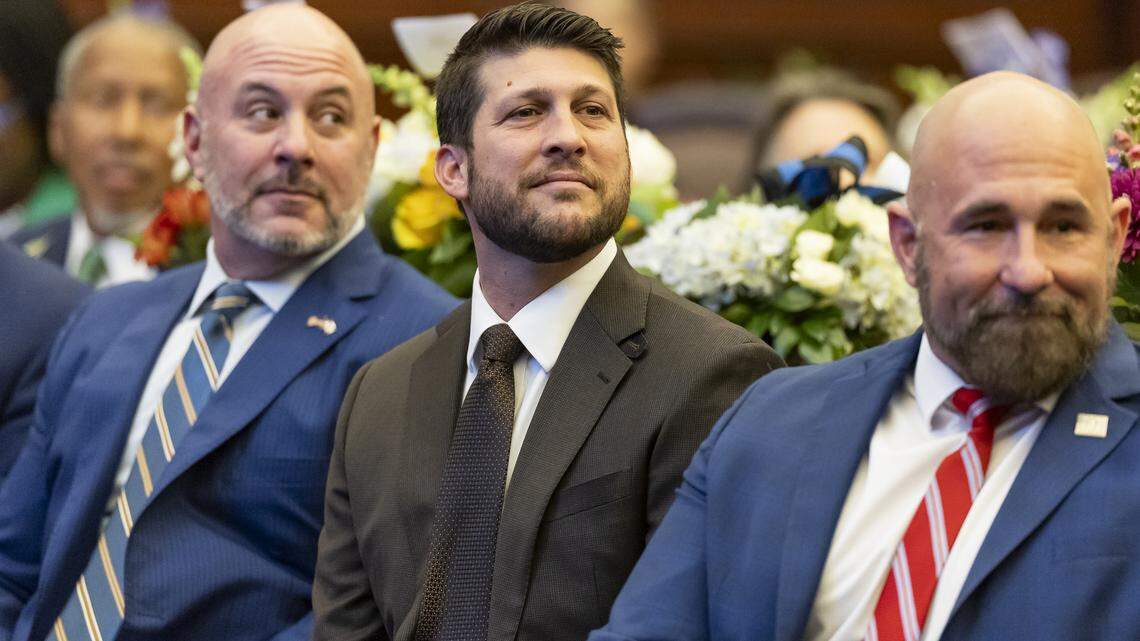
Florida Attorney General James Uthmeier, center, attends the first day of the 2026 legislative session at the Florida State Capitol on Tuesday, Jan. 13, 2026, in Tallahassee, Fla.
Photo by Matias J. Ocner
mocner@miamiherald.com
Tallahassee
Within months of Gov. Ron DeSantis handpicking him as Florida’s new attorney general last winter, James Uthmeier landed a lucrative side gig: a $100,000-a-year teaching assignment at University of Florida’s law school for just two hours of instruction per week.
The former DeSantis aide’s paycheck makes him the highest-paid adjunct professor at UF’s Levin College of Law in at least a quarter century, according to compensation records dating back to 1997. His salary is eight times higher than what the median law school adjunct earns, and comes as the DeSantis administration leans on Florida’s 40 public universities and colleges to justify their spending practices.
Since August, Uthmeier has been moonlighting in the classroom on Monday evenings. The attorney general — a political lightning rod with relatively few academic credentials — lectured 27 law students last fall in an upper-level course examining, among other things, “the implications of executive overreach,” according to syllabi. This spring, he’s leading a 15-student seminar on constitutional law.
The seminar syllabus touts his credentials as Florida’s top legal official, promising students that “Professor Uthmeier will highlight real-life examples of separation of powers and federalism at work.”
Uthmeier’s adjunct job isn’t unusual; attorneys general around the country have taken on part-time instructional roles at state universities. But the pay — for a job that typically pays a few thousand dollars per course — is raising eyebrows in the legal community.
“Somebody needs to justify the Florida attorney general getting $100,000 a year to teach,” said Joseph DeMaria, a Miami attorney and longtime adjunct professor at the University of Miami School of Law. “It’s a hell of an eye opener.”
Combined with his attorney general paycheck, Uthmeier’s teaching stipend pushes his total state-funded salary to $240,000 — nearly $100,000 more than the governor’s annual pay.
Uthmeier’s office did not respond to a request for comment.
The interim dean of UF’s law school, Merritt McAlister, defended Uthmeier’s compensation in an interview with the Herald/Times last week, saying adjunct pay at UF is “all over the map”; some instructors teach for free, while others command higher salaries.
Uthmeier’s value, the dean said, extends beyond his time in the classroom: He has mentored students, hosted dinners and advised the law school’s nascent Program in Law in Government — an initiative designed to “turbocharge” research and programming on topics ranging from originalism to environmental law.
“He’s more of a resource,” McAlister said. “He’s not guiding the program.”
It was a coup, she added, that UF lured the attorney general from the Gators’ bitter rival, Florida State University, where he previously taught as an adjunct instructor.
Despite a behind-the-scenes push for the high-profile hire, UF’s law school didn’t publicly announce Uthmeier’s role until late Saturday — five months after his start date and just days after the Herald/Times began asking university officials about his employment.
‘Get you on the payroll as soon as possible’
Uthmeier’s hiring was set in motion by a member of UF’s Board of Trustees soon after his attorney general appointment last February, McAlister said, declining to identify the trustee. UF’s board is stacked with DeSantis allies and is led by Mori Hosseini, a wealthy Ormond Beach homebuilder and one of the governor’s most prolific donors.
Internal communications, dated April 2025 and obtained by the Herald/Times through a records request, show Uthmeier fielding enthusiastic messages from McAlister about getting him on the law school’s payroll “as soon as possible.”
“Students are so excited for your class!” the dean wrote in one message, adding that she could “begin the term of employment sooner if that might be helpful.” Two weeks later, the attorney general replied that he was eager to teach at Florida’s flagship law school but hadn’t prepared a résumé “in many years,” and would need time to assemble one so paperwork could move forward.
It took another month for Uthmeier’s résumé to land in McAlister’s inbox. That July, McAlister offered Uthmeier a 12-month appointment running through August 2026. The attorney general’s duties: teaching four to five credits across two courses, one in the fall and spring semesters each, and “supporting our new Program in Law and Government through attending events and providing guidance.”
Text messages suggest Uthmeier inquired three days before his start date about working as an independent contractor. McAlister told him that was against school policy. “I can ask Mori for an exception, if one is possible,” the dean said, referring to Hosseini.
Uthmeier declined, saying his team had given the job a look and was “comfortable” with the arrangement.
Florida law allows state employees to hold two public positions under certain “interchange agreements,” enabling them to collect salaries from separate agencies. UF also requires faculty and staff to report outside income and potential conflicts annually. Employees who fail to do so risk potential disciplinary actions up to termination.
Asked for copies of Uthmeier’s interchange agreement and conflict-of-interest disclosures, UF’s public records office said Friday that no such documents exist.
According to the dean, UF’s law school pays for security during Uthmeier’s campus visits, with hourly rates ranging from $50 to $80 depending on the officer’s rank. The university does not cover the attorney general’s travel expenses, the dean said, and it remains unclear how he commutes to Gainesville each week.
‘An expert in executive overreach’
Before DeSantis tapped him as attorney general, Uthmeier had relatively thin courtroom experience. But he did have some classroom bona fides.
A graduate of Georgetown Law, Uthmeier had once taught at FSU’s law school for about $1,500 per course, according to his contract. He earned a bachelor’s in political science from UF, making his return to Gator Nation a bit of a homecoming.
The attorney general’s prior legal experience includes a clerkship for a federal appeals court judge and a brief stint in private practice. He worked in the Department of Commerce for the Trump administration and then joined DeSantis’ office in 2019 as a senior adviser, later rising to chief of staff and helping guide the governor’s legal and policy agenda.
As one of DeSantis’ closest aides, Uthmeier helped coordinate legal strategy for transporting migrants from Texas to Martha’s Vineyard, oversaw responses to pandemic-era litigation and worked on the state’s escalating legal fight with Walt Disney Company. He was also the campaign manager for DeSantis’ 2024 presidential bid.
In his first year as attorney general, Uthmeier has focused heavily on headline-grabbing lawsuits targeting corporate diversity programs and LGBTQ+ initiatives. Among them are cases accusing Starbucks of unlawful race-based hiring practices and alleging Target violated federal law through what his office described as “radical LGBTQ+ activism.”
Uthmeier’s pugilistic litigation style has drawn scrutiny. A federal judge found the attorney general in contempt of court last year after he encouraged local law enforcement agencies to enforce a new state immigration law despite a prior court ruling blocking it.
Uthmeier was also involved in the DeSantis administration’s decision in 2024 to route most of a $10 million Medicaid settlement through the state-created Hope Florida Foundation charity to his own political committee, created to wage a campaign against recreational marijuana. He has defended his actions, saying he did nothing illegal. A criminal investigation in Leon County is ongoing.
The controversies have led some legal observers and UF alumni to question whether Uthmeier is worthy of a faculty role at Florida’s flagship law school.
When informed of Uthmeier’s $100,000 adjunct salary, state Rep. Alex Andrade, a Pensacola Republican who encouraged prosecutors in Leon County to pursue their Hope Florida case, responded with a 10-second laugh.
Andrade, who once taught as an adjunct law instructor for about $2,500 per course at the University of West Florida, noted that UF is effectively paying Uthmeier about $50,000 per class. An alumnus of UF’s law school, Andrade also bristled at the notion of Uthmeier lecturing students about executive overreach.
“He’s an expert in executive overreach,” Andrade quipped.
Florida’s law schools have long recruited high-profile judicial and political figures as temporary instructors. UF’s roster has featured Supreme Court Justice Clarence Thomas and several federal judges.
But Uthmeier’s salary far exceeds those typical arrangements. According to the law school’s compensation records, federal judges’ adjunct salaries have ranged from $31,500 to $0.
DeMaria, the University of Miami law adjunct, defended Uthmeier’s aggressive legal philosophy as a legitimate topic of academic discussion, but argued it’s not worth the $100,000 price tag.
Most adjunct professors teach as a way to mentor students and typically earn only a few thousand dollars annually, said DeMaria, who earns $3,000 per course at UM. He pointed to other prominent politicians who have made far less from their teaching assignments like then-U.S. Senator Marco Rubio, who previously earned $20,784 annually as a political science instructor at Florida International University.
It’s hard to establish a baseline for what attorneys general earn as part-time professors, according to former Maine Attorney General James Tierney. Tierney taught as an adjunct faculty at University of Maine while he was state attorney general, and said he earned no extra compensation for his classroom services.
Teaching law students at Maine, Tierney believed, “was just part of my job.”
‘The Einstein Category’
Details about Uthmeier’s in-class lectures remain scant. The Herald/Times was unable to contact students enrolled in the attorney general’s courses.
But there are signs so far that he’s making some common “rookie adjunct mistakes,” said Bob Jarvis, a longtime law professor at Nova Southeastern University.
Among the pitfalls, according to the professor, are a lack of detailed lesson plans and a comprehensive list of course materials in Uthmeier’s syllabi. Per the syllabi, the attorney general’s classes are “taught with materials selected by the professor rather than a textbook,” with readings uploaded to UF’s online course directory on a weekly basis.
The syllabi omissions show a lack of curricular transparency, Jarvis said, “so until we see those descriptions, we have no idea if he is giving a balanced presentation.”
“If he’s only including one side,” he added, “that’s a problem.”
As for Uthmeier’s teaching stipend, Jarvis said he was more concerned about UF’s rationale for offering a $100,000 salary to Uthmeier than he was about whether the attorney general had asked for the high compensation. Speaking in baseball terms, the professor said “if you can get some idiot to pay $50 million to coach a kid’s team, then more power to you.”
Uthmeier being Florida’s top legal official undoubtedly offers valuable insight and career opportunities for students, Jarvis said. Still, he expressed doubts that the attorney general qualifies for “super adjunct status.”
“If Albert Einstein was looking to teach, it would be perfectly reasonable for a physics department to offer him $1 million — even if he did nothing,” Jarvis said. “What’s Uthmeier done that puts him in the Einstein category?”
In McAlister’s view, Uthmeier is worth the premium. The dean said he’s helping address what she described as a longrunning weakness at the law school: “engaging with different viewpoints.”
It’s the same fault DeSantis has lobbed more broadly at academe, echoing grievances among conservatives scholars who feel marginalized by left-wing groupthink.
As attorney general, Uthmeier has embraced DeSantis’ conservative makeover of Florida higher education, saying “it was an honor” to help install conservatives into multiple college president vacancies and warning state lawmakers that “they were elected to get the woke out of higher ed.” In the past year at UF, the GOP’s push to eliminate academic leaders seen as insufficiently hostile to left-leaning academics effectively derailed the hiring of a new president and multiple college dean searches.
Alluding to the immense political pressure that universities find themselves under, McAlister said Uthmeier is helping UF’s law school “reckon with this moment in higher education.”
“We are proud to have him as a member of this community,” she said.
This story was originally published February 17, 2026 at 5:23 PM.