
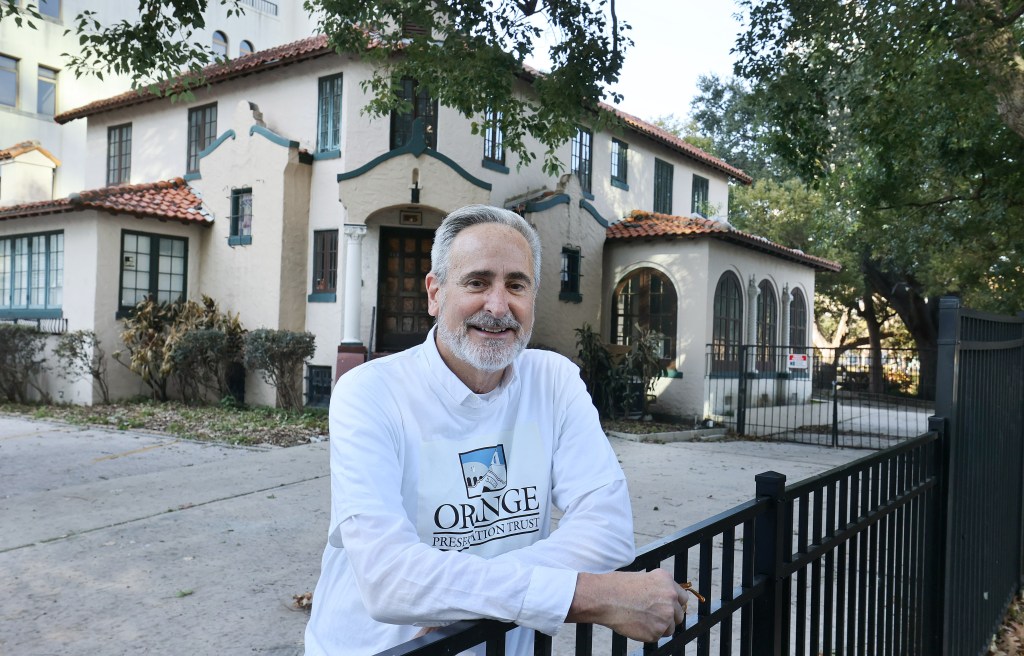
The last remaining historical home facing Lake Eola could be demolished so the park’s entrance can be expanded, and that has upset residents who think the nearly 100-year-old Mediterranean-style building should be preserved.
Lubbe House sits at the southwest corner of the lake, near the intersection of Rosalind Avenue and Central Boulevard in downtown Orlando.
City officials have not confirmed they want to tear down the old building, but their plans for a new entrance to Lake Eola park at that intersection have alarmed those who want Lubbe House preserved.
City Commissioner Patty Sheehan is among them.
“We always seem to be able to find money to do all kinds of multi-million dollar projects, but we can’t seem to do something that would save a beautiful building,” she said.
It is “too premature to say” what the city plans to do with the house, said Ashley Papagni, a city spokeswoman.
To create a new entrance to the park, the city plans to tear down the City Centre building it owns on E. Central Boulevard. Lubbe House stands next door to that structure.
The goal is to create a new signature entryway, with a plaza, a shade structure and a direct view of the famous fountain at the center of the lake. That project is to be completed in the next year or two.
The city obtained Lubbe House last year with the help of the Orlando Land Trust, an organization dedicated to preserving and expanding Lake Eola, which raised money for the purchase of the property.
The house was purchased for more than $2.5 million, according to the Orange County Property Appraiser’s Office.
At the time, trust members believed the Lubbe House, built in 1927, would be incorporated into the design for the park expansion, said Raymond Cox, a member of the Orange Preservation Trust.
But now they’ve heard city officials may want to demolish it instead because renovations would be costly.
“They’re trying to create something they think that the public wants without the public involvement in it,” Cox said.
The trust wants the property to be designated a landmark, which would prevent the city from demolishing it, and it has started that process.
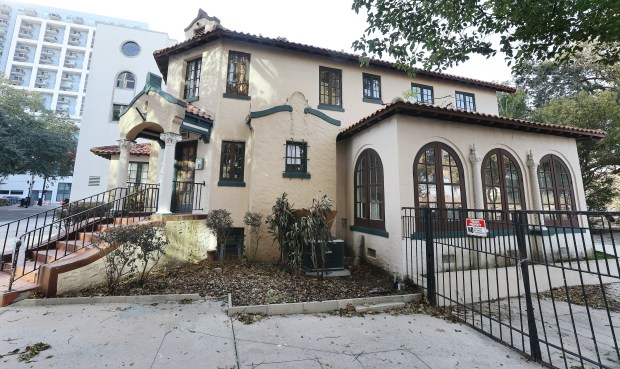 The Lubbe House, on the southwest corner of Lake Eola Park, is pictured on Tuesday, February 10, 2026. It was built in 1927 and it was acquired by the city in March 2025. (Stephen M. Dowell/Orlando Sentinel)
This is not the first time the community has fought for Lubbe House. The home was slated for demolition about a decade ago to make space for a high-rise building. But several residents created the trust and raised money to buy the house and another nearby property.
Cox said that history means the city should be more sensitive to what the public wants for the land. “The irony of this whole thing is the city wouldn’t have this if it wasn’t for those of us who fought for the high-rise from going up,” Cox said.
Sheehan, whose district includes Lake Eola, believed the Lubbe House would be renovated into a tea house, named after Lynn Long and Eugenia Sefcik, two of the co-founders of the Orlando Land Trust.
Others have said they envisioned something like the iconic Tavern on the Green restaurant in New York City’s Central Park.
Sheehan found out about the possible demolition from Cox and said, when she contacted city officials, she was told the cost to renovate Lubbe House might be prohibitive. She has not been provided requested cost estimates, she said, and this week still had no new information on the plans for the old house.
Papagni, the spokeswoman for the city, turned down an Orlando Sentinel request for an interview about Lubbe House with David Barilla, executive director of the Downtown Development Board, which is heading the park project. He said last month the city was evaluating the house before determining its plans.
Connie Geller, a descendant of the Lubbe family, said the house should be designated a landmark to honor the idea of the American dream. She recently wrote a letter urging city commissioners to preserve the house.
Her great-uncle John Peter “Hans” Lubbe, a German immigrant, built the house in 1927 as a home for himself and his wife. The couple had moved from New York to Orlando after the death of their two children, Henry and Helen.
“It was this desperate search for a permanent sanctuary and healing air that brought them to the shores of Lake Eola,” Geller wrote.
The two-story house covers over 3,500 square feet. It was designed by Peter Samwell, who was also the architect for the Park Plaza Hotel in Winter Park. It featured three bedrooms, two sun porches and a balcony.
The city’s Historic Preservation Board was supposed to discuss the house’s landmark designation at a meeting this month but the hearing was delayed until March.
Andrea Otero, another spokeswoman for the city, said the board needed additional time to review the request and to ensure it had “complete and accurate information.”
Geller said she hopes the delay means the city will reconsider its plans. “Let us celebrate the Lubbe house in its 100th year in 2027 as a preserved treasure, not as a memory,” she wrote.