
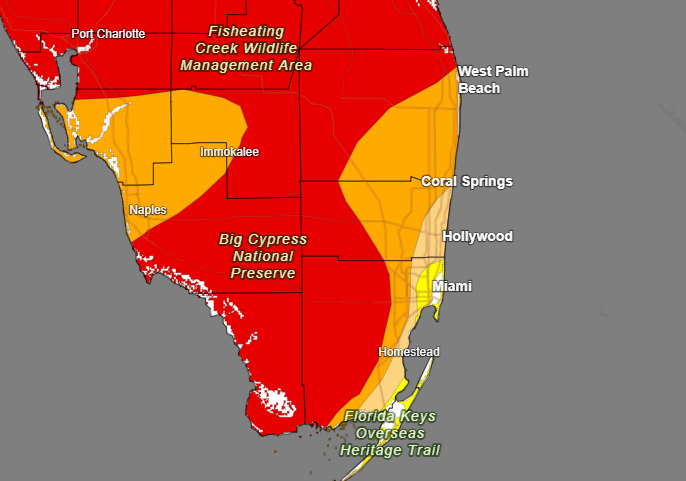
South Florida is in for a dry hot spring this year, says the National Weather Service. Their latest predictions say temperatures are likely to be above normal, and rain levels are likely to be below normal through April.
The region is currently experiencing the worst drought in 25 years, which came on the heels of a dry 2025. Forecasters said the parched conditions will continue through the spring.
“It’s gonna be slow to get rid of this drought,” said AccuWeather meteorologist and long-range forecaster Paul Pastelok. “We’re so far behind right now — we’ve been in dry conditions since the beginning of December.”
Rainfall since Nov. 1 is 59% below normal in parts of Broward County. Lake Okeechobee, a portion of which is in northwest Palm Beach County, is about 2 feet below normal. And the Biscayne Aquifer — which sits below parts of Broward, Palm Beach and Miami-Dade counties and supplies our drinking water — is below average for this time of year.
Though it’s normal for winter to be dry, current conditions are unusual. According the the South Florida Water Management District, the bulk of Broward, Palm Beach and Miami-Dade counties have had only about 15% to 20% of their normal rainfall in the past 30 days.
Earlier this month, Palm Beach County enacted a burn ban and the water management district issued a water shortage warning for Miami-Dade and Monroe, Collier, Glades, Highlands and Lee counties.
Wildfires have become a concern. There are currently 71 wildfires burning in Florida, many of them contained. Most are in Central Florida, there are two in South Florida — both in Homestead.
How the drought started
Chris Fisher, meteorologist with the Miami office of the National Weather Service, said a dry 2025 primed South Florida for the drought we’re in now. The lack of tropical systems over the summer meant less rain, and the late season La Niña made things drier as well.
“We didn’t go into this current dry season with any sort of surplus (ground water) because we didn’t get any significant rainfall amounts from tropical systems. Our climate depends on the second half of the rainy season. … So we were primed to go right back into drought this year.”
“We are still in a La Niña pattern and that favors drier-than-normal and warmer-than-normal conditions,” Fisher said.
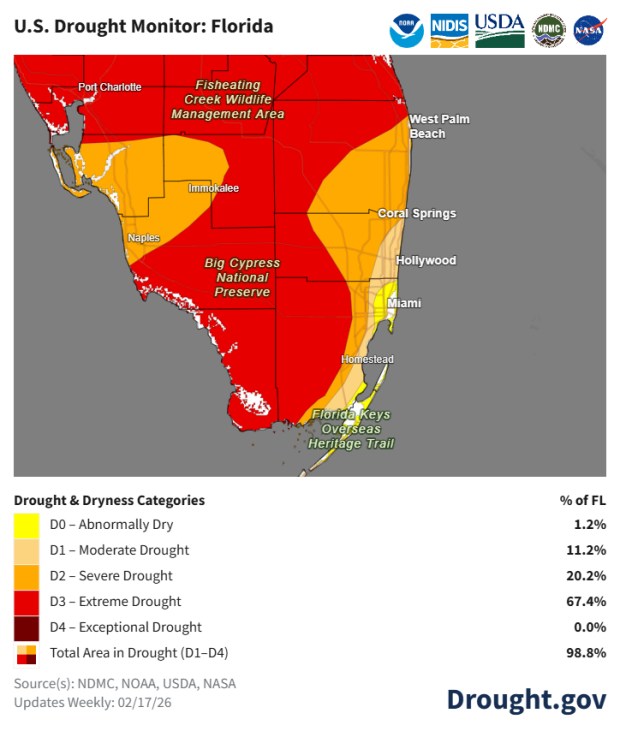 This map show areas of drought across South Florida as of Feb. 17, 2026. (Courtesy, Drought.gov)
La Niña pushes the jet stream farther north as it carries storms across the U.S., leaving the south relatively dry.
The jet stream is not lining up to deliver moisture to the southeast, Pastelok said. “Everything is focused in the west and lifting out towards the great lakes and northeast, and not digging into the southeast, which is how we get our precipitation at this time of year. That pattern persists all the way through February and into the first week of March.”
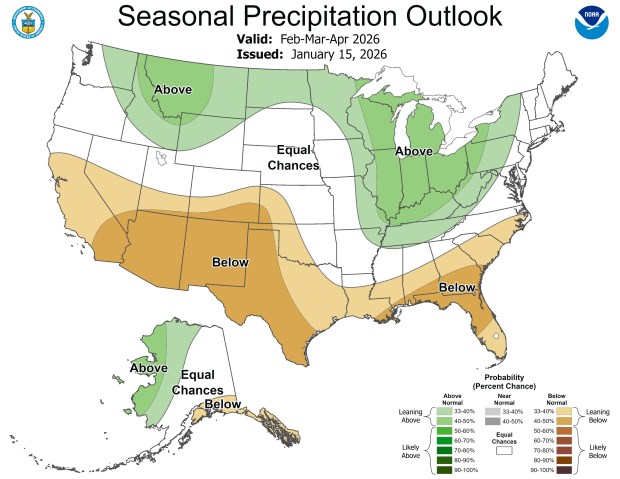 The northward position of the jet stream should keep the northern tier of the U.S. wet for the next three months and the South dry. (Courtesy NWS)
Fisher said the La Niña is expected to shift to a neutral position by late spring or early summer. “By the peak of hurricane seasons, we may even be in a weak El Niño pattern,” he said.
A neutral El Niño-La Niña pattern favors higher rainfall chances overall, said Fisher. “That timing will work pretty well with entering into the rainy season, which starts in mid-May here.”
AccuWeather’s Pastelok also said he expects precipitation to pick up again in May and June.
Impacts
“Drought heading into two driest months of the year (March and April) will be an issue for South Florida … with the potential for wildfires,” said Fisher.
Drought can be brutal for the Everglades, which has suffered over the decades as South Florida’s canal system diverts fresh water from Lake Okeechobee to agricultural needs, or to the coast, where it damages estuaries.
A summer drought in 2015 caused areas of Florida Bay in Everglades National Park to become hypersaline.
When summer water temperatures soared, the hot salty water was unable to hold enough oxygen, and seagrass beds were unable to produce enough oxygen to survive. A massive seagrass die-off occurred and algae blooms spread. Eleven years later, the bay is still recovering.
The Everglades Foundation’s lead science officer, Steve Davis, sees reason for optimism this year, though. He said restoration efforts that improved freshwater flow into Everglades National Park and Florida Bay have made a difference.
“Salinity in the bay is tipping upward, and we’re seeing flows decline into the bay, but because we’ve been able to get so much flow south over the last couple of years, it’s looking OK right now. It’s not as dire as it is farther upstream.”
Areas north of the park, such as the Miccosukee Reservation, are exceptionally dry.
Davis is focused on what happens in May and June. “The concern is … a delayed start to the wet season; that’s what we saw in 2015. If the rains come in May, we should be pretty good in Florida Bay.”