
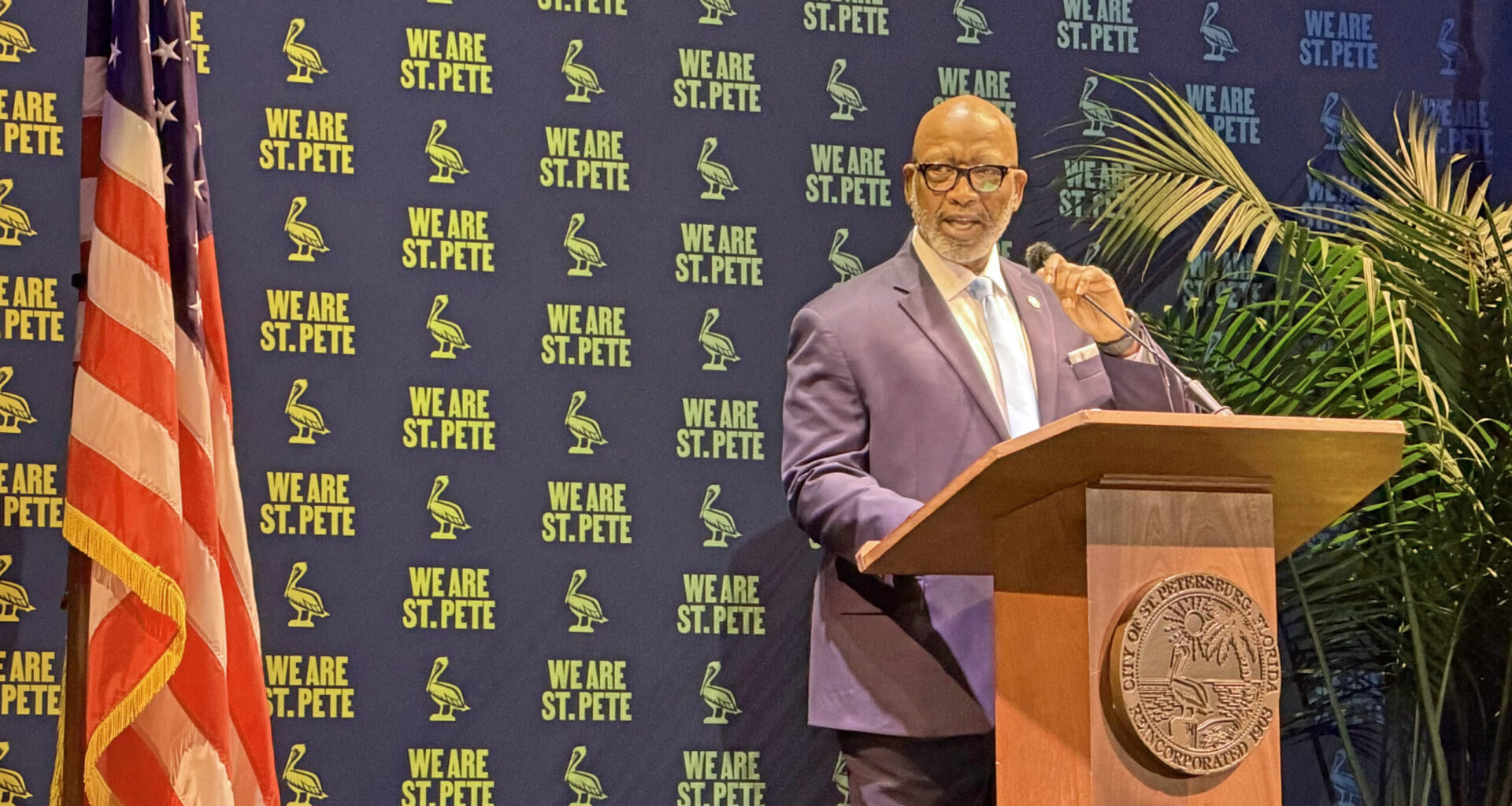
St. Petersburg mayor Ken Welch delivered his annual State of the City address Wednesday morning at the Palladium Theater. It was not only an opportunity to discuss programs and initiatives that launched in 2025, but also what lies ahead – including the future of the Historic Gas Plant District.
Earlier this month, the St. Petersburg City Council approved a resolution to pause selecting a redevelopment project so that more planning could take place.
“After terminating the Tampa Bay Rays-Hines agreements, receiving a viable unsolicited proposal and extending the total time for alternative proposal submission, now is not the time to halt the process,” Welch said. “I agree that we should plan first – as some are calling for. In my view, other than the initial construction of Tropicana Field, planning is in fact the only thing we have done on that site.”
The district, he added, has been studied as part of multiple efforts, including a 2016 master plan from architecture firm HKS and the 2022 Historic Gas Plant Redevelopment request for proposal.
“I’m compelled to honor the promise that I made as a candidate to move us forward on the development of this site if we have a proposal that meets our priorities,” Welch explained. “We will continue with the discipline and transparent evaluation of what has been submitted.”
The administration plans to work alongside the City Council as it reviews proposals. “We’ll make every reasonable effort to accommodate that request in a way,” he added, “that does not return us to paralysis or postpone the progress that may be possible.”
Welch spoke about other projects in the works. These include affordable housing and infrastructure resilience initiatives.
Multiple affordable housing communities are set to open soon, he said. These include Habitat for Humanity Tampa Bay Gulfside’s the Grove and the Deuces Rising Townhomes.
Recent groundbreakings for developments such as Pelican Place and the Fairfield Avenue Apartments have taken place.
“Right now, there are 238 workforce units and 571 affordable units under construction,” Welch explained. “Many of these units will come into completion before the end of the year.”
He explained that residents will be able to vote on an approximately $600 million general obligation bond referendum for sewer system upgrades, flooding solutions and neighborhood improvements.
Eligible individuals should be able to receive Community Development Block Grant-Disaster Recovery funds as part of the City’s Sunrise St. Pete initiative next month, Welch added. This is “financial assistance to help with home repair, rebuilding, elevation and reimbursement” for residents impacted by Hurricanes Idalia and Helene, according to the City’s website.
The Manhattan Casino, an event hall known for its cultural impact on the local African American community, is anticipated to open this summer after an extensive renovation effort, Welch said.
Progress is being made on the St. Petersburg Municipal Marina redevelopment project as well, he added. Interviews with design and build teams that responded to the City’s request begin this week.
In a review of what the St. Petersburg government was able to accomplish in 2025, Welch discussed specific initiatives within his Five Pillars of Progress:
Housing opportunities
Welch spoke on the City’s housing efforts. Last year, he said, 434 multifamily affordable/workforce units, 122 accessory dwelling units and 24 affordable homes were completed.
St. Petersburg also became the first municipality in the state to adopt the Yes in God’s Backyard Provision in December – which allows affordable housing to be built on church property.
Educational initiatives
The city’s library system launched the Bookmobile to make reading more accessible last summer. Additionally, the renovated President Barack Obama Main Library re-opened in September.
In July, the City and the University of South Florida collaborated on Camp Bullseye– which introduced the college experience to middle school students while allowing them to learn about marine biology, entrepreneurship and journalism.
Neighborhood safety
Total crime was down 16% in 2025, Welch said. Additionally, the City recorded the lowest number of homicides – 10 – since 1967.
The St. Petersburg government invested in various infrastructure and safety projects as well, he added. These included expanding walking and biking options. The City was officially designated as a Trail Town by the Florida Department of Environmental Protection in January.
Welch said that 24 community cleanups took place to remove over 50 tons of trash from “streets, parks and public spaces.” Additionally, more than 900 storm drain placards were installed to “raise awareness about water quality.”
Infrastructure and resilience
The City developed the St. Pete Agile Resilience Plan. This will fast-track infrastructure projects by advancing approximately $600 million in already-budgeted investments over five years.
More than 85 infrastructure initiatives were completed following Hurricanes Helene and Milton, which provided more than $47.3 million in improvements, he added. Additionally, the Resilient St. Pete Neighborhoods Pilot Project was created to engage with residents who live in nine flood-prone neighborhoods.
Welch said that the Benjamin F. Shirley Sr. Sanitation Building opened in May as well.
Equitable development, arts and business opportunities
St. Petersburg’s Building Department processed more than 54,000 permits in 2025. The City additionally waived fees for Post Disaster Emergency Permits, which provided $3.03 million in relief, he added.
A new parking garage opened in the EDGE District, with more than 550 spaces. The St. Petersburg government also reached an agreement to acquire a one-mile CSX rail segment to extend the Brooker Creek Trail north from the Historic Gas Plant District.
Welch said that the City awarded 40 Individual Artist Grants in 2025, providing $200,000 to local artists. Ten arts-based nonprofits received Level Up Arts Grants to help fund “community-based projects, youth programs and cultural storytelling.”