
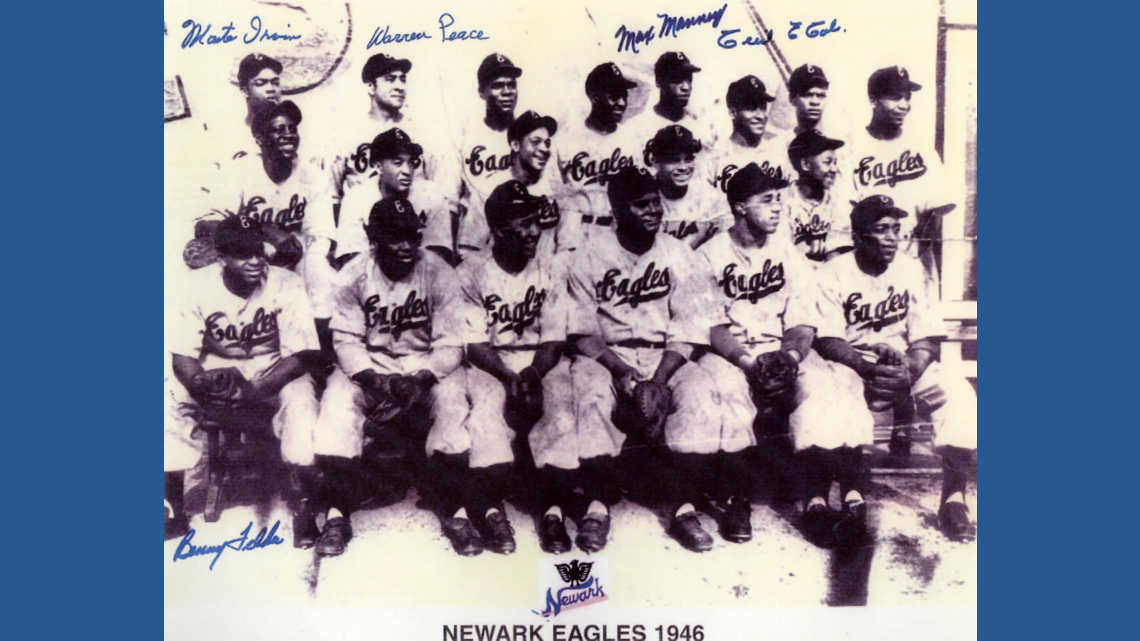
Long before MLB integration, Tampa’s Cyrus Greene Park was home to Negro League teams and players who helped pave the way for future generations.
TAMPA, Fla. — The wind moves quietly across the grass at Cyrus Greene Park. Today, it looks like any other neighborhood field.
But historians say it is anything but ordinary.
“Cyrus Greene Park in East Tampa is one of local baseball’s hallowed grounds,” Rodney Kite-Powell, a historian with the Tampa Bay History Center, said.
Before Major League Baseball integrated in 1947, segregation barred Black players from competing at the sport’s highest level. The Negro Leagues became the top tier of competition for Black athletes — and a central gathering place for Black communities.
“Blacks got together and had a wonderful time and baseball was significant in bringing those people together,” Michael Felder said, whose father, Billy Felder, was a Negro League star.
In Tampa, teams like the Tampa Rockets and the Pepsi Cola Giants played at what was then known as 22nd Street Park, now Cyrus Greene Park. The field served as home to multiple Florida State Negro League teams during the 1940s.
Among the players who rose through those ranks was a young utility player named William “Billy” Felder.
Felder went on to play for the Newark Eagles, winning the Negro League World Series in 1946. But segregation followed him everywhere — even back home in Tampa.
“The Negro and Cuban and dark-skinned ball players could not stay downtown with the regular teams,” Freddie Felder Jr., his nephew, said.
Instead, many players stayed at the Felder family home.
“As I got older, and I remembered being around those guys, I realized I was a part of history, but as a kid, we didn’t reflect on it,” Freddie Felder Jr. said.
Players like Felder weren’t signing lucrative contracts.
“You played for the glory of it, you didn’t get paid,” Michael Felder said.
Much of what is known about Tampa’s Negro League history comes from family memories and newspaper clippings preserved over decades.
“They actually had some pages devoted to Black readers, and there were, of course, Black newspapers as well,” Kite-Powell said.
One clipping shows Felder’s championship team slated to play at 22nd Street Park in the same year Jackie Robinson broke Major League Baseball’s color barrier.
“Jackie wasn’t the best, but he was the best to go because he was willing to take it,” Walter Gibbons recalled, another Tampa-born Negro League player, in a 2014 interview archived by the Tampa-Hillsborough County Public Library.
Still, integration moved slowly.
“Baseball teams were integrated 20 years or more before our schools were, and there’s something telling about that of our history,” Kite-Powell said.
By 1950, the Florida State Negro League had faded.
Felder and Gibbons did not.
Both returned to Cyrus Greene Park, coaching at Belmont Heights Little League and mentoring the next generation.
“He sponsored the ball players down at Belmont Heights, Cyrus Greene, Little League,” Candi Felder, his niece, said.
The program would go on to produce players like Gary Sheffield, who reached the major leagues — a level Felder may have only imagined.
“I think it was more for a love for the game, but in the back of their minds, I think they were thinking about the major leagues as well,” Michael Felder said.
Today, Cyrus Greene Park hosts dozens of Little League games each year.
“There’s something about that space that seems to be perfect for baseball and growing baseball talent,” Kite-Powell said.
Children now run around the same bases as Felder, Gibbons and so many others who once played there under segregation.
“Unless our history is told, nobody would ever know about it,” Candi Felder said.
For those who know the field’s story, Cyrus Greene Park is more than a place to keep score. It is a reminder of the players who built opportunity when doors were closed and of the generations who now play because they did.