
Teaching toddlers the building blocks of coding. Helping foster children succeed in a system that often abandons them. And a new way for struggling students to get the attention they need to meet critical learning goals.
These were just three of the ideas University of Miami students pitched at the Hult Competition last week, part of the inaugural “Harmonizing AI and Humanity” conference hosted by the School of Education and Human Development, held the same day at the Lakeside Village Expo Center.
The Hult Competition is the world’s largest student social enterprise pitch competition, and project ideas must address at least one of the United Nations’ 17 sustainable development goals. Winners of the global event can earn $1 million in seed funding to develop their for-profit business idea with a sustainable goal.
“This competition is a vehicle for young people at the University of Miami carrying questions that challenge the status quo,” said EllenMarie McPhillip, associate dean of undergraduate programs at the School of Education. “But to do more requires curiosity, courage, and the unwavering belief that within the question lies the opportunity to change the world.”
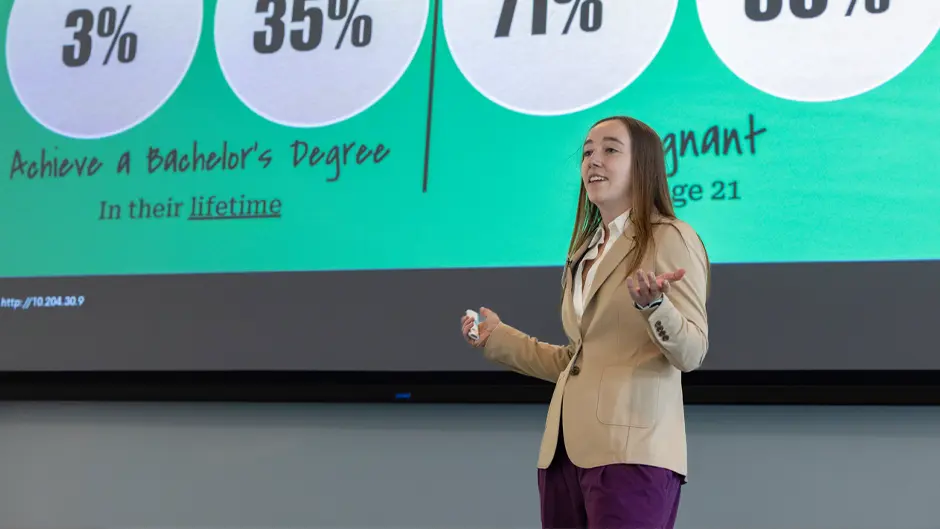
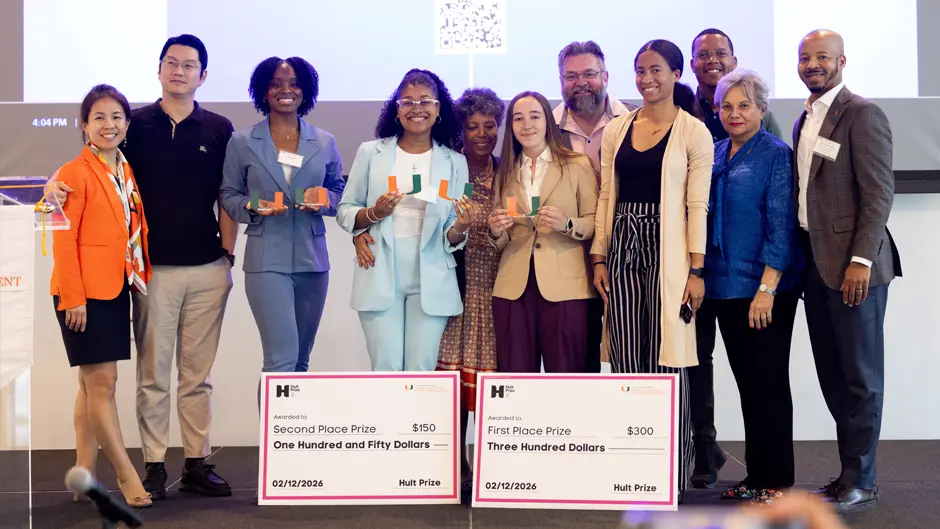 Six teams competed last week to go on to the national competition in Arizona this April, but one product called Joof—an acronym for “Just out of foster care”—led by Addison Necco, edged out the rest. First-year students Necco, and her partner, Isabella Lopez-Merlos, came up with the Joof application, which would support foster children aging out of the system who are in independent living facilities and often have phones. In her pitch, Necco explained that many young adults who age out of foster care often become homeless, pregnant, or incarcerated by the age of 21, and few finish college. As a result, their app aims to help this community thrive, with local support in areas like health, education, finances, housing, and employment.
“Some of these kids have no idea where they would sleep each night, or if there is a bank account for them,” said Necco, who is studying data analytics and intelligence for social impact as well as sport administration. “But with this app, they would have 24/7 support.”
There were many other novel ideas presented at the competition. Graduate student Daija Boyd, who is earning her doctorate in higher education leadership, and undergraduate Madison Gaynor, who is studying elementary education, teamed up to present an alternative to the current system for tracking students with disabilities called Learning Identity Plans, or LIP. These would replace Individual Education Plans, or IEPs, currently used for students with disabilities. Instead of lengthy meetings with goals that are often below grade-level proficiency, the LIPs would be updated in real time based on the child’s personality, progress, and learning style, using artificial intelligence to expedite the process.
“Right now, 91 percent of students go on to the next grade, but their passing rate is much lower,” Boyd said. “We want to use the LIP to help students’ proficiency levels rise in all subjects and to get them to a level of mastery in the material.”
In addition, a team called UFuel was designed to help students pick healthier options at the dining halls on campus, where students are often overwhelmed by choices.
There was also First Bytes, a toy created by first-year students Anabella Alvarez and Matthew Kalman—both studying data analytics and intelligence for social impact—for young children to learn computer coding through a play kitchen.
“This takes elements of block coding and combines them with a toy kitchen, so kids get the sense they are ‘cooking,’ but they are actually coding,” Kalman said.
Overall, students and faculty were glad for the experience to participate in the Hult Competition. Necco is energized to prepare for nationals by further developing Joof with Lopez-Merlos.
“I’ve always wanted to help people but didn’t know which resources to use, so this competition is a really good opportunity for me to learn how I can help people at a larger scale,” Necco said.
The last time the University hosted the Hult Competition was in 2018, when a student team came up with the idea to create an application and reverse-vending machine that allowed users to earn financial rewards for recycling. Their company, called Cycle Technology, earned third place in the University competition. The machines later made their way into major sports stadiums, and the concept was sold in 2023 to Recycle Track Systems.