
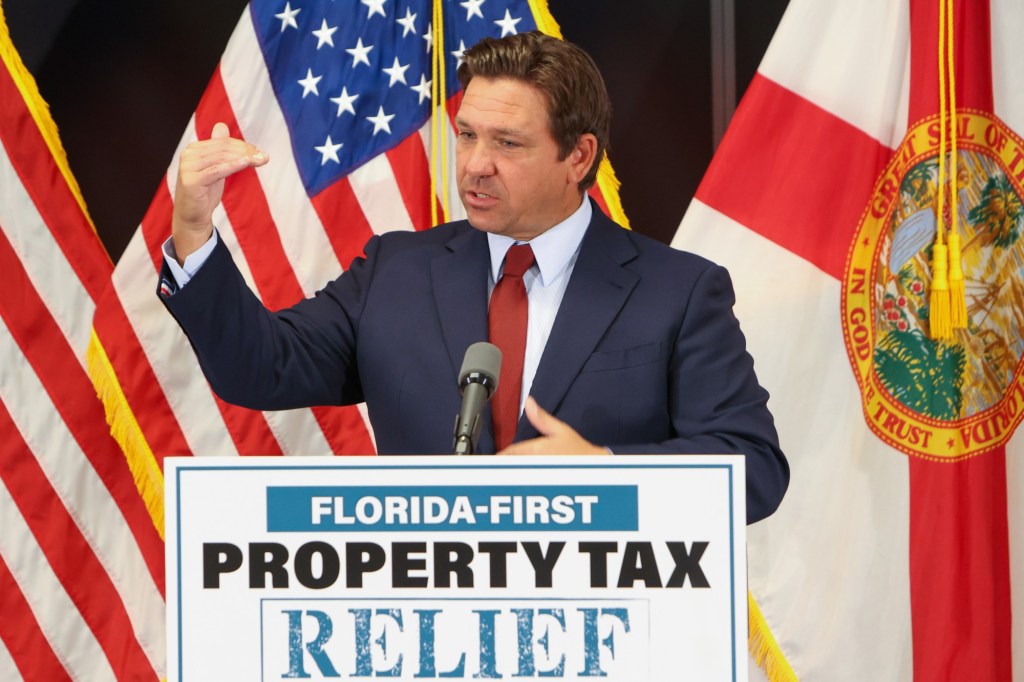
TALLAHASSEE — The Republican-controlled House pushed through an amended bill Thursday that would ask voters in November to immediately eliminate most property taxes on homesteaded property.
The bill passed on a mostly party-line vote would let voters decide if they want to wipe out all but school property taxes on homesteaded properties — a phrase which generally means homeowner-occupied residential properties — starting in January 2027.
The proposal would save some homeowners thousands on their annual bills, but could cost local governments millions and force sharp reductions in services if the tax revenue is not somehow replaced.
The amended bill, filed late Tuesday by bill sponsor Rep. Monique Miller, R-Palm Bay, did away with an earlier House plan to gradually phase out property taxes over 10 years. It means the House is now more in line with property tax reforms advocated by Gov. Ron DeSantis.
Since March, DeSantis has pushed for cutting or eliminating property taxes, but he has not presented his own proposal. It also remains uncertain what the Senate will support.
A House select committee appointed to study property tax reforms had come up with several proposals by late last year, ahead of the current legislative session. At one point, House leaders considered putting multiple proposals on the ballot and letting voters pick, but they have since changed approach.
“This is the one that makes the most sense,” Miller said.
She and other Republican leaders said Floridians are clamoring for tax breaks, and local governments have been collecting more money than they need from property tax collections. But they chose to spare public schools, which get much of their money from property tax revenue and have been squeezed by declining enrollment.
Democrats lambasted the bill as reckless and irresponsible, its justification based on anecdotes without any solid fiscal analysis of the devastating impact it would have on most communities.
“You’re about to bankrupt cities and counties across the state,” said Rep. Robin Bartleman, D-Weston, who proposed an amendment requiring the Legislature to backfill any revenues cities and counties lost if the property taxes are eliminated. It failed.
“Its’s not fair to present this to voters without knowing all the details,” Bartleman said.
An estimated 5.1 million taxpayers have homestead exemptions on their primary residence that give them a break on their taxes and limits future increases, according to the state Department of Revenue.
Cities and counties use those taxes to pay for police, fire and other municipal services.
To get on the November ballot, the House’s plan needs approval from the Senate. The Senate has not endorsed a proposal, however, and President Ben Albritton’s office did not respond to a request for comment after the House voice.
Several hours before the House vote, DeSantis posted on X that he has been working with Senate lawmakers on a tax plan, hinting that it might not be ready until after the regular two-month session ends March 13. The governor doesn’t have the power to put a constitutional amendment to voters and must rely on cooperation from the Legislature to get such a measure placed on the general ballot.
“Given that it can’t be voted on by the people until November, it’s better to do it right than do it quick?” DeSantis posted.
Reached after the House vote, his office refused to provide any further information.
Thursday’s House vote was 80-30 mostly along party lines, with one Democrat – Rep. Leonard Spencer of Orange County – voting with Republicans.
“I don’t agree with a lot of the possible results of ending property taxes. This money pays for important things in our communities, and they might go away if this becomes law,” Spencer said in an email to the Orlando Sentinel. “But I have heard from many people in my community that they are struggling. The cost of groceries, health care, insurance, and taxes have all gone up. For my particular community, I decided to vote yes today.”
The original bill, with a 10-year phaseout, would have had a first-year impact of $4.8 billion statewide and an overall impact of $14.7 billion, Miller said.
She didn’t offer a new calculation for what the impact would be if non-school homesteaded property taxes were eliminated all at once, but one state report estimated the cost could be as much as $18 billion a year.
Miller said she was not concerned about the ability of local governments to absorb that loss, citing CFO Blaise Ingoglia’s “audits” of the state’s largest cities and counties, mostly controlled by Democrats, that found they are overtaxing their residents and overspending.
“This will stimulate a culture of thrift,” she said.
Orange County would lose $500 to $600 million a year if the resolution goes through, said Rep. Bruce Antone, D-Orlando. “That’s seven, eight percent of our budget,” he said.
The county depends on those property tax revenues to deal with tremendous growth in the past five years, Antone said. The county is growing at a rate of 2,500 new people a day, or 500,000 a year, he said. And the popular tourist destination sees 200,000 tourists driving on the county’s roads every day.
“The demand on infrastructure is tremendous,” Antone said.
Rep. Christine Hunchofsky, D-Parkland, said more than 100 small Florida cities would have to give up their police departments if voters approve the resolution.
Miller responded that those “boutique law enforcement divisions” could be absorbed into the county sheriff’s department.
Rep. Anna Eskamani, D-Orlando said the resolution “arguably shifts the burden to renters who are struggling to achieve the goal of home ownership. I am a firm believer in a balanced tax structure that is not regressive.”
Eskamani said that those who make the most money will get the biggest break, while those who make less will see less. Those who don’t pay the homestead will bear the burden.
“I don’t disagree that we have problems with our tax system,” Eskamani said, but this bill doesn’t solve them.
Democrats also noted that the resolution was not accompanied by enacting legislation that would provide details on how to offset the loss of property tax revenue.
They said the Legislature should be focused on property insurance relief and solutions to housing affordability.
Republicans defended the bill as responding to constituents’ demand for tax relief during a growing affordability crisis.
“We are the state body closest to the people, and they asked us to come up here and spend less money,” Miller said. “They asked for relief, and they asked for that in the form of property tax removal.”
Rep. Toby Overdorf, R-Palm City, said the rise in property taxes over the years is no longer sustainable, and it was time for the Legislature to give voters a chance to decide on getting some money back.
“We are giving our voters the choice,” Overdorf, who chaired the select committee on property taxes, said. “It was your voters who put us here. We trust in the voters of Florida by putting this forward.”
If the property tax resolution is approved by the Senate and makes it to the ballot, 60% of voters would need to approve it for the property taxes to be wiped out.