
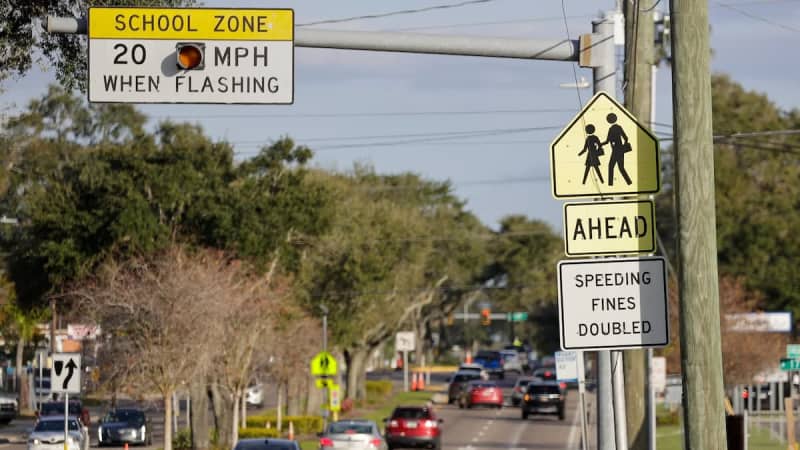
A proposal for school zone speed cameras stirred concerns about surveillance at a Tampa City Council meeting Thursday.
Council members approved an agreement in a 6-1 vote with the speed camera company RedSpeed Florida through an existing contract with the Hillsborough County Sheriff’s Office. Council member Bill Carlson voted no.
RedSpeed is “integrated” with Flock Safety, a tech company that deploys automated license plate readers for use by law enforcement, according to a proposal from the company.
But Tampa Police Chief Lee Bercaw said in a memo that state and local laws would prohibit RedSpeed from sharing data with Flock.
Tampa’s decision comes as residents across the nation urge local leaders to ditch Flock products, citing fears of mass surveillance and concerns that the information collected could be used to aid federal immigration enforcement efforts.
Flock says it does not contract directly with U.S. Immigration and Customs Enforcement, although local agencies can share data they get from Flock with federal immigration agencies.
“I don’t like Flock, and I’m worried about what is coming in our country,” council member Lynn Hurtak said. “But the safeguards around it, and the importance of the school zones, at this point, outweighs it for me.”
The piggyback agreement means Tampa will join Hillsborough County in working with RedSpeed Florida to reduce speeding in school zones, according to an agenda document. The program comes at no cost to the city. For every $100 civil penalty paid, Tampa will get $39.
In a 2024 proposal for the Hillsborough sheriff’s office, RedSpeed Florida noted its relationship to Flock.
“We have collaborated closely with Flock to optimize interoperability, and our intuitive software is already in use across the state,” read the proposal, adding that “only RedSpeed can offer integration with Flock.” Flock is “included in the RedSpeed price,” the proposal said.
For some, that languageraised alarms.
“Why are we merrily going along with erecting a surveillance state?” Rick Fifer asked council members during public comment. “No to these cameras, no to cooperating with ICE.”
He noted that the Tampa Police Department participates in the 287(g) program, an ICE initiative that lets local officers perform limited immigration agent functions.
Longtime community advocate Connie Burton said the program “might start off with good intentions, but where would that data go?”
Bercaw, in a memo, said state statute and the city’s code “would prohibit the sharing of the RedSpeed camera data with Flock, or any other vendor, as a speed detection system in Florida is prohibited from being used for remote surveillance.”
The RedSpeed cameras won’t incorporate automated license plate readers, he said.
The proposal for the Hillsborough sheriff’s office created confusion, Bercaw said, because it “was designed for Georgia and not Florida law.”
Greg Parks, who works with RedSpeed Florida, said the company “has no relationship with ICE.” RedSpeed works with roughly 50 communities across Florida at no expense to taxpayers, he said.
“Speeding is down 90% and less than 10% of people get a second ticket,” Parks said. “It’s dramatically improved safety.”
Tampa was among the first Florida municipalities to implement a 2023 state law that allowed speed cameras in school zones. City Council members in 2024 approved their installation around more than a dozen schools.
Council member Alan Clendenin was the lone vote against the cameras that year. Automated law enforcement was “a slippery slope,” he said.
Council members openly grappled with the decision Thursday.
Hurtak spoke about the federal immigration crackdown in Minneapolis.
“Flock cameras have played a large part in that,” she said. “I’m having a very hard time approving anything that has to do with Flock in our city.”
For council member Luis Viera, “this is only something that’s going to go for the protection of children, for public safety and issues like that.”
Clendenin said he doesn’t “like the government having this kind of technology,” but that he has been “inundated” with public comment in support of the project.
“Who am I,” he said, “to stand in front of what people want?”