
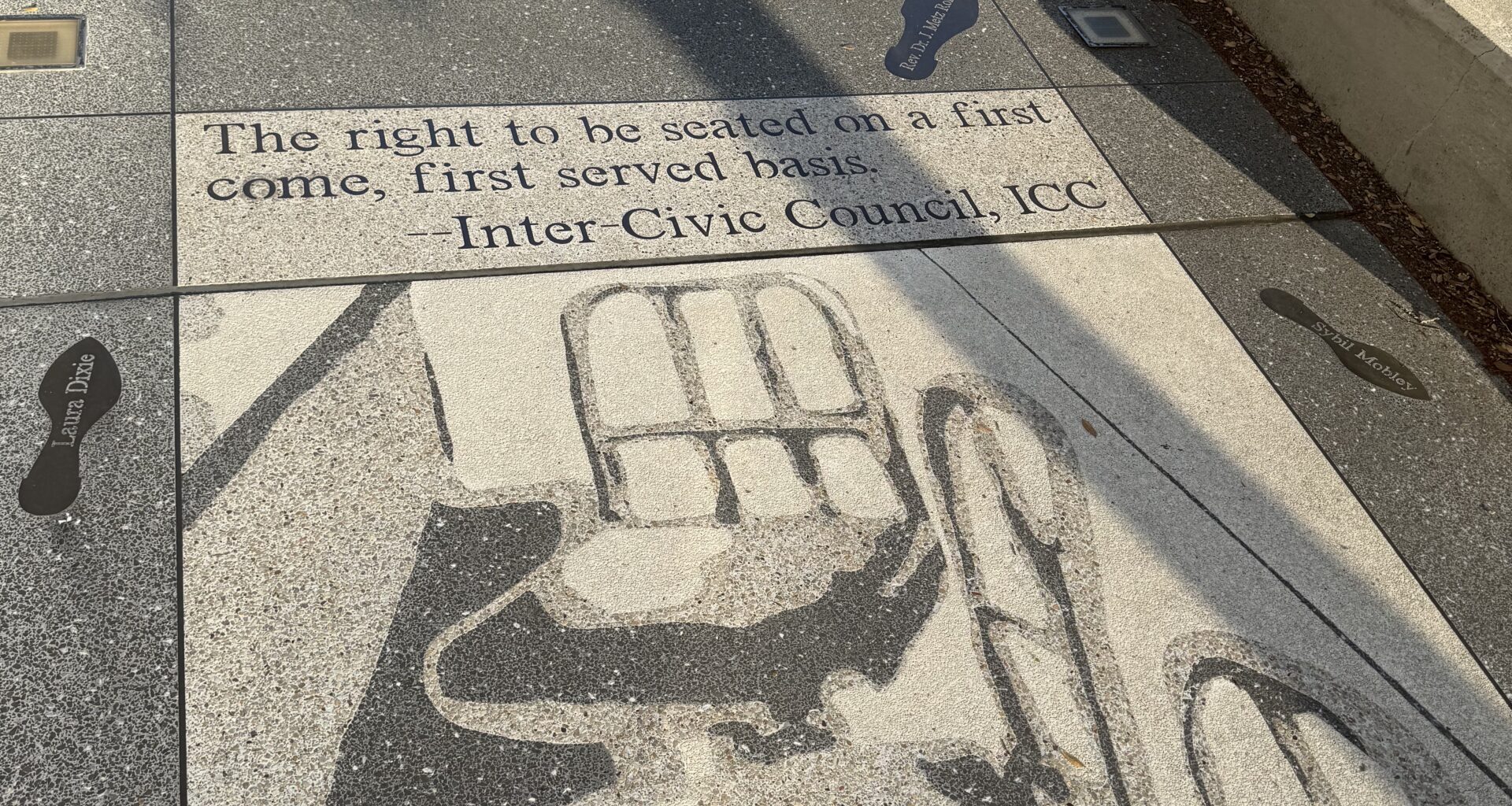
Florida’s Capital city is home to the Civil Rights Heritage Walk, which commemorates two major civil rights events in Tallahassee: the bus boycott of 1956 and the lunch counter sit-ins from 1960 to 1963.
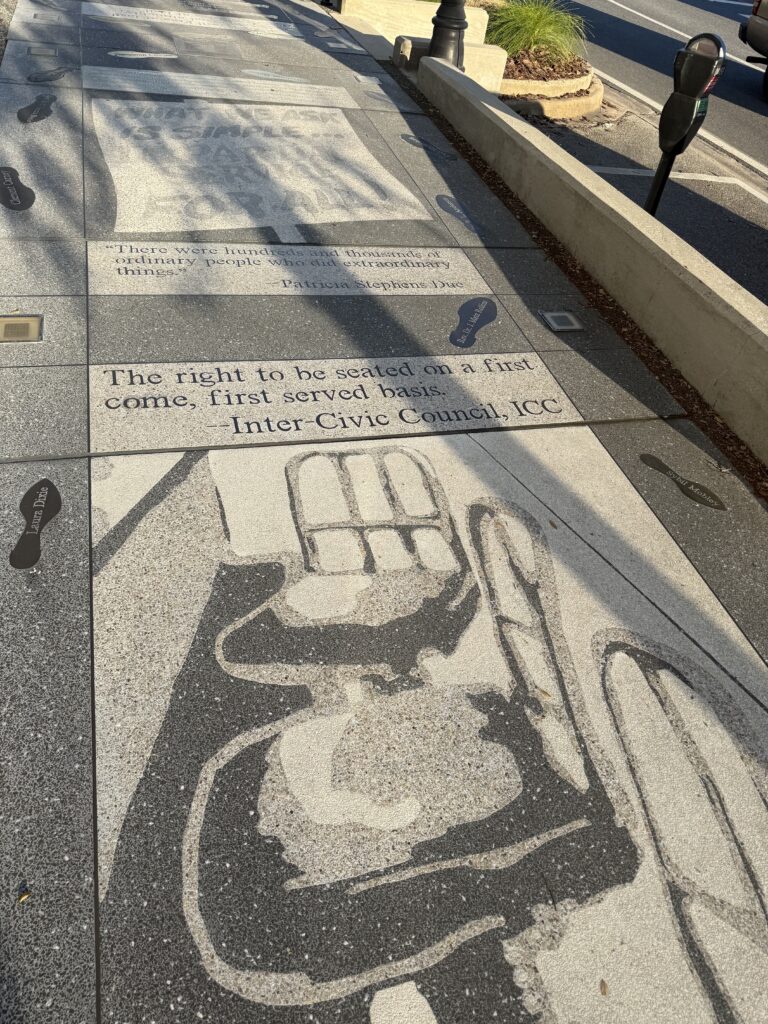 Inter-Civic Council quote displayed at The Civil Rights Heritage Walk in Tallahassee, FL. (Kennadi Gaither/FAMUAN)
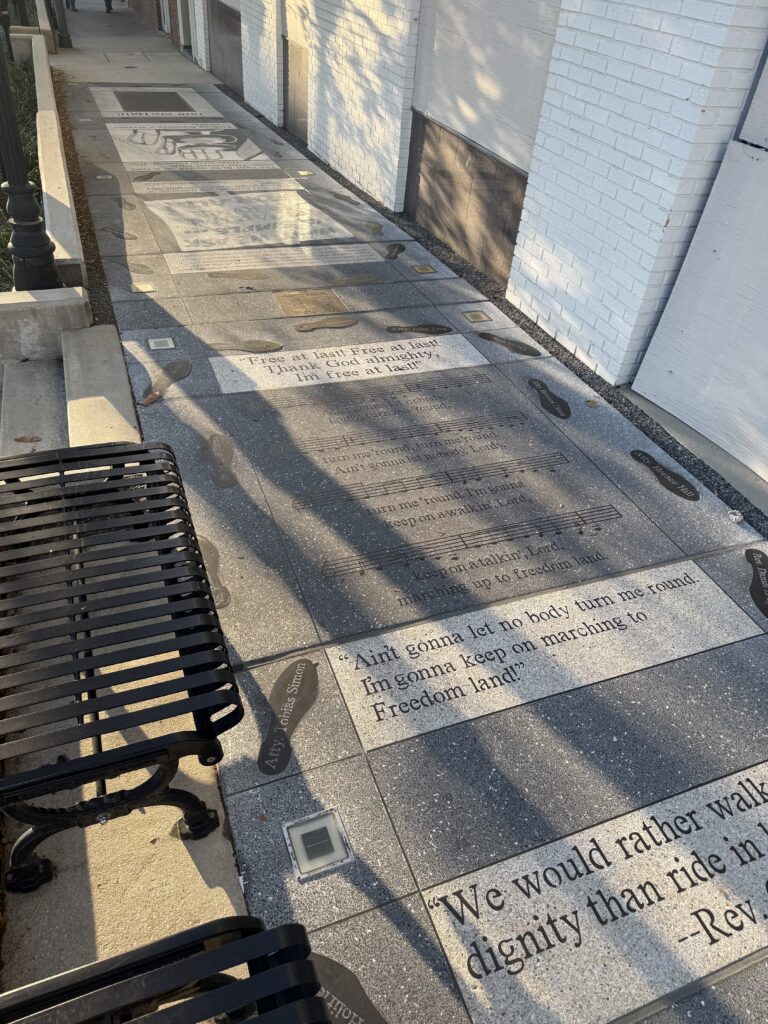 The path at The Civil Rights Heritage Walk in Tallahassee, FL. (Kennadi Gaither/FAMUAN)
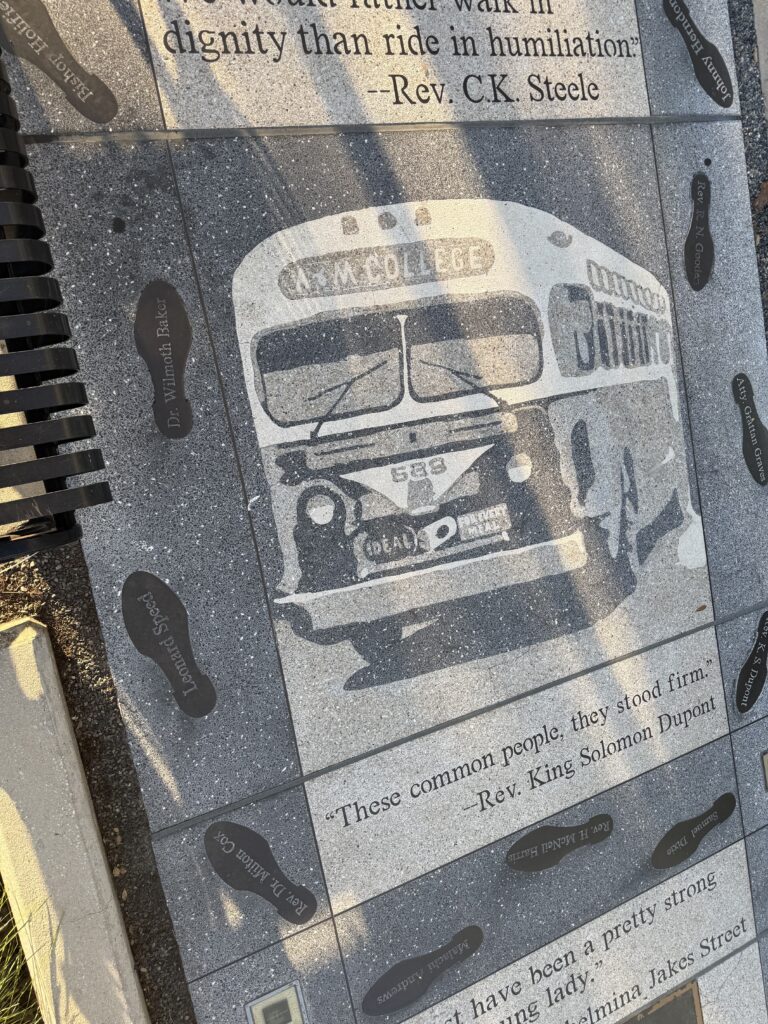 The Tallahassee Bus Boycott represented at The Civil Rights Heritage Walk in Tallahasee, FL. (Kennadi Gaither/FAMUAN)
Although this historical monument represents two pivotal movements in the civil rights era, not everyone feels that this is the message conveyed.
“I do believe this is a poorly made monument,” said Kimberly Williams-Chatmon, a professional researcher and historian. “It is exactly as you described, a sidewalk. The civil rights movement in Florida is often overlooked.”
The monument is less than half a block long, with only one sign indicating what this piece is about. The sign describing the memorial is across the street in front of the Leon County Courthouse.
“The monument is absolutely hidden; it took me over 20 minutes to find it!” Williams-Chatom said. “Why was the monument not located near or on the FAMU campus?”
This artwork was created by Florida State University’s Master Craftsman studio, which has made monuments such as Florida State University’s Legacy Fountain and the United States Air Force Memorial. Their work is prominent in Tallahassee, but this particular piece is less well-known.
“I did not know about this monument that was unveiled in 2013,” said Kina Morgan, a 1994 graduate of FAMU. “I think it is important to make sure we are aware of all the history that happens throughout the years.”
Morgan was unaware of the Civil Rights Heritage Walk. Even though activism played a significant role in the 90s, this monument fails to reach a level that correctly displays that.
“I know back in my day, in the early ’90s, we had several marches to the State Capitol for various reasons, making sure that we have great markers and leveraging social media and websites to talk about our history,” Morgan said.
Bringing awareness and proper recognition to this monument is key to highlighting Tallahassee’s civil rights, but maybe a complete renovation should take effect.
“I would change the monument by constructing it as an actual monument; that is a sidewalk, not a monument,” Williams-Chatmon said. “I would construct something that onlookers can take photos of next to and admire while looking up, not down to.”
This monument that sits on the sidewalk on the other side of the street from the State Capitol on Jefferson St., lacks the substance and notoriety that it should have.
“Having to put our heads down to view anything regarding Civil Rights as a monument should be a sin. I feel that was intentional,” Williams-Chatmon said.
She feels that this heritage walk tells no history and dilutes the history and impact brought to Tallahassee.
“Many people are unaware that MLK, a colleague of C.K. Steele, wrote letters to him speaking to the efforts for Civil Rights in Tallahassee because of the Southern Christian Leadership Conference,” Williams-Chatmon said. “The bus boycott is not a small-town story but a historical event.”