
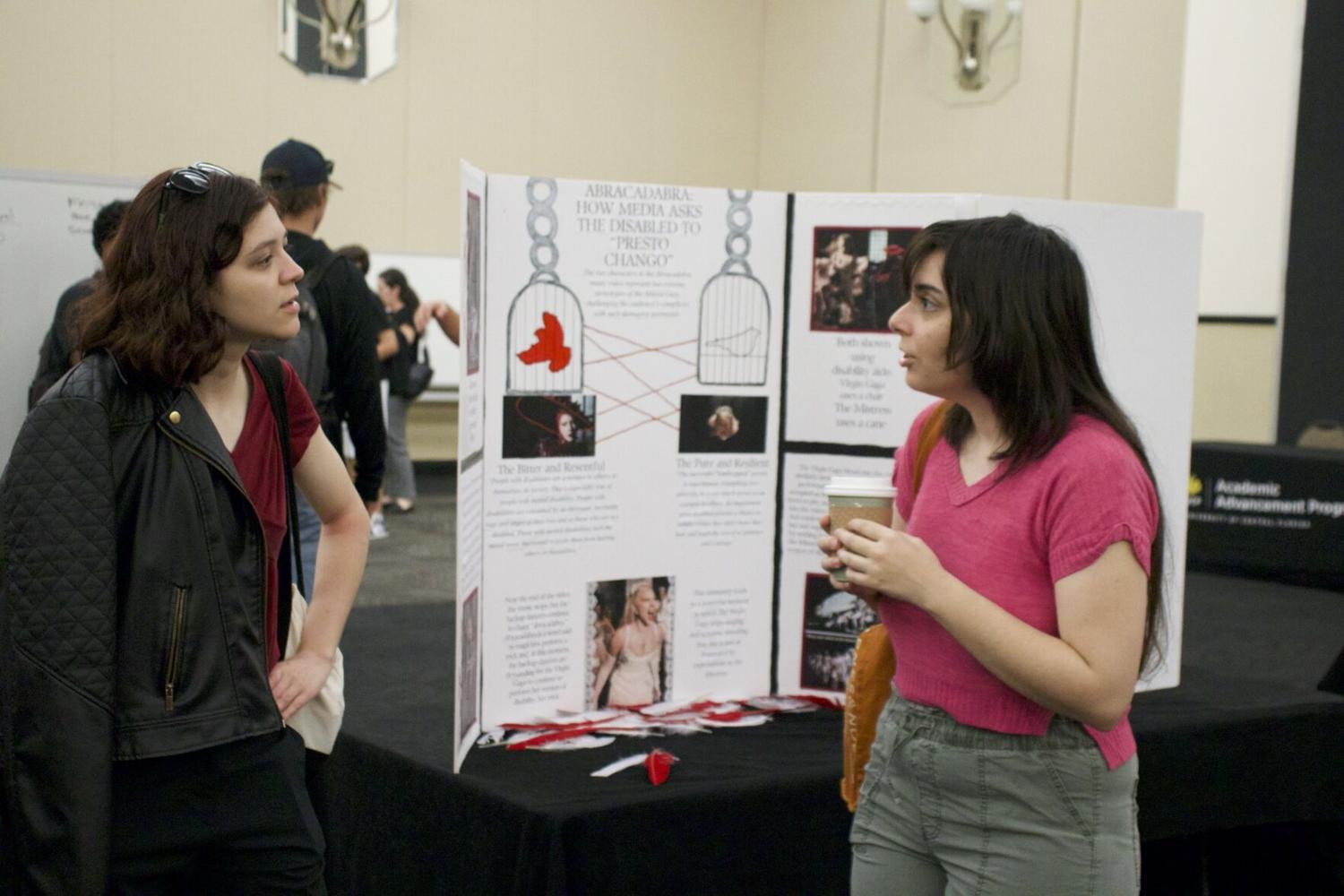

Madelyn Alvarez (left), senior writing and rhetoric major, and Nicole Julie (right), junior writing and rhetoric major, discuss Alvarez’s multimodal poster on Lady Gaga’s “Abrcadarbra” music video in relation to disability rhetoric at the Knights Write Showcase on Wednesday. The annual event highlights selected students’ presentations of class projects in the Writing and Rhetoric Department.
Emmy Bailey
More than a display of assignments, the Knights Write Showcase event revealed how writing at UCF moves off the page and into public conversation on Wednesday in the Pegasus Ballroom.
Held each year since 2010, the event, hosted by the Department of Writing and Rhetoric, highlights undergraduate and graduate research and creative work across disciplines. What began as a platform to display student projects has grown into a university-wide staple showcasing writing in a range of contexts, formats and fields.
“Our university values writing and the arts,” Stuart Dees, a first-year composition class associate instructor who has helped run the showcase since joining the department, said. “So it’s a really nice celebration for showcasing the work that students produce, both undergraduate and graduate.”
For many students, the event marked their first opportunity to share their research publicly.
“I had a student one year who was really hesitant to speak in front of a crowd and share their work,” Dees said. “But they presented their work, and they told me how much better they felt not only themselves but their public presence.”
One featured panel, “Communicating Scientific Information in Visual and Narrative Forms,” explored how storytelling and design intersect with health and medicine. Students from the courses graphic medicine and writing about health and medicine examined how narratives and comics can convey complex medical information.
Silviana Buzatu (second from right), senior clinical psychology major, speaks during a panel discussion about how tone and facial expressions influence what people believe at the Knights Write Showcase on Wednesday. The panel examined how narratives can interact with health and medicine to convey information to audiences.
Emmy Bailey
Aden Abramovitz, junior biomedical sciences major, presented a project transforming medical information into a comic strip format.
“I learned that communication is not just through words, but through symbols as well,” Ambramovitz said. “I didn’t realize that it could transcend more languages than I thought.”
Though initially nervous, Abramovitz said he grew more confident as he shared his work.
“I feel like it’s important to let people know about the use of comics in medicine,” Abramovitz said.
Beyond panels, students presented multimodal posters covering topics such as literacy and language, rhetoric within diverse communities and pop culture analysis. Attendees circulated through the ballroom, asking questions and engaging directly with presenters.
Madelyn Alvarez, a senior writing and rhetoric major in the “Rhetoric in Pop Culture” class, presented a multimodal poster showcasing how Lady Gaga contributes to disability theory and rhetorical criticism.
“I wrote about Lady Gaga’s music video “Abracadabra” from a disability studies lens and how the two characters in the video represent two stereotypes of disability,” Alvarez said. “And she stares back at the audience and demands that you call into question your portrayal of disabled individuals and how you kind of limit them to their disability rather than seeing them as fully realized individuals.”
Dees emphasized that the showcase offers more than a chance to present coursework; it allows students to step into a professional space and see how their research makes an impact in the world around them.
“So it might be the students’ first chance to not only think of themselves as a student but to now feel like a scholar. This is all about students, and that’s why we are here,” Dees said.