
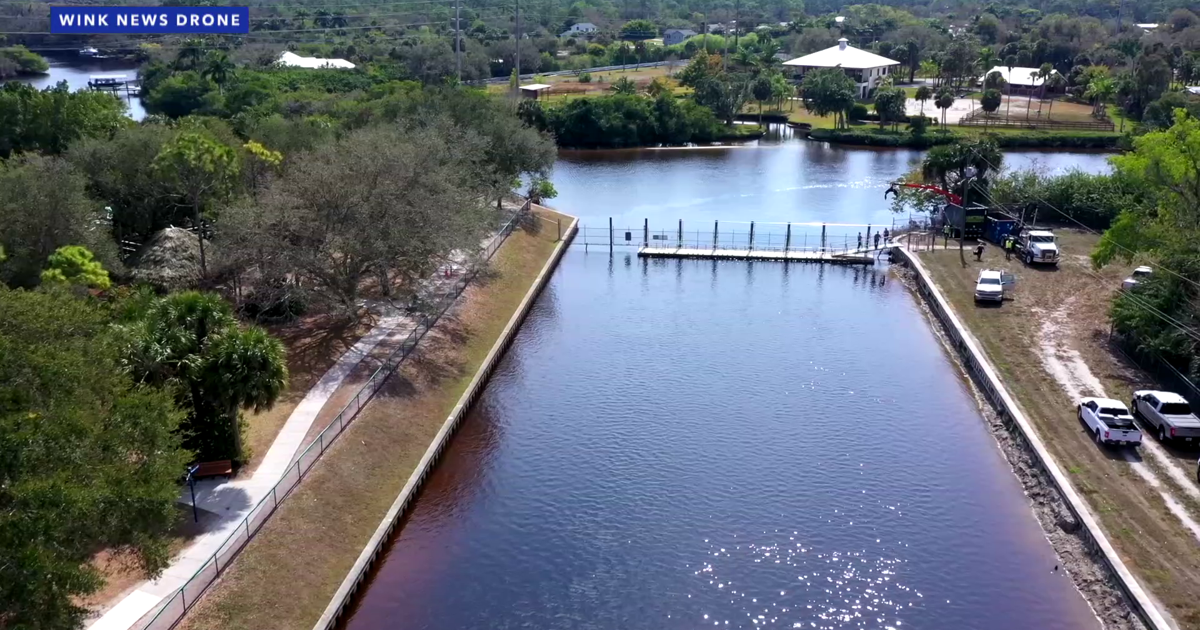
LEE COUNTY, Fla (WINK) — More than two dozen manatees found dead in Lee County in less than a week is “not normal,” according to a local conservation biologist.
The deaths, reported along the Orange River near Manatee Park, are under investigation by the Florida Fish and Wildlife Conservation Commission (FWC), which says cold stress may be a contributing factor.
Dr. Matt Ware, assistant professor of conservation biology at Florida Gulf Coast University, says the concentration and speed of the deaths stand out.
“To have 25 come in in such a short timeframe is very abnormal,” Ware said. “It’s a lot to come in, you know, all at once.”
The spike compared to recent data
According to preliminary FWC data from Jan. 1 through Feb. 13 this year:
Lee County: 18 manatee deathsCharlotte County: 4 manatee deathsCollier County: 5 manatee deathsStatewide total: 85 deaths23 of those manatee deaths are attributed to cold stress
Those figures do not include the more than two dozen newly reported deaths in Lee County.
“You take a look at 2025 strandings in Lee County, in total about 113,” Ware said. “Just in this last week, we’ve already got about a fifth of what we would have got last year. So, it’s obviously a pretty big jump, very quickly standing out.
How 2025 compares
Looking at FWC’s 2025 statewide data provides further context on common threats and mortality:
– 632 total manatee deaths were recorded in Florida in 2025.
Lee: 113 deaths (second highest in the state)Charlotte: 25 deathsCollier: 9 deaths33 manatees were diagnosed with cold stress disease50 deaths were attributed to red tide blooms25% of all deaths were caused by watercraft collisions, meaning boats remain a major threat.
FWC also notes that more than one-third of manatees that died last year did not receive a necropsy, leaving some causes undetermined.
Ware explained that not every animal can be examined due to physical limitations such as facility space, freezer capacity, carcass condition, and staffing constraints.
“We want to necropsy as many as we can, to get as full of a data set as we can. But sometimes, that’s just not practical. It’s not reasonable,” Ware said.
Why cold stress makes sense
Ware says the possible explanation FWC has given so far, cold stress, is plausible.
Manatees are highly sensitive to cold water. Prolonged exposure can cause cold stress syndrome, similar to hypothermia in humans.
“With this cold snap that just came through, that explanation makes sense,” Ware said. “That comparison would be like hypothermia for us.”
Ware says the issue likely goes beyond temperature alone. Manatees are already facing long-term stressors, including: declining seagrass beds, increasing nutrient pollution and decreasing water quality.
“They’re already in a weakened state. You’ve put them now under this, this new stressor, and now you’ve got more of them tipping over that lethal threshold than obviously we would like to see o a given day,” Ware said.
The 2021 unusual mortality event
The current spike also brings back memories of 2021, when Florida recorded 1,100 manatee deaths, the highest in recent history.
That period — from late 2020 into April 2022 — was classified as an “Unusual Mortality Event,” according to Ware.
Ware said those deaths were tied to a combination of cold stress and severe seagrass loss, particularly along Florida’s east coast in the Indian River Lagoon.
After 2021, mortality numbers returned closer to baseline:
2022: 800 deaths2023: 5552024: 5652025: 632
FWC says they are investigating to determine the confirmed cause of death in the latest Lee County cases.
Officials will examine how geographically concentrated the deaths are and whether similar spikes appear in neighboring counties.
In the meantime, Ware is urging the public to remain vigilant.
“For folks that are out on the water you see something, go ahead and say something,” Ware said.
He also encourages boaters to slow down and give manatees space, especially during the winter months when they are already under heightened stress.