
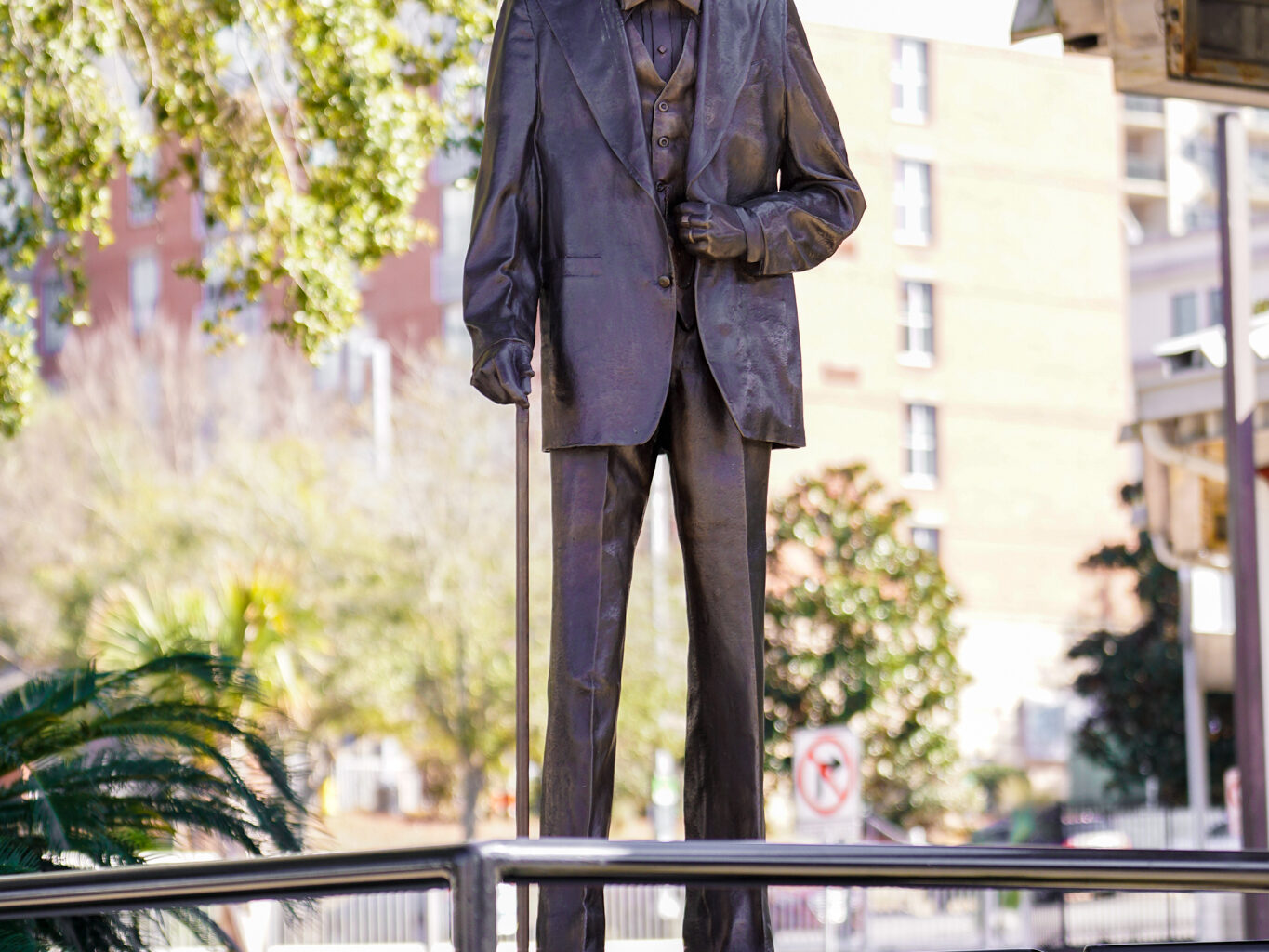
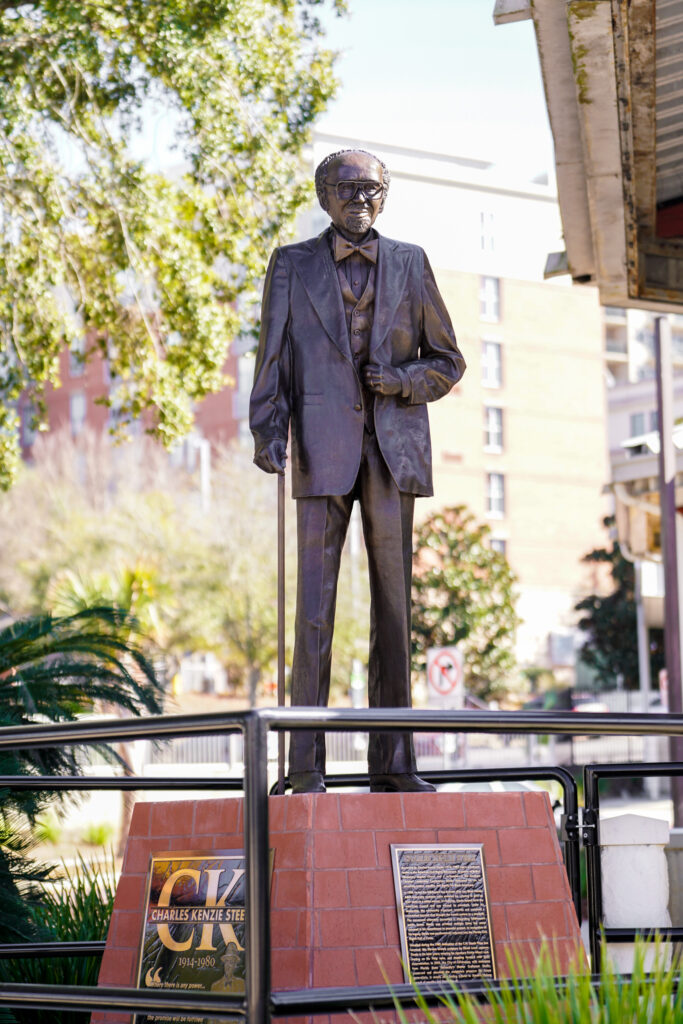
Statue of Rev. C.K. Steele’s resolute gaze over the C.K. Steele bus plaza. (Khalil-Lullah Ballentine/FAMUAN)
The solemn slogan that defined the Rev. C.K. Steele’s moral resolve at the heart of the civil rights movement in Tallahassee, Florida, was “I would rather walk in dignity than ride in humiliation.”
“I would rather walk in dignity than ride in humiliation.”
Rev. C.K. Steele
Steele, an iconic local figure, was instrumental in the student-led Tallahassee bus boycott—a 7-month-long, historic movement that ignited social change for Black people in the South and served as a precursor to other student-initiated demonstrations, such as the 1960 Atlanta and Greensboro sit-ins and the 1961 Freedom Rides.
It’s been 70 years since this resistance.
Five months after Rosa Parks’ refusal to give up her seat to a white passenger, sparking the Alabama bus boycott, two Florida A&M University students followed suit, catalyzing a similar civil rights movement in Tallahassee, which is now considered one of the major successful and economically devastating demonstrations led by African Americans.
On May 26, 1956, in the height of Jim Crow America, Wilhelmina Jakes and Carrie Patterson sat down in the only two vacant seats in the “whites only” section on a crowded local city bus.
When the two refused to move, the bus driver called the police, and Jakes and Patterson were arrested on the charge of “placing themselves in a position to start a riot.” and released on bond the same day.
Steele, an NAACP Representative and close friend of Dr. Martin Luther King Jr., visited Jakes and Patterson the next morning to express solidarity with the two.
Consequently, a cross was set ablaze in their front yard.
As news of the arrest rapidly spread through Tallahassee’s Black community, anger and unrest defined the collective emotions. FAMU Student Body President Brodes Hartley called for a student assembly, proposing a bus boycott for the remaining semester.
The Black community had a similar meeting, deciding whether to join the students’ efforts. In an unopposed vote, the Inter-Civic Council was created and formed to advocate for increased access to seating, equally hired African American bus drivers and hospitality.
Led by Steele and the Rev. D.B. Speed, the ICC established a carpool system with members loaning their cars and encouraging ride sharing for transportation. Despite arrests and legal intimidation from law enforcement, the ICC and bus boycott prevailed.
According to meeting reports documented on Florida Memory, Rev. Daniel D.B. Speed gave a summary and progress of the carpooling operations the ICC’s Aug. 1, 1956, meeting, asking more car owners to step forward to help. Within that meeting, the council amassed a little over $600 to support the carpool.
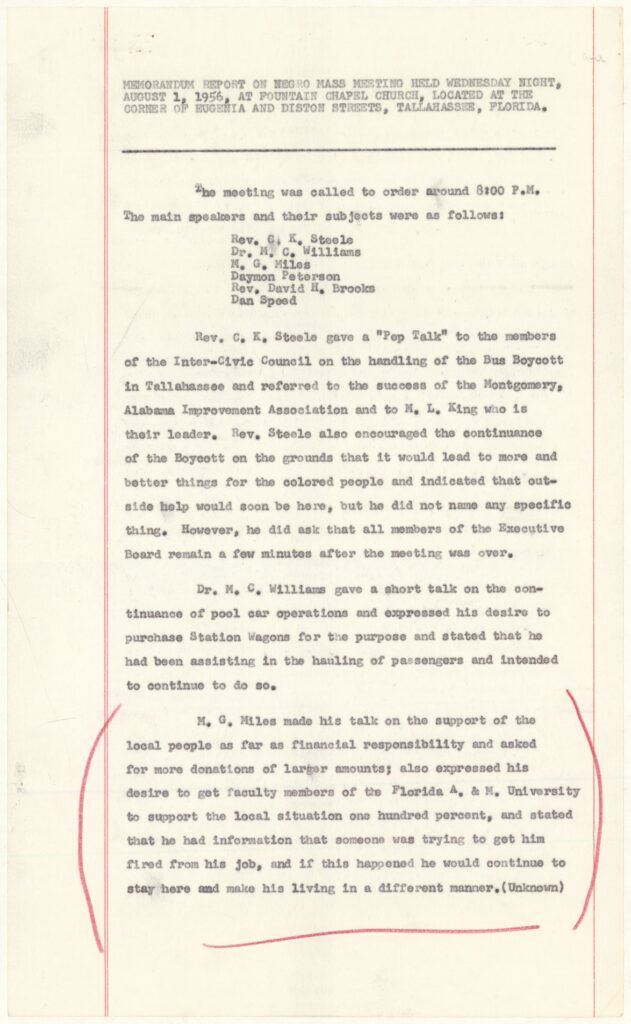
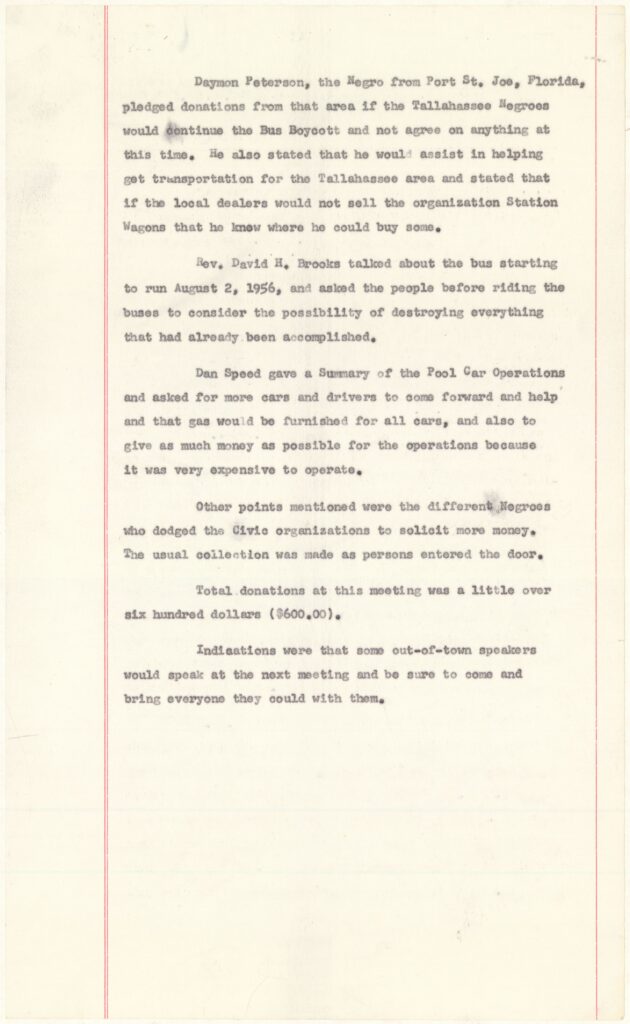
The ICC’s meeting minutes were documented on August 1, 1956. (State Archives of Florida, Series S776)
FAMU’s former Dean of Students and pastor Rev. Moses G. Miles personally saw to it that students did not ride the bus to avoid accidents. He encouraged the rest of the council to “not ride the buses at all” in a motivational speech.
With clearly defined policies in house, the ICC sent an urgent telegram to Florida Gov. LeRoy Collins.
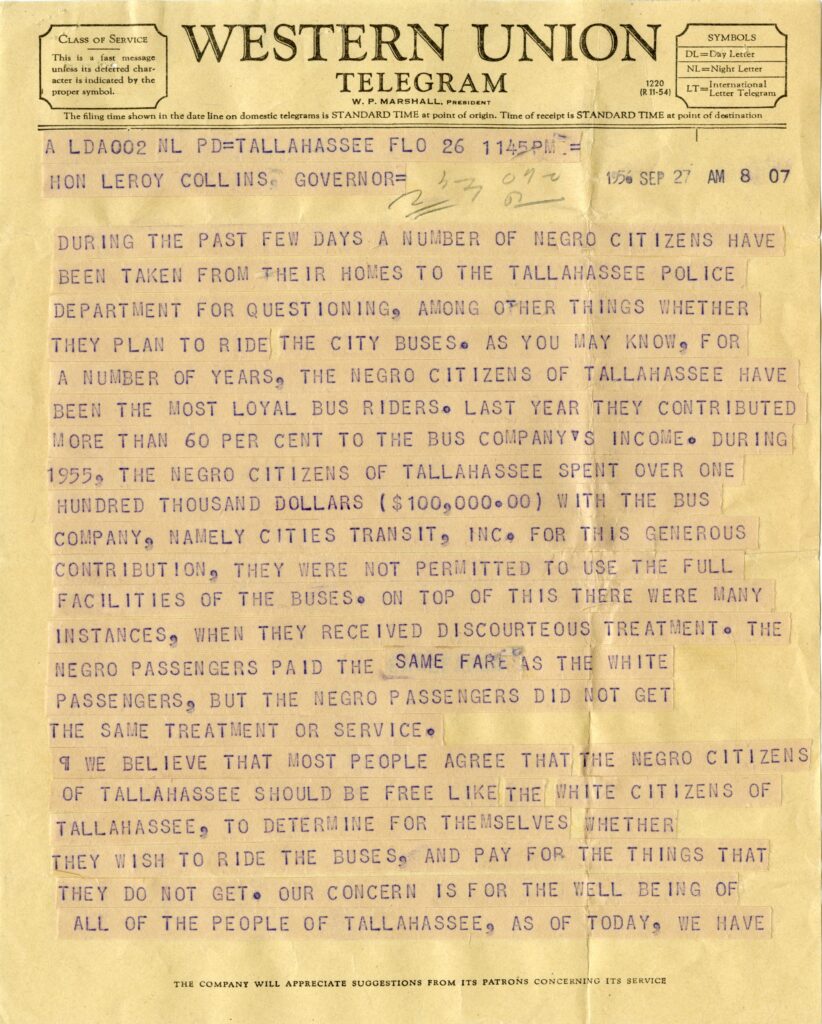
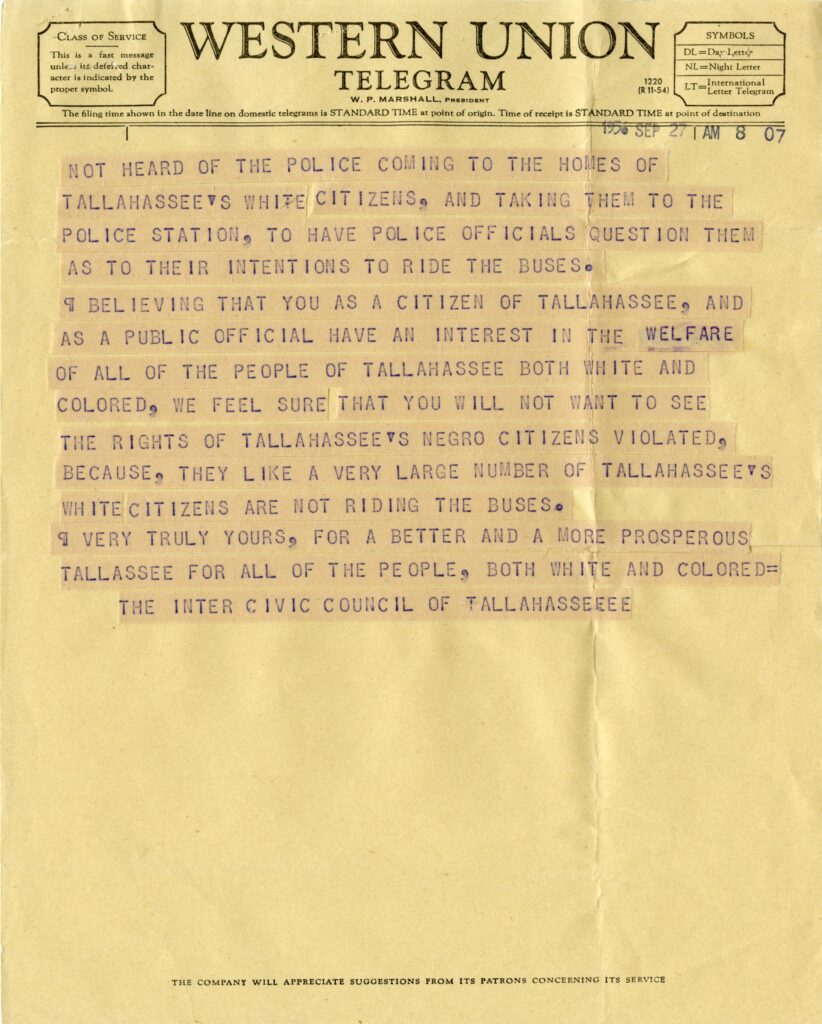
The ICC’s telegram to Gov. LeRoy Collins. (State Archives of Florida, Series S776)
“During 1955, the Negro citizens of Tallahassee have spent over 100,000 with the bus companies,” the message read. “We believe that most people agree that the Negro citizens of Tallahassee should be free like the white citizens of Tallahassee, to determine for themselves whether they wish to ride the buses and pay for the things they do not get.”
The boycott continued well into December 1956, until the U.S. Supreme Court abolished bus segregation through the 14th Amendment’s Equal Protection Clause.
“The 1956 Tallahassee Bus Boycott struck a critical blow against racial segregation in Florida’s capital city,” said Larry O. Rivers, Ph.D., University of West Georgia associate professor and scholar on Tallahassee’s bus boycott, James Hudson’s contributions and FAMU’s religious life program. “It, along with the 1956 Browder v. Gayle federal case ruling that declared bus segregation to be unconstitutional, led to the end of Jim Crow bus seating in Tallahassee.”
In January, the city of Tallahassee unveiled Steele’s newly restored statue at the C.K. Steele bus plaza. Originally sculpted in 1985, Florida State University’s Master Craftsman Studio and program director John Raulerson aided in its restoration.
“It was a great honor for Master Craftsman Studio to be trusted and chosen to work on the restoration of Reverend Steel’s sculpture,” Raulerson said. “But to be trusted to work on something of this historical magnitude … that honors a man’s legacy, who had such a positive influence on our community and world, was truly special and humbling.”
This year, May 26 will mark a significant day for Black history in Tallahassee, as local officials now recognize the anniversary as “Tallahassee Bus Boycott Remembrance Day.”
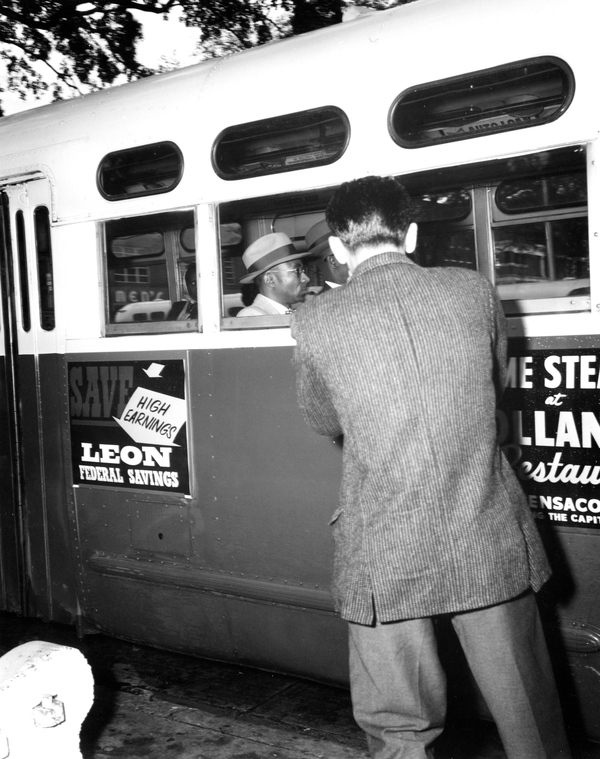
Rev. C.K. Steele (center left) and Rev. H. McNeal Harris protesting segregated bus seats. (Florida Memory)
For its 70th anniversary, Tallahassee organizers are planning numerous events leading up to the day of the boycott.
Ted Ellis, first director of FSU’s Civil Rights Institute and artist of Walt Disney’s first 1999 Black Heritage Celebration poster at Epcot Center and “Obama: The 44th President,” hopes to bridge the gap between FAMU and FSU through community engagements.
“I’m pumped up and deliberate in what this looks like; the Civil Rights Insititue is the focus for sharing scholarly information to students,” Ellis said. “And how do we do that around the importance of civil rights, social justice and civic responsibilities? Pragmatically, we want heavy student engagement and participation.”
In addition to celebrating 100 years of Black History Month, America is celebrating its 250th anniversary. Supervised by FSU College of Social Sciences and Public Policy Dean Tim Chapin, Ellis hopes to integrate the two celebrations together in the upcoming Unity 5K walk to recognize medical challenges marginalized communities face through his position.
“We’re looking to have 250 markers of African Americans who have served in a civil rights space and medical practices to empower and improve the quality of life for those who have been underserved,” Ellis said.
Additionally, he is organizing another bus ride to Selma to Montgomery on Mar. 28, encapsulating the essence of marches from Selma’s Brown Chapel AME Church in 1965 following Bloody Sunday. Last year’s organized bus ride is currently being made into a film.
“We were welcomed by the foot soldiers, those who were telling their stories on the ground during civil rights,” Ellis said, reflecting on last year’s bus ride. “It’s going to be an annual commitment in this space.”
Through these initiatives, he hopes to continue educating the public on the legacy of civil rights movements across America starting in Tallahassee, specifically engaging young people during Black History Month.
“We got to heal the earth,” Ellis said. “We’ve got to heal humanity so that we can live better and do better for the finite time that we’re here. We’ve got a lot of work to do.”
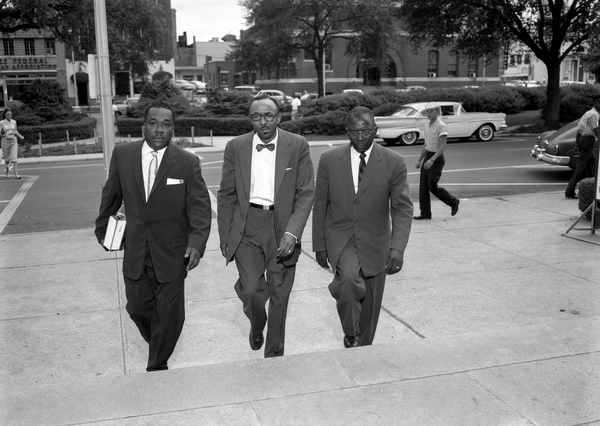
Francisco A. Rodriguez, Reverend C.K. Steele and Reverend Daniel B. Speed walk toward the courthouse in Tallahassee. (Florida Memory)