
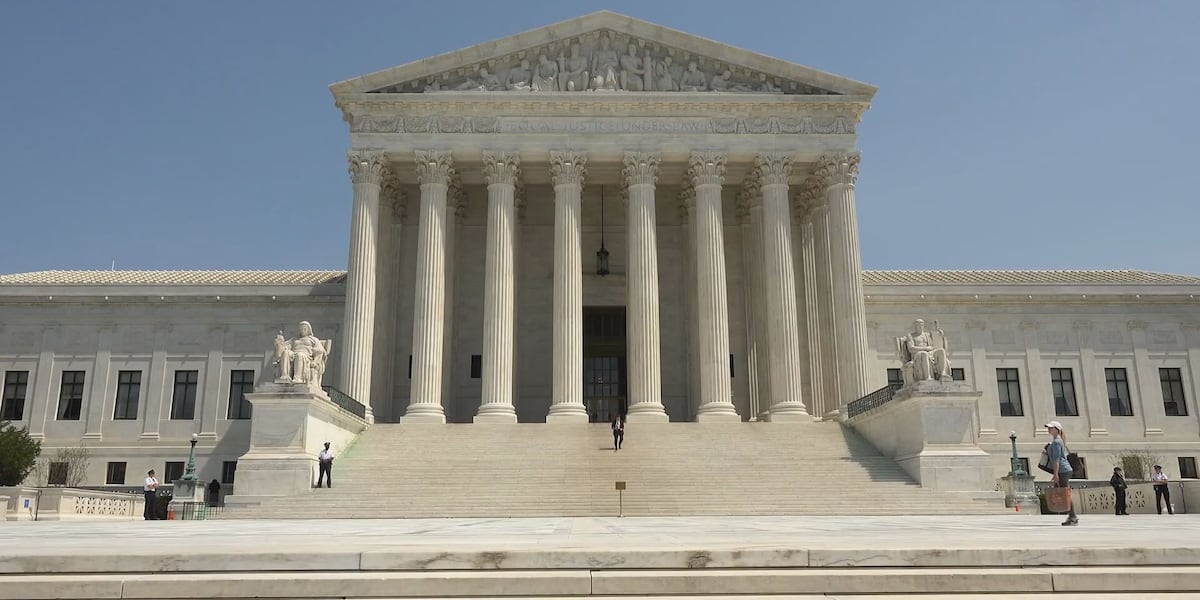
TALLAHASSEE, Fla. (WCTV) – On Friday, in a 6-3 ruling, President Donald Trump’s tariffs were tossed by the Supreme Court of the United States. Three conservative justices joined the majority.
WCTV spoke to professors at Florida State University to get insight on how that decision could affect everyone’s wallet, and maybe your business’s bottom line.
Frederick Abbott, Professor of International Law at FSU, says there is no simple solution to this, and how it will all play out from here is complicated.
“There is no preexisting framework to address something like what’s just happened,” Abbott said.
Abbott says the U.S. Supreme Court struck down the president’s use of authority under the International Emergency Economic Powers Act.
“The court simply said the president does not have the power to impose tariffs on each and every country in the world at whatever amount he wants for whatever duration he wants,” Abbott said.
Abbott says that the act was intended to address national emergencies and to let the U.S. impose sanctions on foreign countries. He says no language in the law references tariffs.
“While it’s been used from time to time, it’s never been used to do something like what President Trump has tried to do with it, and that was one of the Supreme Court’s main findings,” Abbott said.
Law professor Jacob Eisler says the decision sends a broader message.
“It gives us some comfort that rule of law is alive and well in the U.S., and it suggests that the unitary executive theory, which has been advanced not just in the Trump administration for the past decade and a half or so, does have limits. The president does not have sole authority in the U.S. Congress did not authorize him to impose tariffs. Congress is the institution with that power. If Trump wants to impose these tariffs on these terms, he’ll need Congress’s cooperation,” Eisler said.
Abbott says there’s hope this could mean relief for consumers.
“In principle, this level of taxation is going to go down, and eventually prices should go down,” Abbott said.
As for what happens next, Professor Abbott says the court spent very little time laying out the next steps. Instead, the justices remanded the case to lower courts.
To keep up with the latest news as it develops, follow WCTV on Facebook, Instagram, YouTube, Nextdoor and X (Twitter).
Have a news tip or see an error? Write to us here. Please include the article’s headline in your message.
Be the first to see all the biggest headlines by downloading the WCTV News app. Click here to get started.
Copyright 2026 WCTV. All rights reserved.