
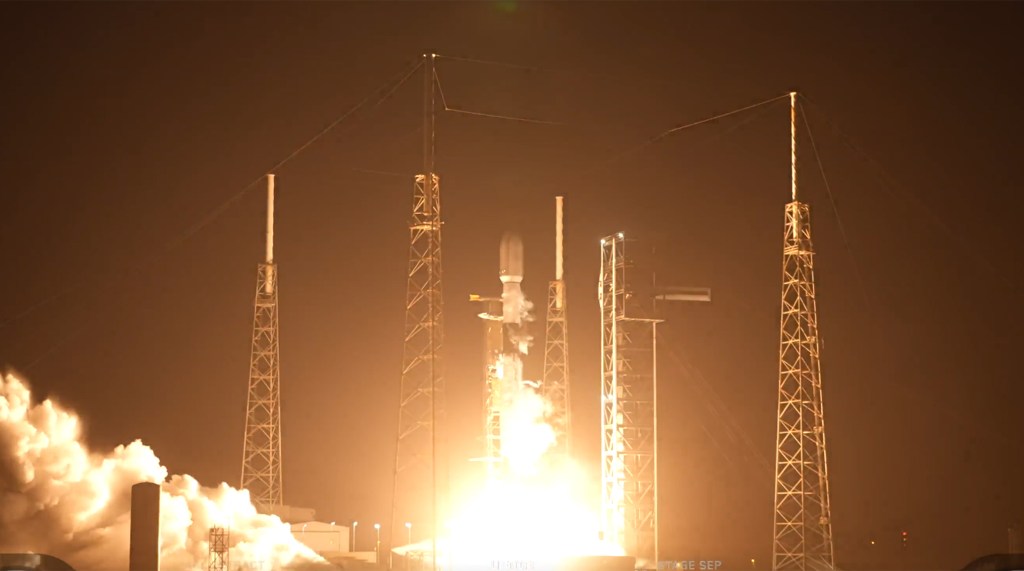
It was business as usual for SpaceX, which sent up a rocket from the Space Coast on Thursday night, but the first stage took a turn for a rare landing off the Bahamas.
Liftoff! pic.twitter.com/2GJk3WScto
— SpaceX (@SpaceX) February 20, 2026
A Falcon 9 on the Starlink 10-36 mission with 29 Starlink satellites lifted off from Cape Canaveral Space Force Station’s Space Launch Complex 40 at 8:41 p.m.
This was the 26th flight of the first-stage booster, which made a recovery landing downrange on the droneship Just Read the Instructions stationed in the Atlantic off the coast of the Bahamas.
It was only be the second booster landing off the island nation coming one year and one day since the first landing.
Falcon 9 lands on the Just Read the Instructions droneship off the coast of The Bahamas pic.twitter.com/h5Ju4ndXSj
— SpaceX (@SpaceX) February 20, 2026
“There is the possibility that residents of and visitors to the Bahamas may hear one or more sonic booms during the landing, but what may be experienced will depend on weather and other conditions,” the company posted on its website.
Last year’s landing had the droneship parked in the Exuma Sound north of Exuma, south of Eleuthera and west of Cat Island.
“It puts us at the cutting edge of innovation,” said Chester Cooper, the Bahamas deputy prime minister for tourism, investments and aviation ahead of last year’s landing. “It gives us, a small country of 400,000 people, an opportunity to participate in the aerospace industry.”
SpaceX said at the time that the landing collaboration would allow it to hit new orbital trajectories.
The agreement, though, was paused after debris from a Starship launch from Texas that went awry last March threatened the nation’s sundry islands.
It normally lands Falcon 9 boosters on its droneships farther north in the open Atlantic or back at Cape Canaveral for land recoveries. The company used its new Landing Zone 40 adjacent the SLC-40 launch pad during the Crew-12 launch last week.
This was the 11th launch on the Space Coast this year, with SpaceX responsible for all but one of them. United Launch Alliance flew the other with its Vulcan rocket.
The launch came alongside NASA’s wet dress rehearsal for the Artemis II mission with teams running through a simulated countdown for the moon mission at Kennedy Space Center’s Launch Pad 39-B.
If the test goes well, NASA could aim for the historic launch as early as March 6.