
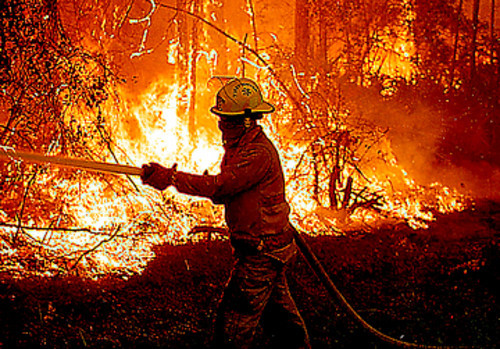
Florida is in the grip of a record drought. Floridians can see it in the withered tones of roadside vegetation and hear it in the dry crunch of their once-green lawns.
But those who have been around for decades might sense something that more recent arrivals miss: Instead of the brown and shriveled leaves, they visualize shades of yellow, orange and red. Instead of the subtle snap of dead grass, they hear the roar of flames hungrily consuming forested land, leaping across roads and threatening homes. Some still vividly recall the heavy, thick pall of smoke that drifted through the entire region, fed by furious wildfires to the east and north. And some still look at their neighbors’ homes, with trees arching over homes and increasingly parched shrubs planted close to the foundation, and think, “that’s fuel.”
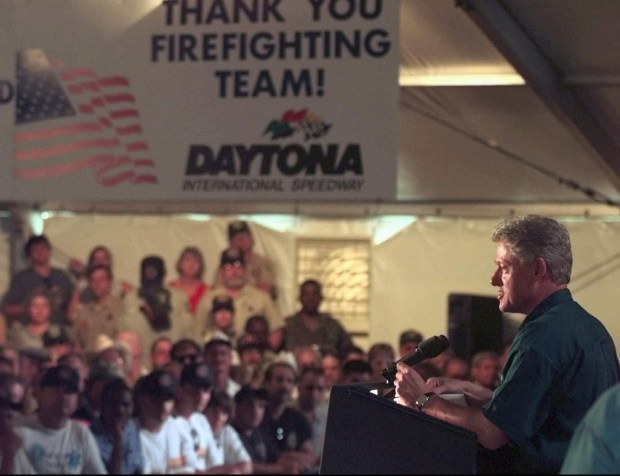
They are remembering the spring and summer of 1998, when much of the state was in the grip of what came to be known as “the Florida firestorm.” When, for the first time, an entire county — Flagler — was evacuated because so much of it was on fire. Half a million acres burned, destroying $300 million in timber and at least 150 homes and other structures. Major events were canceled, including July 4 festivities and the race then known as the Pepsi 400. Instead of raking in the cash from race fans, the Daytona International Speedway converted its fancy catering tents to house and feed hundreds of firefighters. They came here from across the nation to help fight each new blaze, and were greeted with fervent gratitude.
JOE MARQUETTE / AP
President Clinton talks to assembled firefighters at the Daytona International Speedway on Thursday, July 9, 1998. Clinton made a stop in Daytona Beach to meet with those firefighters who fought the Florida wildfires and to meet with people af(ected by the fires. AP file
It was possible to drive down major roads, including State Road 100 in Flagler County or Clyde Morris Boulevard in Daytona Beach, and see fires burning in parcels directly adjacent to apartments, homes and shopping centers. And Floridians who never saw a flame e were hit with respiratory ailments, with some forced to move out of state until the smoke and ash settled.
Floridians who lived through the firestors are starting to fear what might be coming. Florida’s Forestry Service has already tallied more than 900 wildfires through Feb. 16. Most of them are small but in total, nearly 40,000 acres has burned. Meanwhile, the Keetch-Byram drought index is creeping higher. In some parts of the state, including Marion County and much of South Florida, the KBDI is already as high as it was in May of 1998, when extreme drought conditions played a maor role in the speed and volatility of the fires.That should put state and local officials on high alert. And among the state’s professional foresters and firefighters, there is certainly growing awareness of the potential threat.
But many Floridians — particularly those who have moved here since 1998 and have no prior experience with wildfires on a massive scale — don’t see these signs and don’t comprehend the omens. They arrived ready to worry about hurricanes, but might not think of fire in the same hazardous terms.
So the first task is to tell them what could be coming, and make them believe it. Experts are already comparing the conditions of today with the weather in the early part of 1998, and they don’t like what they see. In some ways, Florida is already more susceptible to fire, thanks to that drought index.
The next, to educate residents about ways that they can make their homes safe from fire. Floridians don’t learn the fundamentals of fire safety — including measures that can protect their homes (particularly those in rural areas) from the ravages of fire. They need to be told about the common, human actions that can spark a blaze in seconds, such as the way a car’s catalytic converter can set dried roadside vegetation alight if the vehicle pulls off to the side of the road.
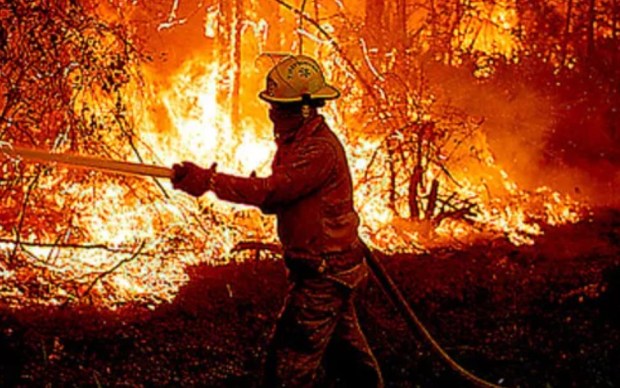 Firefighter Mike Pultorak of the Seffner Mango Fire Department in Hillsborough County battles a wildfire on U.S. 92 in Volusia County between Daytona Beach and De Land on Thursday, June 25, 1998. AP FILE
Florida has active fire-education programs at the local and state level. But that message must be magnified. Over his seven years in office, Gov. Ron DeSantis has become remarkably effective at advising Floridians about the dangers of hurricanes. He should do the same for wildfires, elevating the message to get state residents’ attention and then making sure they understand the potential dangers. He must order state forestry officials to produce plans for deploying the state’s impressive array of firefighting aircraft and other advanced equipment.
And those in control of the free state of Florida had better start thinking seriously about how and when it implements widespread bans on campfires, pyrotechnics and other potential sources of lethal sparks. In Central Florida, Osceola, Lake and Volusia counties are already under burn bans. Orange and Seminole should follow suit . Better yet, DeSantis can make the ban statewide,
In many cases, these won’t be popular decisions. There was a statewide rumble of disappointment and dissatisfaction in 1998 when most Florida cities cancelled their July 4 fireworks, banned sparklers and became zealous about pursuing those who broke the rules. But the time to plan is now, before cities start to draw up contracts for expensive fireworks displays and families plan summer camping trips.
DeSantis and other state leaders should brace for blowback – but they must also stand firm, if they are to save Florida from the fire when it comes.
The Orlando Sentinel Editorial Board consists of Opinion Editor Krys Fluker, Executive Editor Roger Simmons and Viewpoints Editor Jay Reddick. Use insight@orlandosentinel.com to contact us.