
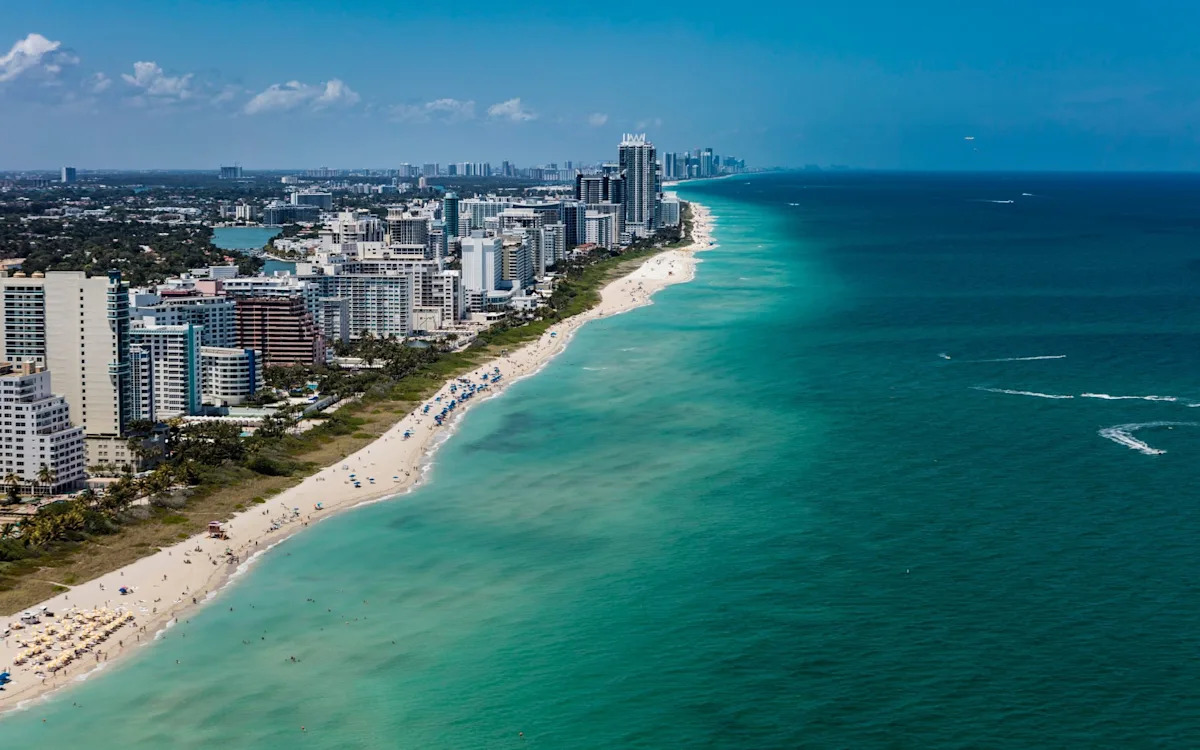
It was after passing the fifth giant advert for plastic surgery in the short walkway between the car park and the shopping mall (just after an initial polite notice requesting no guns in the precinct) that I began to wonder whether Miami would ever escape from its old stereotypes.
Certainly, those of you who are reading this in the perpetual precipitation of gloom-bound Britain might be comforted to know that these stereotypes are still true to life.
There is indeed somewhere to escape where drizzle is a novelty, where hipsters recline by the beach like Olympian gods in tartan-patterned string vests and diamond-studded plimsolls, and centenarian dowagers cruise palm-fringed boulevards in Cadillacs, their every care and wrinkle smoothed away by the solicitous needle of their Botox-armed beauticians.
But what about those of us who are resolutely not beach-body ready, and whose pleasures lie in more egg-headed pursuits? Is there anything for us overwrought intellectuals in this place of outward beauty and ease?
Increasingly, there is, and it goes hand-in-hand with profound changes in the city’s character. From being a run-down backwater in the 1980s, the world of Miami Vice, it is now set on challenging New York for its pre-eminence as a financial centre.
This development has been supercharged by the victory of Zohran Mamdani as New York mayor. Since he took office, dozens of companies have decided to move from New York to downtown Miami and Brickell, Miami’s business district, to escape Mamdani’s high taxes and take advantage of Florida’s commerce-friendly regime.
With this influx of business comes grand benefactions. Much local talk at present is about the move of the hedge fund billionaire Ken Griffin from Chicago (which faces similar problems to New York) to Coconut Grove, a lush suburb famous for its sailing club. Gossip is everywhere about his stream of donations to city institutions – $50mn for a hospital, so many millions for a school – and the belief that his desire to see Miami overtake the Big Apple in the long run will be supported by his personal wealth of over $35bn.
Griffin is certainly not the only wealthy person to be investing in the city, and such investment is not just post-Mamdani. Nevertheless, much of it is still recent.
Two large world-class art museums, the Rubell and the Pérez, have grand new premises which opened in the last decade, the former financed privately and the latter a public-private partnership. The Frost family have also paid around $70mn to build a city science museum and a music centre at the University of Miami. Downtown Miami will also host the Trump Presidential Library.
Beyond these grand projects, there is a critical mass of interested people, money, energy and confidence for people to be intellectually creative. Every day, it seems, there are free classical concerts and international academic conferences open to the public.
But there is much that goes on outside the University. I am writing this in the courtyard café of Books and Books, the city’s premier independent bookseller. Its denizens might be sporting loafers with no socks and suspiciously plump lips, but they are still trotting to their tables with heavy paperbacks in their tanned paws.
The staff have just been boasting to me about the stream of authors who are regular visitors – Sarah J. Maas of Thorns and Roses fame, singer-songwriter Thurston Moore, novelist Edwidge Danticat, Cuban-American poet Richard Blanco.
Most refreshing about this spot is its genuine openness to diversity of thought and discussion. In particular, the area near the University, Coral Gables, famous for its southern Mediterranean-style buildings, is a real meeting point of political views. I have given Classics lectures here on the idea of the tradition of western civilisation – now a dirty idea in great parts of left-leaning academia – which were received with great positivity.
At the same time, the critique of the Republican government and, in particular, its effects on the education system are still made reasonably. Books and Books rejoices in hosting events dedicated to “banned books” withdrawn from the state school system under recent laws. These different approaches co-exist with an astonishing lack of rancour.
It might not be possible to steal Florida’s sun, but perhaps a modicum of self-confidence and policies for financial prosperity might actually boost the intellectual life in our showery British archipelago.
Bijan Omrani is the author of God is an Englishman: Christianity and the Creation of England